
Macron in Montenegro: Europe's enlargement, or the appearance of it
Macron's Montenegro visit combined a €313M hospital contract with a Franco-German plan to integrate the Balkans into the EU ahead of formal accession.

Emmanuel Macron landed in Montenegro on June 4, 2026, for the first official visit by a French head of state since the two countries established diplomatic relations. Behind the ceremony lay a clear political statement timed to coincide with an EU-Western Balkans summit the following day in Tivat. What Macron came to do in Cetinje was not simply reaffirm a friendship — it was to accelerate a process the European Union has struggled to move forward.
At a glance
Macron explicitly backed Montenegro’s EU membership bid by 2028, calling it the region’s frontrunner; France’s Bouygues Group simultaneously signed a hospital construction contract worth more than €313 million in Podgorica.
France and Germany jointly released a document proposing to grant EU candidate countries privileged access to the EU’s single market and observer status in EU meetings — a staged-integration approach ahead of formal accession.
Macron also reaffirmed French support for the Lebanon-Israel ceasefire and Paris’s readiness to reactivate the Franco-American monitoring mechanism, at a press conference that opened with a tribute to a Serbian UNIFIL peacekeeper killed in southern Lebanon.
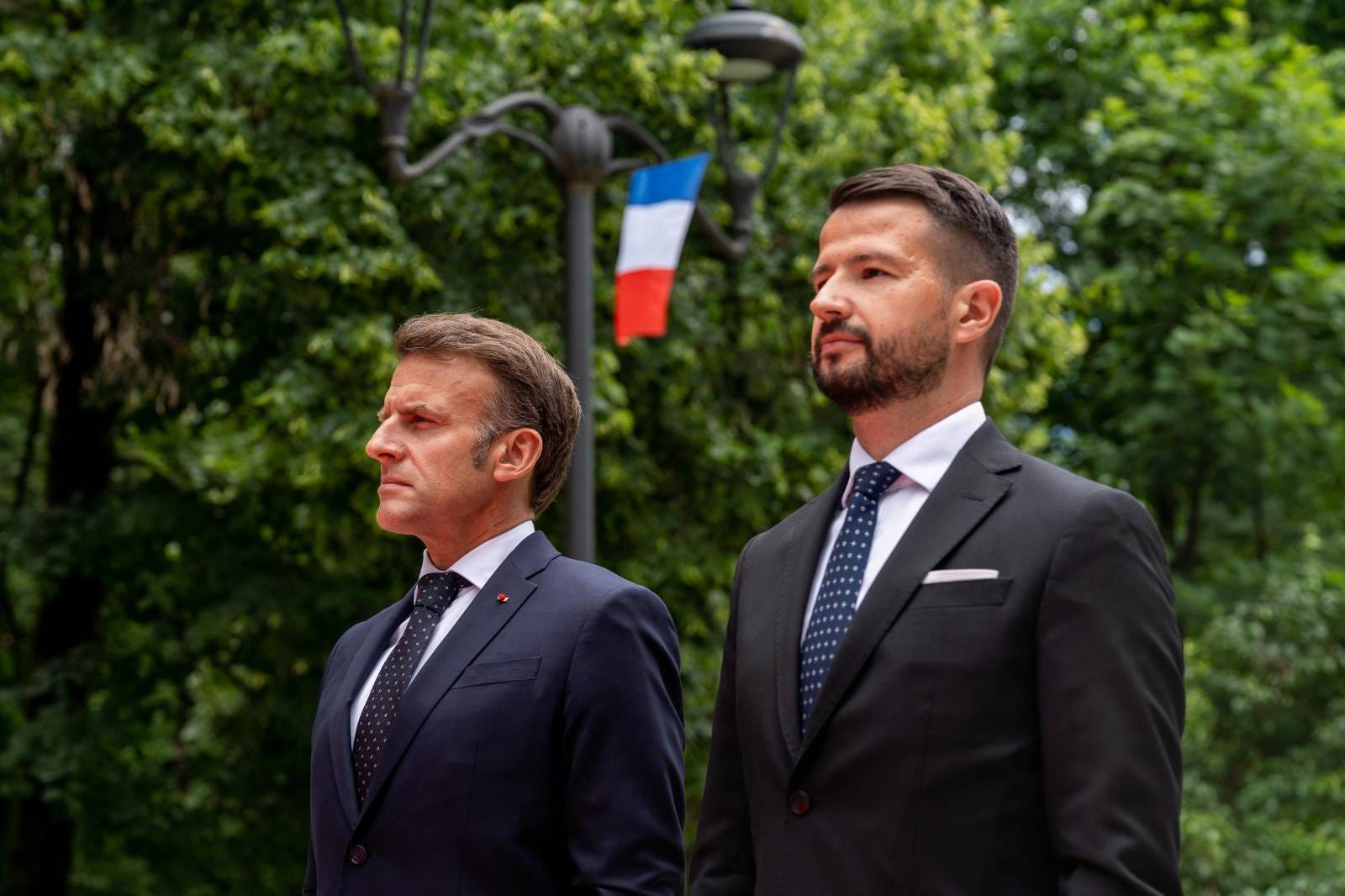
This image is used for illustrative purposes only.
What €313 million and a historic visit are actually worth
Diplomatic visits are measured as much by their concrete deliverables as by their speeches. By that standard, Cetinje delivered something rare: a major industrial contract. France’s Bouygues Group signed an agreement for the construction of a university hospital center in Podgorica, Montenegro’s administrative capital, worth more than €313 million (approximately $340 million at current exchange rates). On top of that: two French-built patrol vessels for the Montenegrin navy, support for the Western Balkans Cyber Capacity Centre in Podgorica, and cooperation agreements on road infrastructure and the energy transition.
For a country of 600,000 people with a modest GDP by European standards, these are significant commitments. France did not come to Montenegro with words alone — it came with order books. That shifts the nature of the engagement: this is no longer just political sponsorship, but a mutually agreed economic dependency.
Enlargement at two speeds: Podgorica moves forward, others fall back
The regional context gives the visit additional weight. Montenegro is currently the most advanced of the Western Balkan countries on the path to EU membership, and is targeting accession in 2028 — which would make it the 28th EU member state, the first country to join since Croatia in 2013, ending a fifteen-year silence in the enlargement process.
The picture around it, however, is discouraging. Serbia’s parliament recently passed controversial judicial laws. Bosnia-Herzegovina has accumulated delays in its reform agenda due to internal political disputes. Kosovo remains in a political deadlock that has blocked all meaningful progress. This uneven regional landscape raises a question that European capitals rarely voice directly:
Can the EU admit one country while its neighbors drift?
Macron answered cautiously: each country’s own reform pace — not the electoral calendars of member states — will determine the speed of accession. But the Franco-German document released ahead of the summit suggests something more ambitious, and more risky: what if integration did not have to wait for formal accession?
The Franco-German plan: integrate before joining
This is the most substantive political element of the day, and the least discussed. France and Germany jointly published a policy document calling for a “new dynamic” in eastward enlargement. Two concrete steps are sketched out: privileged access to the EU’s single market — the largest in the world — for candidate countries, and observer status in EU meetings before formal accession.
This graduated-integration logic is not new in European policy circles. But having it jointly backed by Paris and Berlin, the day before an EU-Balkans summit, gives it a different political weight. It could help break a real impasse: Western Balkan countries have waited so long that the credibility of the process itself has eroded. By offering tangible benefits ahead of final accession, the EU would have the means to sustain pro-European sentiment in the region — in countries where competing outside powers have been steadily building influence.
The formula remains conditional on what the document calls “own merits” — no access without reforms. That safeguard is essential, but it raises a structural question: who evaluates merit, and by what criteria? Recent enlargement history suggests that formal accession is no guarantee that reforms hold once the door closes.
Lebanon in the background: Macron plays on two fronts
The Montenegro visit did not sideline the Lebanon file. Macron opened the joint press conference with President Jakov Milatović — Montenegro’s head of state since 2023 — by paying tribute to a Serbian peacekeeper from UNIFIL, the United Nations Interim Force in Lebanon, killed in the south of the country. The gesture signaled that France intends to remain a militarily engaged actor in Lebanon’s stabilization, not just a diplomatic broker.
Paris indicated its readiness to support the reactivation of the Franco-American coordination mechanism set up to monitor the ceasefire between Lebanon and Israel. The stated goal is twofold: that Hezbollah, the Iran-backed Lebanese militant group and political party that maintains a parallel armed force in the south, gradually loses its de facto weapons monopoly in the region, and that the Lebanese state reasserts full territorial sovereignty. Both objectives remain more declaratory than operational on the ground — which makes reactivating the monitoring mechanism a practical necessity, not a diplomatic courtesy.
What Cetinje reveals: symbolism as strategy
The choice of Cetinje — Montenegro’s historic capital, as opposed to Podgorica, the administrative seat — was deliberate. Macron visited the monastery there alongside Bishop Joanikije Mićović. In a country that this year marks the 20th anniversary of the restoration of its independence following the breakup of Yugoslavia, symbols carry weight that formal texts cannot.
France came to sign contracts. It also came to produce images durable enough to outlast the institutional fatigue that comes with decade-long accession processes — because European enlargement runs on political will, and political will is sustained by moments, not memoranda.
The Bottom Line
The real test of the Cetinje visit will not come from the visit itself. It will come from the EU-Western Balkans summit that followed the next day in Tivat, and from whether the Franco-German policy document on staged integration finds enough support to become something more than a well-intentioned proposal. It will come, further out, from whether European institutions can translate what two leaders sketched in a page into workable procedures. EU enlargement has survived many broken promises. The question is no longer whether France supports Montenegro — that is now settled in concrete and patrol vessels. The question is whether the EU as a whole is still capable of meeting a deadline it has set for itself.
Sources: Anadolu Agency · Le Monde · RTBF · AFP