
Macron breaks his silence on Kremlin voice in French media
A Russian commentator with no press credentials holds prime slots on French TV, pushes Kremlin talking points — and carries a valid French residency card.

After nine years, President Macron finally said publicly what he first said to her face at Versailles.
At a Glance
For the first time since a 2017 confrontation at Versailles, Emmanuel Macron publicly stated on June 4, 2026, that Xenia Fedorova — former head of Russia’s state-funded RT France and now a regular commentator on Bolloré-owned media — remains what she always was: a state propaganda operator. “Things haven’t changed. I think the same,” he said.
After RT France was banned by the EU and shut down in January 2023, Fedorova repositioned herself inside the media network of French billionaire Vincent Bolloré, appearing on CNews, Europe 1, and the weekly JDNews — without a French press card.
Pressure is mounting: France’s broadcast regulator Arcom has opened two formal complaints in May alone, centrist MEPs are seeking EU individual sanctions, and France’s foreign minister has called her “a certified propagandist serving Putin’s line.”
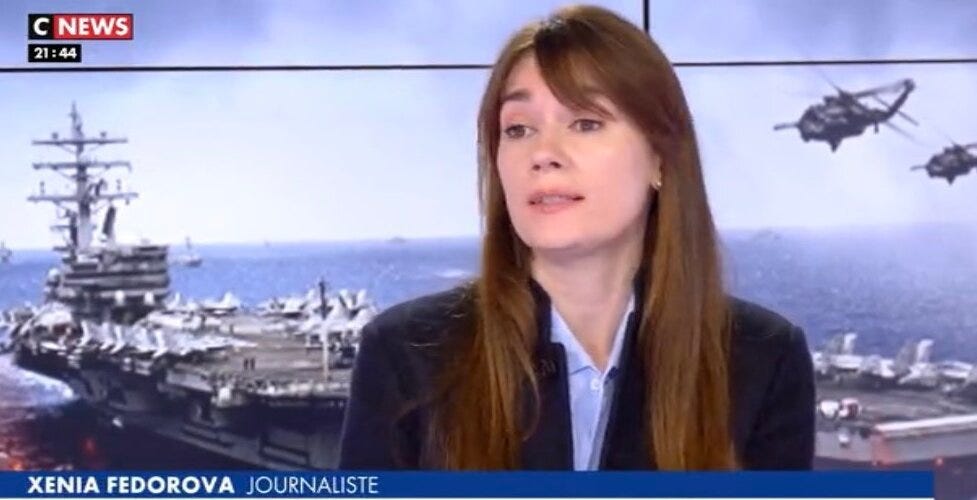
This image is used for illustrative purposes only.
The Versailles moment, nine years later
June 2017. Emmanuel Macron, freshly elected, hosts Vladimir Putin at the Palace of Versailles. In the press room, a journalist — Xenia Fedorova, then president of RT France — complains she was denied access to Macron’s campaign headquarters. He responds directly: RT France, he says, behaved as “organs of influence, propaganda and false propaganda” that “produced falsehoods” about him. “I considered they had no place there,” he tells her in front of Putin.
Nine years later, speaking at a press conference in Montenegro on June 4, 2026, Macron retrieved that memory with surgical precision. The person he had addressed at Versailles had been “ostensibly in charge of a media outlet, but which was in fact a state propaganda agency.” Then: “Things haven’t changed. I think the same.”
This was not an offhand remark. It was the first direct public statement by a sitting French president on a case that has been embarrassing his own government for weeks.
How a state broadcaster’s director became a prime-time commentator
Fedorova ran RT France from 2017 until its closure in January 2023. The channel, the French branch of Russia’s state-funded RT network, was suspended from EU airwaves on March 2, 2022 — one week after Russia’s full-scale invasion of Ukraine — and permanently banned after the EU’s Court of Justice rejected its appeal in July 2022. When France’s Treasury froze the channel’s bank accounts in January 2023, Fedorova announced the closure, leaving 123 employees — including 77 credentialed journalists — without pay.
She did not return to Russia. Instead, she negotiated a place in Vincent Bolloré’s media empire. Today, she appears Wednesdays and Sundays on CNews’s “L’Heure Inter,” holds a weekly column in the JDNews news weekly, and hosts the religious program “Lumières orthodoxes” on CNews and CStar. In early 2025, she published a book titled Bannie (”Banned”) through Fayard — a publishing house owned by the Bolloré group — in which she accuses the French government of trying to “silence” her and rejects the characterization of Russia’s war as an act of aggression.
The controversy crystallized following reports that senior government officials had attended a lunch where Fedorova was also present — six days before Foreign Minister Jean-Noël Barrot publicly stated on France Inter that she was “a certified propagandist serving as a relay for Kremlin disinformation.”
“In a democracy, you can spread lies without being sent to the gulag.” — Jean-Noël Barrot, French Foreign Minister, France Inter, May 29, 2026
Regulators under pressure, institutions showing their limits
France’s broadcast regulator, the Arcom, received two formal complaints in May 2026 alone, both targeting “a lack of honesty and rigor” in her broadcasts. The first concerned her May 9 appearance — the anniversary of the Soviet victory over Nazi Germany — during which she falsely accused Latvia, an EU and NATO member state, of “glorifying Nazism.” The second targeted her May 10 claim that “it is the West that decided to prolong these conflicts,” echoing the Kremlin’s standard framing of the war in Ukraine. Government spokesperson Maud Bregeon called the statements “very serious.” No sanctions have been issued to date.
At the European Parliament, the centrist Renew Europe group took a further step: a letter initiated by French MEP Nathalie Loiseau formally requests EU individual sanctions against Fedorova under a mechanism adopted in October 2024 targeting individuals responsible for “coordinated disinformation and information manipulation.” Valérie Hayer, who leads the Renew Europe group, had already filed a separate complaint with Arcom in May.
On the residency question, Interior Minister Laurent Nuñez insisted the 2024 renewal of Fedorova’s long-stay card — valid for ten years — was routine, with “no intervention” by the state. Fedorova has consistently defended her commentary as protected free speech.
Analysis — democracy’s self-defeating paradox
This case lays bare a structural contradiction that liberal democracies have yet to resolve: how do you respond to an influence strategy that exploits the very freedoms it seeks to undermine?
The model is internally coherent. A state-backed outlet is established inside a target democracy, shut down under pressure, and its operator is repositioned within a domestically owned media platform with aligned editorial sympathies. Free speech protections cover the commentator. Media pluralism legitimizes her presence. Administrative procedure regularizes her stay. The system works at every step — and that is precisely where the paradox lies.
The concentration of RT France’s former head within the Bolloré group’s outlets — CNews, Europe 1, JDNews, Fayard — could represent a structural entry point for narratives favorable to Moscow, if one follows the logic of the institutional critics. This hypothesis, advanced by ministers and elected officials but not formally established, is worth naming. It implies no proven coordination — but it raises a governance question that regulators have not yet answered.
What the Macron-Versailles-Montenegro arc reveals, in the end, is also the relative impotence of political speech in the face of legal mechanics. A president can name the threat publicly. He cannot unilaterally revoke a residency permit. “It is not the president, acting as a sovereign decision-maker, who overturns residency permits or grants them,” Macron acknowledged himself.
The Bottom Line
France has a broadcast regulator, a sanctions framework, an immigration law, and a foreign minister who calls things by their name. It also has press freedom and the rule of law, which by design protect what they cannot prove. The real question raised by the Fedorova case is not “should she be expelled?” — existing rules already govern that. It is more uncomfortable: how long can a democracy, in the name of its own values, tolerate a vector of hostile influence that breaks no law explicitly, but methodically erodes the shared perception of reality?
Sources: France Info · France 24 · Euronews · AFP · Public Sénat