
Leo XIV in Madrid: a million faithful, and a warning to Catholic Spain
Pope Leo XIV drew over a million faithful to Madrid's Plaza de Cibeles for Corpus Christi — and warned Spain's faith must not become a museum.

At a Glance
More than a million people gathered in Madrid on June 7, 2026, for the Corpus Christi Mass celebrated by Pope Leo XIV — the first American-born pope in the history of the Catholic Church
In his homily, Leo XIV urged Spain not to let its faith become “a museum of the past,” calling for active conversion oriented toward the common good
Queen Letizia, dressed in white according to the “privilege of white” reserved for Catholic queens, welcomed the pope alongside King Felipe VI of Spain, underscoring the state dimension of the visit
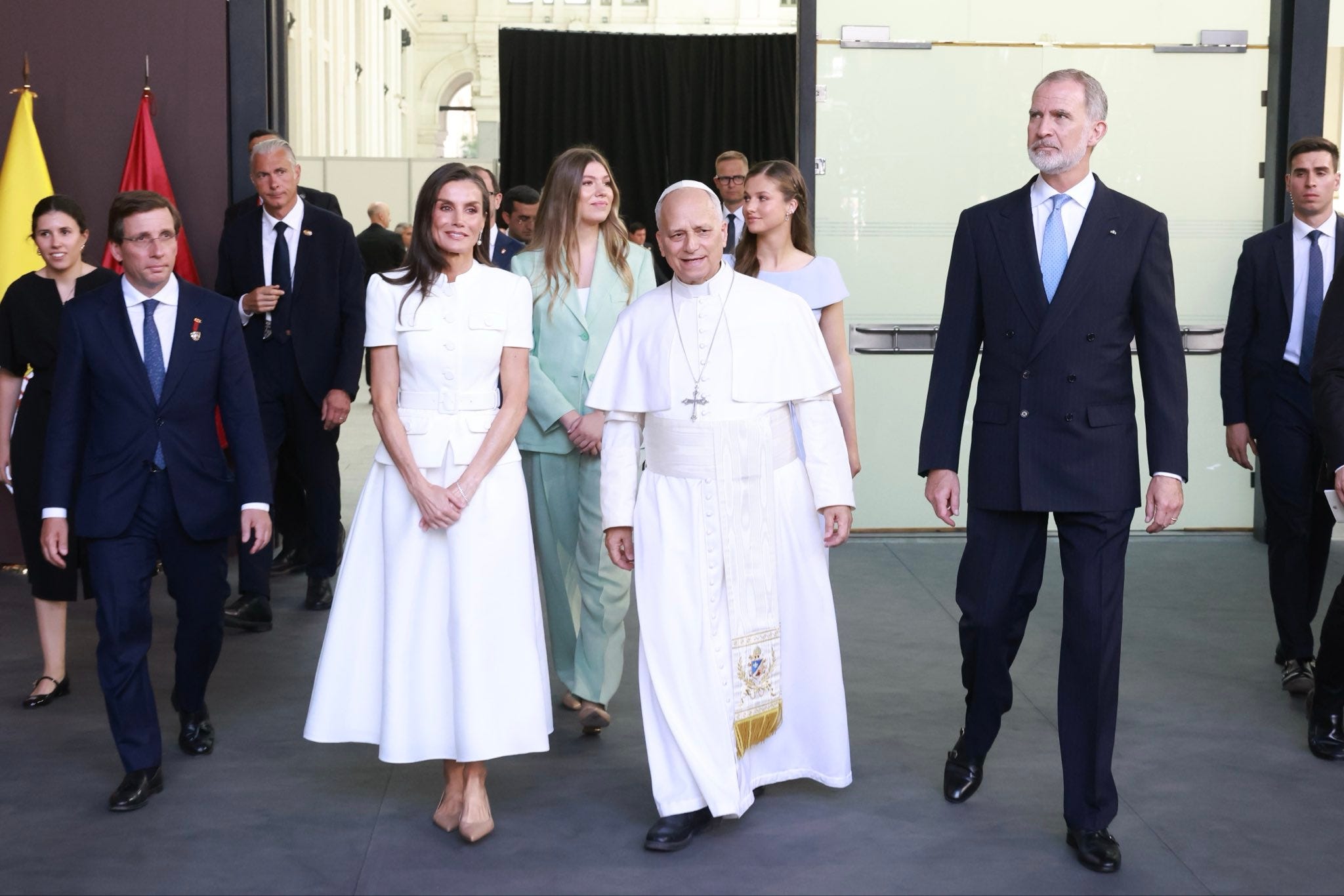
This image is used for illustrative purposes only.
Plaza de Cibeles turned into an open-air cathedral
By dawn on Sunday, June 7, 2026, thousands of chairs were already lined up on the Plaza de Cibeles, facing Madrid’s City Hall. Within hours, that massive arrangement had become a reference point in a sea of people: more than a million faithful had converged on the heart of the Spanish capital for Corpus Christi — one of Catholicism’s most solemn feasts, commemorating the real presence of Christ in the Eucharist — presided over by Pope Leo XIV, the first American-born pope in the history of the Catholic Church.
Official figures put more than 380,000 accreditations, but since the event was open to the general public, actual turnout far exceeded that count. Multiple media outlets and news agencies confirmed the presence of over a million worshippers, in an atmosphere authorities described as calm and orderly. A significant police deployment helped ensure the day passed without incident.
Among the most striking images: as Leo XIV moved through the crowd aboard the popemobile, babies were lifted above the throng every few feet — a scene that speaks volumes about the sociology of a Spanish Catholicism still deeply embedded in the rituals of life’s milestones.
The “privilege of white”: a carefully choreographed symbolic diplomacy
Queen Letizia’s decision to wear white — on Saturday to welcome the pope, then again Sunday for the Mass — was no sartorial coincidence. The privilegio del blanco, or “privilege of white,” is a protocol permission granted by the Holy See to a select few Catholic sovereigns. It allows these queens — and only queens, not princesses — to wear white in papal audiences, where protocol otherwise requires dark or black attire.
This protocol detail signals something larger. Leo XIV’s visit to Spain is also a diplomatic act. Spain — a country whose national identity was partly built around Catholicism, around Corpus Christi processions and towering spiritual figures like St. John of the Cross and St. Teresa of Ávila — represents prime terrain of symbolic legitimation for a pope still in the early years of his pontificate. King Felipe VI of Spain received the pope alongside the queen, making the visit a full state reception.
A homily against folklore: Leo XIV’s political message
The heart of the event was not the spectacle — it was the text. And Leo XIV’s homily in Madrid was not the address of a pope on a courtesy call.
The pontiff opened by reaffirming what the Eucharist means in Catholic theology: not a commemorative rite but the real, living presence of Christ — nourishing, in his words, with “a love stronger than death.” A classically doctrinal framing — but then the address shifted.
Leo XIV acknowledged the depth of Spain’s Catholic roots: centuries of processions, flower-petal carpets laid across cobblestone streets, monstrances carried through cities, entire artistic and architectural traditions shaped by the feast. But he immediately posed the uncomfortable question: could this historically monumental faith calcify into heritage? His warning was measured but direct.
“The religiosity that has animated Spain for centuries must not become a museum of the past to visit, but a school of faith to draw from today.” [translated from Spanish]
The caution implicitly addressed a Spain where, according to recent sociological surveys, younger generations increasingly identify as non-believing or non-practicing, even as the cultural expressions of Catholicism — Holy Week, Corpus Christi, pilgrimages — remain massive public events. A Catholicism of spectacle that Leo XIV declined to simply endorse.
St. John of the Cross and St. Manuel González: two models for the Church ahead
To ground his argument, the pope invoked two Spanish spiritual figures. First, St. John of the Cross — the 16th-century mystic who, imprisoned in Toledo around the Corpus Christi feast of 1578, produced some of the most powerful poetic and mystical works in the Hispanic Catholic tradition. A figure of interior faith enduring adversity, summoned by Leo XIV as a model of divine presence that requires no grandeur to be real.
Then, St. Manuel González — a less internationally known figure, a Spanish bishop of the 19th and 20th centuries nicknamed “the bishop of abandoned tabernacles” for his attention to forgotten rural shrines. A quiet countermodel to the very eventful religiosity that the Mass itself paradoxically represented: faith in the margins, far from cameras, as authentic as in the great assemblies.
The choice of these two figures was not incidental. It suggests Leo XIV intends to build a pontificate focused on interior depth and concrete social engagement — not on the spectacularization of a Church-as-museum.
The bottom line
The question this Madrid Mass implicitly raises extends well beyond Spain’s borders. Across Western Europe, historically dominant religious institutions face the same paradox: ceremonies still capable of mobilizing massive crowds, alongside accelerating decline in everyday practice. Leo XIV, the first pope from the Americas, appears to have chosen to name that paradox rather than celebrate it. Can the Church be both visible heritage and active force for social transformation? Madrid, on June 7, 2026, may have been the first full-scale test of the answer he intends to give.
Sources: Euronews · Associated Press