
Latvia's government falls over drone warfare it couldn't stop
The resignation of Prime Minister Evika Silina exposes a Baltic air defense gap that goes far beyond domestic politics — and raises uncomfortable questions for NATO's eastern flank.

At a Glance:
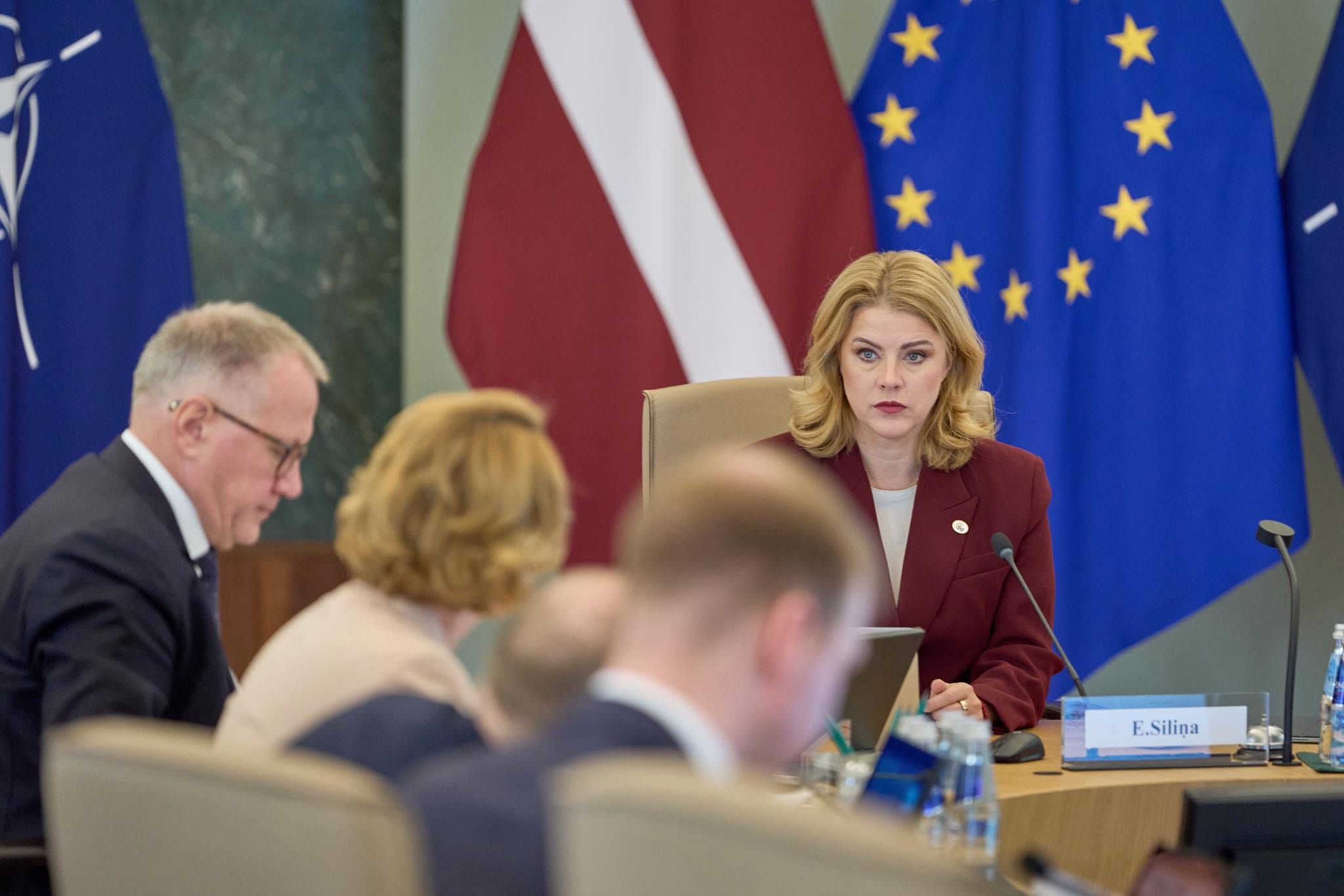
Latvian Prime Minister Evika Silina announced her resignation on May 14 after her center-right coalition lost its parliamentary majority over a dispute triggered by a series of drone incursions into Latvian territory.
The immediate catalyst: two Ukrainian drones crashed onto Latvian soil on May 7 — one striking a petroleum storage facility near Rezekne — after their guidance systems were apparently jammed by Russian air defenses.
Ukraine responded by offering a defense cooperation deal, what both sides are calling the “Drone Deal,” to help Latvia build a layered air defense system.
Latvia: a government brought down by its own fire lines
Latvia’s ruling coalition, in power since 2023, did not survive the impossible political equation the war in Ukraine placed before it. When two Ukrainian drones — knocked off course after their guidance systems were apparently jammed by Russian defenses — crashed on Latvian soil on May 7, with one striking a petroleum storage depot near Rezekne in the country’s east, the question of political accountability followed almost instantly.
Prime Minister Evika Silina pointed to her defense minister as the expendable variable. Andris Spruds, a member of the Progressives party — Latvia’s center-left junior coalition partner, roughly analogous to a reform-oriented third party holding the balance of power in a U.S. coalition government — resigned on Monday. But his party refused to absorb the blow quietly: it withdrew from the coalition, accusing Silina of having used Spruds as a scapegoat to protect her own position. Without the Progressives, her majority in the Saeima — Latvia’s unicameral parliament — collapsed. Rather than face a no-confidence vote, Silina announced her own resignation at a press conference in Riga.
The sequence follows a familiar pattern in fragile coalition governments: a national security failure rapidly becomes a crisis of internal trust, in which managing the political fallout eclipses managing the actual problem.
An open sky, an exposed state
What this episode reveals is more unsettling than a cabinet reshuffle. Latvia — a NATO member sharing a border with Russia, which has steadily increased its defense commitments in line with Alliance targets — had its airspace breached repeatedly by drones from both warring parties without a single interception. These incidents have accumulated since Russia’s full-scale invasion of Ukraine in 2022, involving both Russian and Ukrainian aircraft.
The May 7 incident produced no casualties and no significant material damage. But that relative fortune obscures the structural issue the crash made visible: Latvia apparently did not detect, intercept, or even clearly track the drones before impact. For a country hosting NATO ground forces and positioned on the Alliance’s most exposed eastern flank, this gap could signal a mismatch between ground-level military capacity and deep aerial surveillance — not unlike a U.S. state that discovers its missile defense radar failed to register an incoming threat. Latvian authorities have not confirmed this diagnosis, but the political crisis has made it impossible to avoid.
The Ukrainian response: a “Drone Deal” as diplomatic repair
Kyiv moved quickly to contain the fallout. President Volodymyr Zelensky announced he would send Ukrainian defense experts to Latvia to share hard-won experience in air protection, and proposed formalizing the relationship through what both sides are calling a “Drone Deal” — a framework designed to build a multi-layered air defense system against a range of aerial threats. The announcement followed a meeting between Zelensky and Latvian President Edgars Rinkevics.
The initiative is diplomatically astute. It implicitly acknowledges Ukrainian responsibility for the incidents while converting that liability into a vehicle for deeper security cooperation. For Kyiv, the calculus is straightforward: the Baltic states count among the most determined advocates for military support to Ukraine within the European Union, and they cannot afford to alienate them. For Riga, accepting the offer means publicly acknowledging its defensive vulnerabilities — a political cost, but arguably lower than the cost of the next unexplained crash.
The bottom line
Latvia now faces the challenge of forming a new government in a political environment where the line between domestic politics and national security has effectively disappeared. The real question is not who will succeed Evika Silina, but whether her successor will be willing to say aloud what this crisis has revealed in silence: that
Baltic states, despite full NATO integration and years of defense investment, may still carry blind spots in their air defense architecture that neither Alliance infrastructure nor national budgets have yet addressed.
The next drone — Russian or Ukrainian — may not land without casualties.
Sources: France Info · AFP