
Kyiv under fire: Russia deploys the Oreshnik

In the early hours of May 24, 2026, Russia launched one of the most intensive strikes of the entire war against Kyiv — 90 missiles and 600 drones, including, for the first time near the capital, a nuclear-capable Oreshnik ballistic missile. Four dead, more than 80 wounded. The toll goes beyond the attack itself: it signals a new phase.
At a Glance
Russia fired 600 drones and 90 missiles at Ukraine overnight on May 23–24, including an Oreshnik missile against Bila Tserkva, 50 miles south of Kyiv — the first confirmed use of that weapon in the capital’s immediate vicinity.
The provisional toll stands at four dead and more than 80 wounded, with casualties recorded in the Bucha and Obukhiv districts and damage reported across nine neighborhoods of the capital.
Moscow framed the attack as retaliation for Ukrainian strikes, a characterization Kyiv flatly rejects.
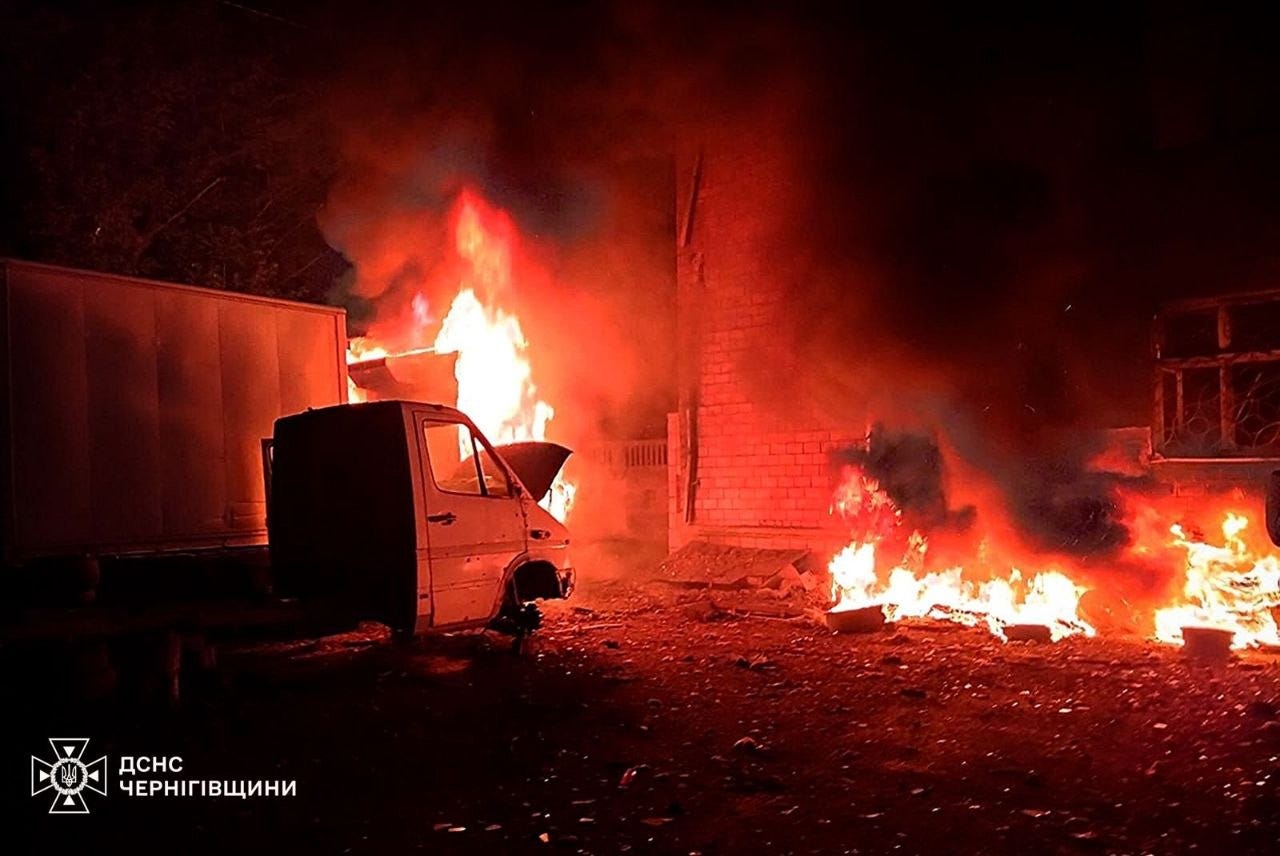
This image is used for illustrative purposes only.
A night of fire across nine districts
The nationwide air raid alert that sounded across Ukraine on the night of May 23–24 preceded one of the most intense barrages since Russia’s full-scale invasion began in 2022. Nine districts of Kyiv were struck simultaneously: residential buildings, supermarkets, warehouses, schools. In the Shevchenko neighborhood, a school was hit while residents were sheltering inside.
Kyiv Mayor Vitali Klitschko reported two deaths in the capital and 56 wounded. Two additional victims were confirmed in the broader Kyiv region, in the districts of Bucha and Obukhiv. President Volodymyr Zelensky later put the total number of wounded at 83. The bombardment continued past dawn, with additional missiles and drones still tracked heading toward Kyiv. The head of Kyiv’s military administration, Tymour Tkachenko, reported damage across at least nine city districts, with residential buildings bearing the brunt.
Ukraine’s air force said it intercepted or neutralized 55 missiles and 549 drones out of the 690 launched.
The Oreshnik steps into the open
The militarily significant detail of this attack is not its scale — already staggering — but the weapon Russia chose to strike Bila Tserkva, a city of roughly 200,000 people located 50 miles south of Kyiv. Zelensky stated that Russia deployed an Oreshnik — a hypersonic, multiple-warhead ballistic missile roughly analogous, in its deterrence role, to a conventionally armed version of the U.S. Air Force’s Minuteman III ICBM, though with capabilities Moscow claims go far beyond it.
Russia’s Defense Ministry confirmed the use of the Oreshnik, describing it as a response to what it called “Ukrainian terrorist attacks against civilian infrastructure on Russian territory.” Kyiv disputed that framing: Ukrainian authorities say they targeted a Russian Rubicon drone unit deployed near Starobilsk — not civilian infrastructure. This factual dispute, unresolved at the time of publication, is central to the diplomatic sequence now unfolding.
The Oreshnik had previously been used against the Ukrainian city of Dnipro in November 2024, then again in early 2025 in the western Lviv region. This is its first documented deployment in the immediate orbit of Kyiv. Vladimir Putin has described the weapon’s capabilities in explicitly deterrent terms: a speed ten times that of sound, the ability to penetrate bunkers buried “three, four or more levels underground,” and — a claim that cannot be independently verified — effects comparable to a nuclear strike when multiple conventionally armed Oréshniks are used in combination.
A calibrated escalation
The events of the past 48 hours form a sequence worth reading as a whole. Two days before the attack on Kyiv, a Ukrainian strike hit a dormitory in Starobilsk, in the Russian-occupied Luhansk region. Moscow reported 18 dead — a figure it provided unilaterally and that cannot be independently verified. Putin explicitly promised retaliation. The overnight barrage of May 24 followed that pledge — whether as direct execution of it remains unconfirmed.
This sequence — a contested Ukrainian strike, a public vow of reprisal, then a massive salvo incorporating the Oreshnik — could suggest that Moscow is attempting to formalize a doctrine of graduated escalation. The logic, if confirmed, would be stark: any Ukrainian strike on occupied or Russian territory met with a disproportionate response, calibrated to maximize psychological pressure on the civilian population. This remains an analytical hypothesis, not an established fact.
What is confirmed is that Zelensky had already warned — based on intelligence — the day before the attack, in coordination with the U.S. Embassy in Kyiv. The fact that Western intelligence anticipated the strike without being able to prevent it raises pointed questions about the current limits of military support for Kyiv.
The Bottom Line
This missile is not merely a weapon — it could constitute a diplomatic argument Moscow is placing on the negotiating table.
At precisely the moment when U.S.-led mediation efforts are losing momentum and Washington’s attention is shifting toward the Middle East, the Oreshnik‘s deployment within striking distance of Kyiv marks a threshold. The question this night raises is not only military: how far is the Atlantic Alliance prepared to let the threshold of the unacceptable slide before recalibrating its support?
Sources: France Info · Euronews