
Kyiv mourns as Zelensky vows to strike back
Russia leveled a Kyiv apartment block days after a U.S.-brokered truce expired. Zelensky vowed to hit back — and did. What comes next for the war?

A residential building leveled, 24 dead including three children, and a wave of Ukrainian drones targeting a Russian oil refinery — the sequence of events on May 14 and 15 illustrates the military and diplomatic deadlock grinding down this conflict, less than a week after Washington brokered a 72-hour ceasefire.
At a Glance
In the early hours of May 14, 2026, a massive Russian strike partially destroyed a nine-story apartment building in Kyiv’s Darnytskyi district, killing 24 people including three children; Russia launched more than 1,500 drones and dozens of missiles at Ukraine over two consecutive days
Ukrainian President Volodymyr Zelensky declared strikes on Russian oil and military production facilities “entirely justified”; Ukraine’s military claimed a strike on the Ryazan oil refinery, roughly 110 miles southeast of Moscow, killing at least four people on the Russian side
An exchange of 205 prisoners of war on each side, completed May 15, marked the first phase of a larger deal covering 1,000 detainees — the only concrete outcome of the 72-hour truce initiated by U.S. President Donald Trump
A building, one night, 24 dead
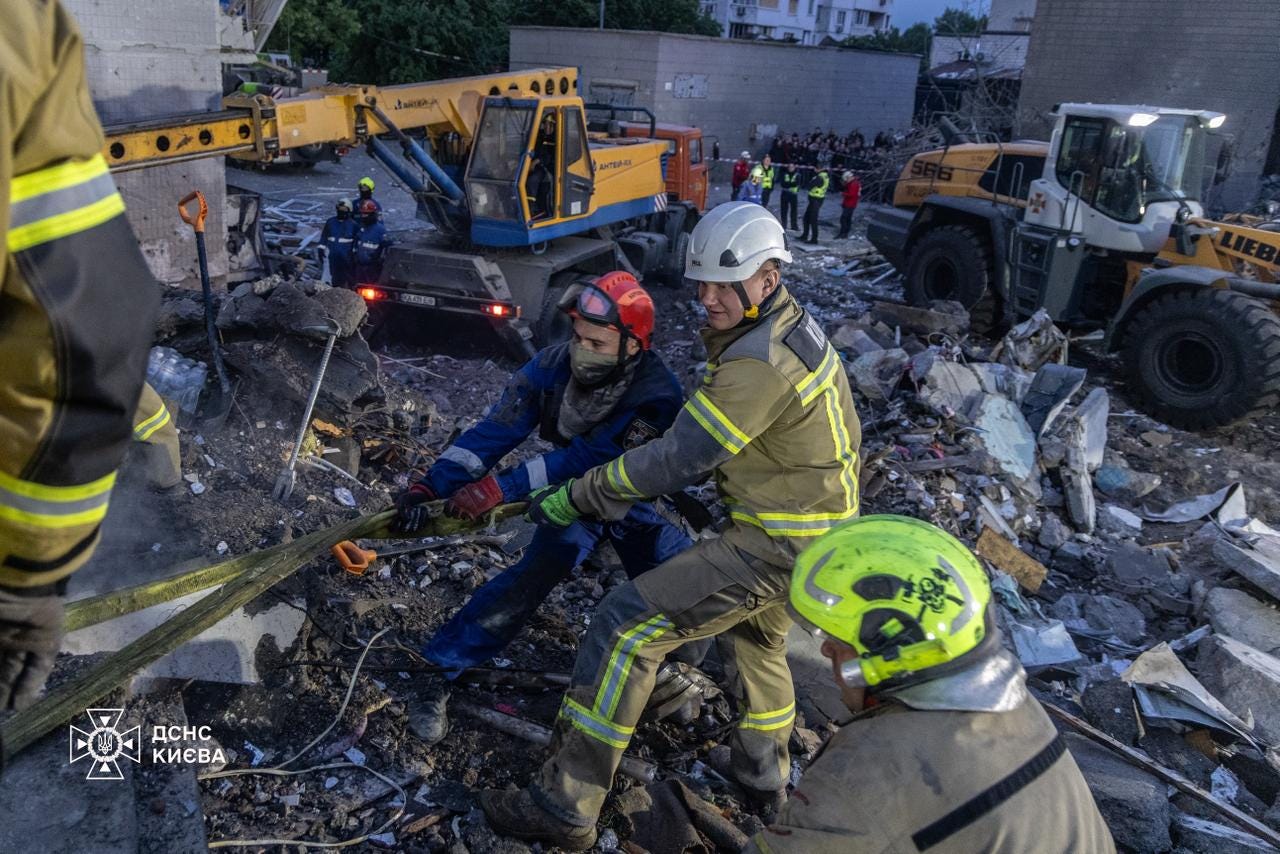
The attack began just before 1 a.m. A nationwide air raid alert warned that Russia had launched MiG-31 missile carriers. The first explosions rang out across Kyiv around 3 a.m., as Ukrainian air defenses engaged incoming drones. Minutes later, the ballistic missiles arrived. In Kyiv’s Darnytskyi district — a dense residential neighborhood on the left bank of the Dnipro River, tucked between a suburban forest and the water — a missile struck a nine-story apartment block head-on, collapsing several floors and trapping residents under the rubble. Rescue teams pulled 28 people out alive; 48 were injured.
The final death toll reached 24, including three children born in 2008, 2010, and 2013. According to Zelensky’s preliminary analysis, the missile that hit the building was a recently manufactured Kh-101 cruise missile — which, he argued, proves Russia is still sourcing the components it needs by circumventing international sanctions.
The damage extended well beyond that single building. Six of Kyiv’s districts were hit. Drone debris ignited fires in residential buildings in the Dniprovskyi and Obolonskyi districts; water supply was cut to the eastern part of the city. Twenty sites in the capital were struck in total, including a school and a veterinary clinic. The offices of Skyeton, a defense contractor specializing in reconnaissance drones, were also destroyed — though the company said it had anticipated the attack and relocated its production in advance. Moscow did not immediately comment on the strike targeting the residential building. Russia characterized its overall barrage as targeting military-linked infrastructure and energy facilities supporting Ukraine’s armed forces, and denies deliberately striking civilians.
The Trump truce: a pause with no sequel
The diplomatic context makes the sequence all the more stark. The previous weekend, Donald Trump had secured a 72-hour ceasefire — running from Saturday, May 9 to Monday, May 11. Fighting continued at reduced intensity over those three days, according to observers, but the mass attacks resumed the moment the truce expired, in the early hours of Tuesday morning.
The strike on Kyiv came while Trump was on a state visit to China — a timing Zelensky characterized as deliberate. Russia, he argued, had stockpiled drones and missiles specifically to launch a maximum-scale strike at the precise moment American attention was focused on Beijing. Trump, speaking to reporters aboard Air Force One on his return, acknowledged the strikes could complicate diplomatic efforts to end the war. Days earlier, Russian President Vladimir Putin had suggested the war may be nearing its end — a line quickly echoed by Kremlin spokesman Dmitry Peskov. Zelensky dismissed the claim outright, saying Moscow’s actions showed no genuine intention to stop fighting.
Ryazan: Ukraine’s answer
Ukraine’s response came swiftly. Overnight on May 14–15, Ukraine’s military launched a large-scale long-range drone attack targeting energy and military infrastructure across some fifteen Russian regions and Russian-occupied Crimea. The Ryazan oil refinery — operated by state-controlled energy giant Rosneft and one of Russia’s largest fuel production facilities — was struck, triggering a spectacular fire. Ryazan region Governor Pavel Malkov confirmed that 99 Ukrainian drones had targeted the region overnight; at least four people were killed, including a child, and dozens more were injured in the city of Ryazan itself. Two high-rise residential buildings were also damaged.
Russia’s Defense Ministry claimed it had shot down 355 Ukrainian drones across its territory that night. The previous day, a plant operated by Russian state energy company Gazprom in Astrakhan had also been taken offline after a drone-triggered fire, halting production at a facility capable of processing up to 3 million tons of gas condensate annually, according to local sources.
Zelensky framed these strikes explicitly as retaliation and economic pressure. He had convened his top military, intelligence, and security officials to define how Ukraine would respond. The damage to residential buildings in Ryazan during the Ukrainian attack was acknowledged in Russian official statements — a circumstance Kyiv did not deny, while continuing to characterize the operation as targeting military and energy infrastructure.
Analysis — Peace as theater, war as reality
① The timing as strategic signal
Zelensky’s suggestion — that the attack was deliberately synchronized with Trump’s China trip — deserves serious consideration, even if its exact intent cannot be formally established. If the sequencing was intentional, it could indicate that Moscow calibrates its military escalation around windows of reduced American attention, striking hardest when Washington is looking elsewhere. This pattern, unconfirmed at this stage, is consistent with a conflict in which diplomacy and bombardment coexist as instruments of the same power calculus.
② The prisoner exchange: the only tangible dividend
Against this backdrop of maximum violence, the exchange of 205 prisoners of war on each side on May 15 stands out sharply. It is the first phase of a larger agreement — 1,000 detainees each — tied to Trump’s ceasefire framework. The previous exchange of this scale dated to May 2025, following direct negotiations in Istanbul. These swaps remain one of the only concrete outputs of an otherwise stalled diplomatic process — the equivalent, roughly speaking, of what an independent federal prosecutor might extract from a coerced mediation: discrete acts, no structural agreement.
③ The sanctions question: a missile that testifies
The detail of the recently manufactured Kh-101 missile — raised by Zelensky himself — goes beyond war communication. If the preliminary analysis holds, it would document the persistence of supply chains for missile components despite four years of sanctions regimes. This could fuel mounting pressure on Kyiv’s allies to tighten export control mechanisms — a diplomatic front that has remained less visible than debates over weapons deliveries.
④ The symmetry of civilian strikes
The destruction of a residential building in Kyiv and the damage to apartment blocks in Ryazan create an uncomfortable symmetry for both sides. Moscow denies targeting civilians; Kyiv insists it targets military and energy infrastructure. Both narratives are partially true and partially instrumentalized. This mirrored escalation logic — observable since the war’s outset — makes any unilateral de-escalation politically untenable for either belligerent.
The bottom line
The 72-hour truce produced a prisoner exchange. It did not produce a ceasefire.
Between a Kyiv in mourning and a Ryazan on fire, the question is no longer who strikes harder — but whether any mechanism still exists to turn a negotiated pause into a lasting stop.
The answer, at this stage, remains open.
Sources: AFP · Kyiv Independent · Al Jazeera · CBS News · NBC News · CBC News · PBS NewsHour · Kyiv Post