
Hungary's reset: Magyar takes his pro-EU drive to Berlin

Less than a month into office, Hungary’s new Prime Minister Péter Magyar is moving fast to restore his country’s place in mainstream Europe — starting with a high-profile visit to German Chancellor Friedrich Merz in Berlin.
At a Glance
Péter Magyar met German Chancellor Friedrich Merz in Berlin on June 2, as part of a diplomatic tour that will continue with a visit to French President Emmanuel Macron in Paris on June 3.
The two leaders discussed bilateral cooperation, EU competitiveness, German investment in Hungary, and support for Ukraine — a file directly tied to Hungary’s longstanding veto on Ukrainian EU membership.
The meeting came days after the unblocking of €16.4 billion (approximately $17.7 billion) in EU funds frozen for years over rule-of-law concerns.
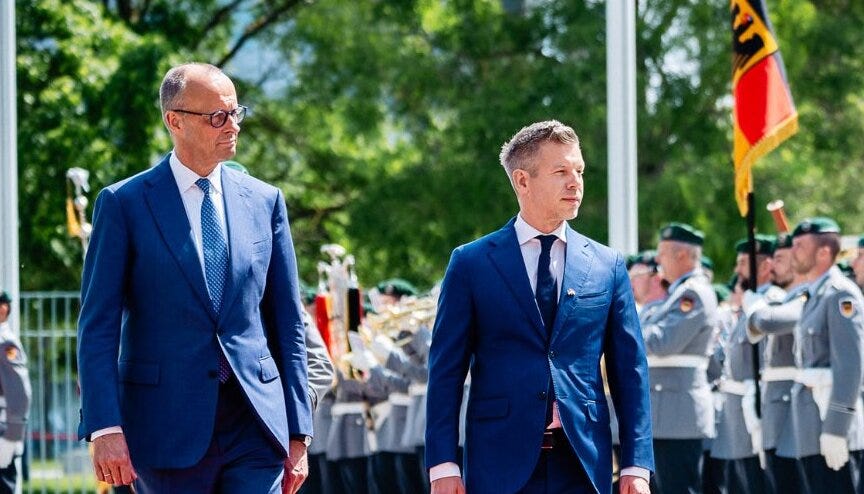
This image is used for illustrative purposes only.
The end of a long estrangement
For fifteen years, Hungary occupied an awkward position inside the European Union: a full member state that openly defied its foundational rules. Under Viktor Orbán, Hungary’s former prime minister and longtime leader of the nationalist Fidesz party, Budapest systematically blocked collective EU initiatives — from support for Ukraine to migration solidarity mechanisms — while accumulating conflicts with the European Commission over judicial independence, anti-corruption standards, and democratic backsliding. The result: €16.4 billion in EU funds frozen, and deepening isolation within EU institutions.
The landslide victory of Péter Magyar in Hungary’s May 2026 parliamentary elections broke that pattern. Magyar, who built his political movement as a pro-European opposition to Orbán, made restoring Hungary’s relationship with the EU the cornerstone of his foreign policy agenda from day one.
The pace since then has been striking. In late May, a deal with the European Commission, the EU’s executive arm, unlocked the frozen funds. Two weeks earlier, Magyar had traveled to Warsaw and Vienna. On June 2, he arrived in Berlin. Paris follows the next day. The itinerary has both geographic and symbolic logic: Germany is Hungary’s largest trading partner; France is the EU’s political engine.
Merz, Zelensky, and the Ukrainian condition
At the chancellery, Merz described the Hungarian prime minister as “an inspiration for all of Europe” — an unusually warm formulation from a German chancellor that underscored just how dramatically the bilateral relationship had shifted since the Orbán era.
Beyond the warm words, concrete agendas dominated the joint press conference. Strengthening German investment in Hungary was high on the list, with Germany’s industrial giants — particularly in the automotive sector — heavily present in Hungary. EU competitiveness, a cross-cutting concern amid sustained commercial pressure from the United States and China, was also addressed.
But the most pressing issue remains Ukraine. The EU has been waiting for Hungary to lift its veto on Ukrainian accession — a process that, under Orbán, had been held hostage to an array of political grievances. Magyar has set an explicit condition: a guarantee from Kyiv protecting the educational and linguistic rights of the Hungarian-speaking minority living in Zakarpattia, a Ukrainian region bordering Hungary. He stated his readiness to meet Ukrainian President Volodymyr Zelensky the following week, provided that such a guarantee was on the table.
Merz calibrated his support carefully: resolving the minority rights issue is necessary, he said, but it should not become an obstacle to Ukraine’s EU integration process. A formulation that validated Magyar’s condition without endorsing it as a blocking mechanism.
Analysis: a reset driven by budget, not ideology
Hungary’s return to the European mainstream is not the product of a sudden ideological conversion — it is driven by a hard fiscal deadline. Of the €16.4 billion in unlocked EU funds, €10 billion from the EU’s post-pandemic recovery fund will be permanently forfeited if Budapest does not meet all outstanding conditions before the end of August 2026. Magyar’s room for maneuver is narrow: he must move quickly, while securing the approval of all 27 EU member states for the disbursement.
That constraint is also an opportunity. In a European Union weakened by the rise of nationalist and populist forces across France, Germany, Italy, and the Netherlands, a pro-European Hungary could shift the internal balance on key votes: Ukraine, rule of law, the EU’s multi-year budget. A Hungary aligned with Brussels strengthens the institutional majority on precisely the files where it has been most contested.
For Magyar, the challenge is twofold. He must deliver on his Brussels commitments within a tight budgetary window. And he must manage a domestic opposition that, if Fidesz retains significant electoral weight, could exploit any concession framed as bowing to EU pressure.
The Berlin-Paris tour does not close this chapter — it opens it. What will matter next is the legislative and judicial sequence that demonstrates whether the break with the Orbán era is substantive, not merely diplomatic.
The Bottom Line
Hungary has a new prime minister. Does it have a new trajectory? The welcome in Berlin was warm, the funds have been unblocked, the pro-European rhetoric is unambiguous.
Institutions are judged by what they do, not what they say.
The August 2026 deadline — with €10 billion on the line — will be the first real test of what Hungary’s “fresh start” is actually worth.
Sources: Euronews