
Hungary's president refuses to go
Tamás Sulyok, Hungary's head of state appointed by the Fidesz party, has defied Prime Minister Péter Magyar's resignation deadline.

Behind this institutional standoff lies something far larger: the battle to reclaim Hungary’s constitutional architecture after years of state capture under Viktor Orbán.
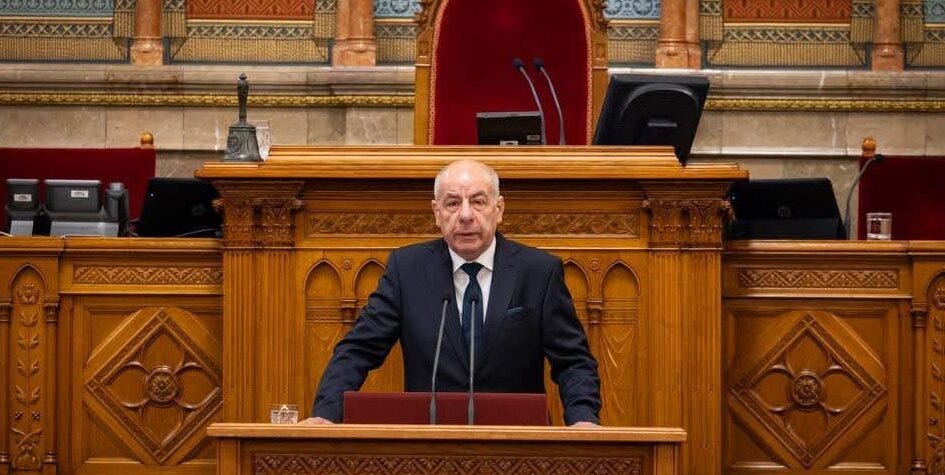
This image is used for illustrative purposes only.
At a Glance
Tamás Sulyok rejected the government’s ultimatum, saying he will wait for the opinion of the Venice Commission — the Council of Europe’s advisory body on constitutional matters — before deciding his next move.
Prime Minister Péter Magyar, who took office on May 9 following his Tisza party’s landslide victory in April, demanded the simultaneous resignation of nine senior institutional figures, including the head of the Constitutional Court, the prosecutor general, and the presidents of several judicial and regulatory bodies.
The looming question: can a democratically elected government force out the appointees of the regime it defeated at the polls — and what happens if the constitution itself blocks the way?
A president who invokes the law to hold on
The deadline was Sunday, May 31, at midnight. That evening, Tamás Sulyok, Hungary’s president, posted a video on Facebook announcing he would not resign. He said he was waiting for guidance from the Venice Commission — to which he filed a formal request around May 29 — and insisted his case must be handled through proper constitutional channels. He also expressed his desire to keep cooperating with the government, including on legislation needed to unlock frozen EU funds.
Prime Minister Péter Magyar — who took office on May 9 after his Tisza party won 141 of 199 parliamentary seats on April 12, ending sixteen years of Viktor Orbán’s rule — responded immediately, also on Facebook. He accused Sulyok of having never stood with the most vulnerable, never defended the rule of law, and ultimately protecting nothing but his monthly salary of 6.3 million forints (roughly $17,000, according to Magyar’s public statements). Magyar announced he would visit the president Monday morning at 8 a.m., accompanied by the minister of justice.
An unprecedented institutional purge
What Magyar is demanding goes far beyond the president. His May 31 ultimatum targeted nine senior institutional figures simultaneously: in addition to Sulyok, he called for the resignation of Prosecutor General Gábor Bálint Nagy; Péter Polt, president of Hungary’s Constitutional Court — along with the court’s remaining 14 members, bringing the total to all 15 seats; András Zs. Varga, president of the Kúria, Hungary’s supreme court; György Barna Senyei, president of the National Office for the Judiciary; László Windisch, president of the State Audit Office; Csaba Balázs Rigó, president of the Competition Authority; and András Koltay, president of the National Media and Infocommunications Authority.
This is not an ordinary list. These are the pillars of the institutional architecture that Viktor Orbán methodically built over his years in power — placing loyalists at the head of every counter-power until those institutions were hollowed out from within. For an American reader: imagine a new administration simultaneously demanding the resignations of the FBI director, several Supreme Court justices, the comptroller general, and the federal media regulator — all appointed by the previous government and suspected of remaining loyal to it.
The Orbán machine faces its succession crisis
The recent history of Hungarian presidents tells its own story. Pál Schmitt, the first president elected with a Fidesz parliamentary majority, was forced to resign after a plagiarism scandal involving his doctoral thesis. János Áder succeeded him, Fidesz loyalty intact. Katalin Novák, the third president from the same mold, was swept out by a scandal over a pardon granted in a child abuse case. Tamás Sulyok is the fourth in that line.
The pattern holds: under Hungary’s constitutional system, the president is elected by parliament — not by direct popular vote — and holds largely ceremonial and symbolic powers, though the office does play a role in constitutional review and in ratifying legislation. Every Fidesz-backed president has supported Orbán’s governments without exception. For Magyar, leaving these figures in place means allowing the old regime to keep its hands on the institutions designed to check it.
Analysis: the constitutional succession war
The crisis unfolding in Budapest is a textbook case of the institutional capture problem: when an authoritarian or semi-authoritarian government loses power, its successors inherit institutions whose inner workings were reshaped to serve the previous regime.
Winning at the ballot box is not enough — you also have to reclaim the bodies meant to hold power accountable.
Magyar has chosen frontal confrontation and the public ultimatum. Sulyok, for his part, is playing for time by invoking legal process — the Venice Commission, constitutional procedure, institutional dialogue. This posture is not necessarily in bad faith: a president who resigns under government pressure sets a dangerous precedent for the independence of the office, whatever the political coloring of the government demanding it.
But it may also be convenient. The salary figure Magyar raised is not mere rhetoric: it signals a reading of the situation in which the personal interests of institutional officeholders may be weighing heavier than the democratic demands of political transition.
The deeper question is one of leverage. Magyar’s Tisza party holds a two-thirds supermajority in parliament — enough, in principle, to amend the constitution itself. But the Constitutional Court, whose members he is simultaneously trying to remove, could block or delay such changes. The institution designed to referee the rules of the game is itself a player in the conflict. Hungary’s constitution offers no clear procedure for removing a sitting president who refuses to leave voluntarily. That silence is where this battle will now play out.
The Bottom Line
Sulyok’s refusal raises a question that extends well beyond Hungary: how far can — and should — a democratically elected government go to dislodge the appointees of the regime it defeated? Constitutional law often says “not quickly enough”; democracy sometimes says “not far enough.” The Venice Commission, invoked by Sulyok as a shield, may become the unexpected referee of this dilemma — and the central test of what a real political transition actually means.
Sources: Euronews · Euractiv · Hungarian Conservative