
How France kept a Kremlin propagandist's residency intact
A Russian national who once ran Moscow's French-language TV arm and now broadcasts on Bolloré-owned CNews holds a ten-year French residency card renewed in 2024. No one in government will say how.

At a Glance
Xenia Fedorova — former head of RT France, the French-language outlet of Russia’s state-controlled RT network, and now a commentator on CNews and Europe 1, both owned by French billionaire Vincent Bolloré’s media empire — holds a ten-year French residency permit renewed in 2024, two years after Russia’s invasion of Ukraine.
France’s successive interior ministers — Gérald Darmanin, then Bruno Retailleau — and two successive Paris police prefects have deflected all questions, each invoking procedural language: an “automatic” renewal, a “renewal by right.”
The case lays bare a structural gap: France’s foreign-policy stance against Russian influence operations and its routine administrative machinery operate in separate silos — with no mandatory link between them.
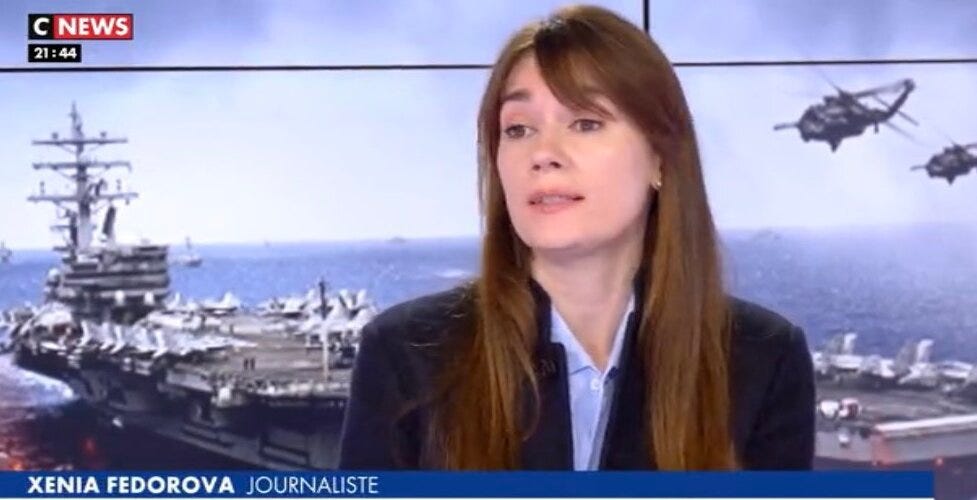
This image is used for illustrative purposes only.
How a Kremlin-linked broadcaster became a long-term French resident
In March 2017, Xenia Fedorova arrived in France on a visa issued by the French consulate in Frankfurt, where she had been working for Ruptly, a video news agency owned by RT, in Berlin. She launched RT France — the French-language arm of Russia’s state-funded RT broadcasting network — and quickly obtained a passeport talent, a French residency permit granted on the basis of professional expertise, in her capacity as the channel’s mandataire sociale, the French legal equivalent of a managing director.
The legal logic was straightforward at the time: RT France was incorporated under French law, and the passeport talent procedure contains no provision to screen applicants on the basis of their employer’s foreign allegiances. In 2022, France’s audiovisual regulator, the Autorité de Régulation de la Communication Audiovisuelle et Numérique (Arcom) — roughly equivalent to the U.S. Federal Communications Commission — suspended RT France’s broadcast license. The European Union subsequently banned RT from operating across all member states following Russia’s invasion of Ukraine. Fedorova left the network’s leadership.
She then joined the media properties of Vivendi, the French conglomerate historically associated with Vincent Bolloré: CNews, Europe 1, and the digital outlet JDNews. Her residency status, however, was not reviewed. In 2024, she received a ten-year carte de résident — France’s long-term residency card, equivalent in practical terms to permanent residency — on renewal.
A government that passed the buck
The entourage of Gérald Darmanin, who was France’s interior minister at the time of the renewal, described the process as “automatic.” Laurent Nuñez, then Paris’s police prefect — a senior official who serves as the central government’s representative in the capital and oversees residency procedures — called it a “renewal by right.” Both formulations are technically defensible: under French administrative law, a foreign national who has resided legally in France for a sufficient number of years is entitled to a long-term residency card without the reviewing authority being obligated to assess the applicant’s political profile.
The automaticity argument opens a larger question rather than closing it.
At the same time, French services tasked with countering foreign influence operations — including Viginum, the government unit created in 2021 specifically to detect and document foreign digital interference — would have had every reason to flag Fedorova’s background, even if no source currently confirms that they did. The gap between what the security apparatus knew and what the administrative machinery did is precisely the problem the government has yet to address.
Foreign Minister Jean-Noël Barrot finally weighed in on May 29, 2026, calling Fedorova a “seasoned propagandist” who “does Vladimir Putin’s bidding.” [translated from French] The phrase is pointed — and it raises an obvious question: if that is the government’s assessment, how did its own civil servants renew her residency papers two years earlier without any apparent review?
Fedorova has not responded publicly to the questions raised about her residency status.
The structural gap no one fixed
The Fedorova case is a case study in how Russian influence operations in Western Europe need not be covert to be effective. They flourish in the administrative blind spots — the places where general rules apply mechanically, without anyone bearing explicit responsibility for asking the political question.
Since 2022, several European Union member states have expelled journalists affiliated with Russian state media or revoked their press credentials. France suspended RT France but drew no administrative consequences for the individuals who had led it. This asymmetry between the political decision and its administrative follow-through reflects less a deliberate conspiracy than a systemic gap in institutional design.
The European Union adopted its European Media Freedom Act (EMFA) in 2024 — a regulation designed to protect media pluralism and prevent undue concentrations of editorial influence across member states, whose provisions are entering into force progressively. The regulation does not directly address the residency status of foreign nationals employed by private media groups. The Fedorova affair makes that lacuna suddenly visible.
There is also a distinct and separate question this case raises: the role of privately owned media conglomerates in amplifying messaging that aligns with the interests of a foreign power at war with a European ally. That question goes beyond administrative law. It belongs to a broader and as yet unresolved debate about media regulation, editorial independence, and the transparency of foreign influence in European public life.
The bottom line
The legal question of whether Xenia Fedorova is entitled to live in France is one administrative law can answer. The harder question is whether France is capable of aligning its foreign policy, its counter-influence machinery, and its daily administrative procedures into a single coherent posture. Until that alignment is achieved, the French presidency’s embarrassment will repeat itself — different names, same blind spot.
Sources: Le Monde · Arcom · francetvinfo.fr