
Henry Nowak's murder becomes a culture war
A stabbing in Southampton exposes cracks in British policing — and how fast a tragedy becomes a weapon in the UK's culture wars.

At a Glance
Henry Nowak, 18, was stabbed to death in Southampton last December by Vickrum Digwa, 23, a Sikh man who falsely claimed to police that he had acted in self-defense after being racially abused. On Monday, Digwa was convicted of murder and sentenced to life in prison with a minimum of 21 years.
Body-camera footage showing officers handcuffing the dying teenager — after believing his attacker’s account — triggered violent protests outside Southampton’s police headquarters and immediate political exploitation by far-right figures.
The case raises urgent questions about British police training and the weight given to racism allegations in the field, and shows how fast individual tragedies can be weaponized in the UK’s culture wars.
This image is used for illustrative purposes only.
A murder and two competing narratives
Henry Nowak was walking home from a night out with friends in Southampton when Vickrum Digwa stabbed him repeatedly with a kirpan — a ceremonial Sikh blade measuring 21 centimeters (about 8.3 inches). Digwa immediately told officers who arrived on the scene that he had been racially abused and had acted in self-defense. The police believed him.
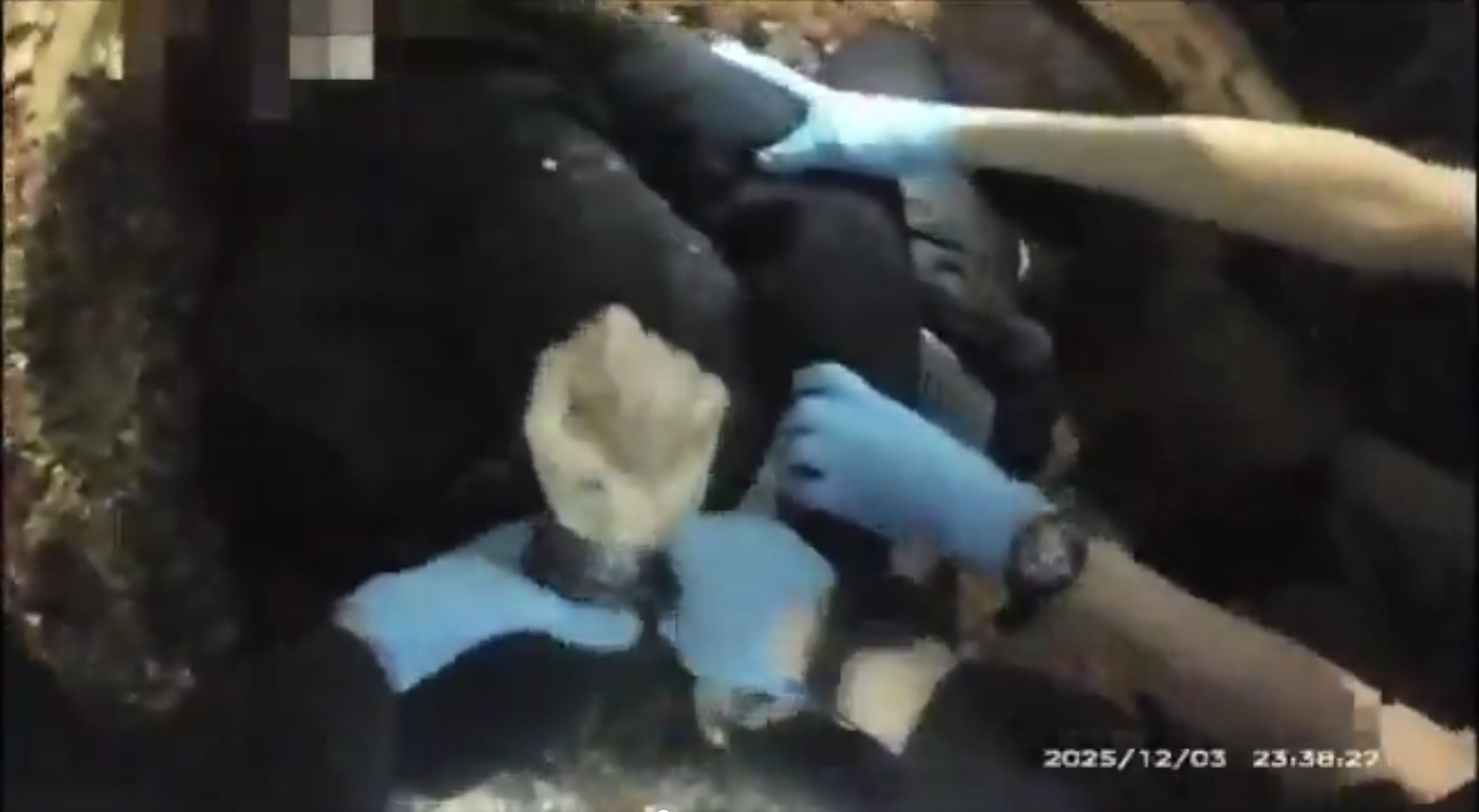
Body-camera footage captured what happened next: officers handcuffed Nowak as he lay dying on the pavement. He can be heard telling them he cannot breathe and that he has been stabbed. An officer replies that he doesn’t think so. Only after discovering Nowak’s wounds did police remove the handcuffs and begin CPR. Henry Nowak died shortly after.
On Monday, Digwa was found guilty of murder and sentenced to life imprisonment with a minimum of 21 years. The Independent Office for Police Conduct (IOPC), the UK’s independent police oversight body, has opened an investigation into the officers’ conduct. One of the four officers involved has resigned; the other three, treated as witnesses, remain on duty.
The police and their own contradiction
The sequence of events raises a question British authorities cannot sidestep: did officers place excessive weight on Digwa’s racism allegation, at the expense of assessing what was plainly in front of them?
Home Secretary Shabana Mahmood rejected the idea that different policing standards exist for different communities. Prime Minister Keir Starmer went further, saying questions needed to be answered about how “allegations of racism influenced decision-making in this case.” Coming from a Labour prime minister, that phrasing was notable — it could signal that a review of police field doctrine is being considered, though no concrete policy direction has yet been announced.
Exploitation as reflex
The conviction did not close the wound — it tore it wider. The following evening, after body-camera footage was released publicly, hundreds of protesters gathered outside Southampton’s police headquarters, chanting “Justice for Henry.” Officers were pelted with bricks, stones, chairs, and fireworks.
Tommy Robinson — the far-right political activist — mobilized the Nowak case to push his “two-tier policing” argument: the claim, popular in nationalist circles, that ethnic minorities receive preferential treatment from authorities. Nigel Farage, leader of the anti-immigration Reform UK party, called for “pure cold rage” and invoked an end to “anti-white prejudice.”
Both figures made public statements before the street violence had fully escalated.
The Sikh community caught in the crossfire
The painful irony is that the Sikh community — whose member committed the crime — is itself a casualty of its aftermath. A coalition of Sikh community groups condemned the murder without reservation, calling it “a moment of madness by an individual for which there is no excuse,” while denouncing the abuse and hate speech directed at the broader community throughout the trial.
Sikh community representatives also noted that the blade used by Digwa did not conform to the religious standards governing a traditional kirpan — which is typically small, blunt, and worn as a symbol of faith, not as a functional weapon. That distinction was largely absent from public debate.
The weapon of an individual crime has become, in public discourse, a symbol attached to an entire faith community.
The kirpan‘s permitted status under UK law as a religious observance now sits at the center of a debate it should not be asked to resolve alone.
Henry Nowak’s father, Mark Nowak, asked publicly that his son’s death not be used to generate “more division, hate, or tension.” That is not the outcome those exploiting this tragedy appear to be seeking.
The bottom line
The Nowak case is a test. Can systemic lessons be drawn from a horrific event without feeding the culture wars that have seized on it? British policing owes answers on how racism accusations shape split-second field decisions. Lawmakers face a genuine question about whether the rules governing ceremonial weapons need review. But if those debates are swamped by racial grievance politics — from any direction — the only winner will be the far right. And Henry Nowak will remain what it has already made him: a weapon.
Sources: Euronews