
Germany's Merz problem: a chancellor under fire
Germany's Friedrich Merz has a 14% approval rating — and his own party is already whispering a replacement's name.

At a Glance
Friedrich Merz, Germany’s chancellor since May 6, 2025, has an approval rating of just 14% — the lowest of any postwar German chancellor on record.
German newspapers are openly asking whether Hendrik Wüst, the popular conservative governor of North Rhine-Westphalia, could replace him without new elections.
Such a mid-term leadership change is theoretically possible under Germany’s constitution, but has happened only once in the country’s postwar history, in 1966.
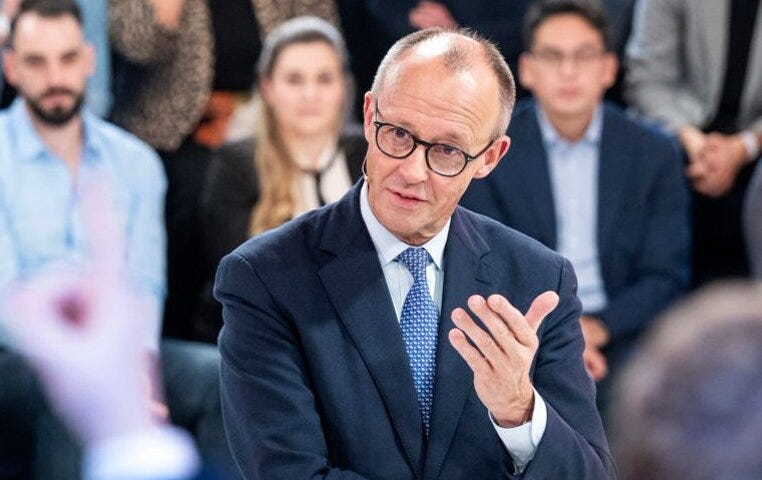
This image is used for illustrative purposes only.
A government that promised more than it delivered
Friedrich Merz was elected chancellor on May 6, 2025 — but not without a warning sign. He failed to secure a parliamentary majority in the first round of voting, a historic first in postwar Germany, and was confirmed only in a second vote with 325 out of 630 seats. The fragility on that opening day never entirely dissipated.
A year later, the results on the policy front are modest at best. Tax reform, pension policy, long-term care insurance, healthcare — none of these have moved meaningfully, according to Aiko Wagner, a political scientist at the Freie Universität Berlin.
Merz’s coalition partner — the center-left Social Democratic Party (SPD), Germany’s traditional labor-oriented party — has added to the turbulence. Coalition disputes have spilled repeatedly into public view, projecting an image of a government that struggles to govern.
The numbers tell the rest of the story. According to polling firm Forsa, Merz’s conservative alliance — the CDU/CSU, Germany’s mainstream center-right bloc — stands at just 22% in voting intentions. It trails the Alternative für Deutschland (AfD), Germany’s far-right party, which polls at 27%.
The name everyone is whispering
Over the past several weeks, speculation about Merz’s future has moved from the margins to the front pages. Two of Germany’s leading dailies — Die Welt and the Berliner Morgenpost — ran the same headline question: “Wüst instead of Merz?”
Hendrik Wüst, 50, serves as governor of North Rhine-Westphalia, Germany’s most populous state. In a political popularity index compiled by polling firm Insa, he ranks third among German politicians. Merz ranks twentieth. That gap — within the same party — is what has turned a fringe hypothesis into a front-page story.
The government’s spokesperson, Stefan Kornelius, dismissed the speculation as not worth commenting on. Several CDU and CSU leaders offered public support for Merz at a regional party conference in the state of Hesse. Wüst himself pushed back firmly, calling the rumors “simply absurd.”
In March 2026, Merz was re-elected chairman of the CDU with roughly 91% of delegate votes at the party’s national conference in Stuttgart — a solid result, though notably lower than his previous mandates. The internal base has not broken. But the direction of travel is visible.
The Wüst calculation
There is a reason Wüst’s denial carries some credibility beyond mere politeness. Leaving his governorship now would mean gambling a strong regional position — and a state election in North Rhine-Westphalia due in spring 2027, which he is widely expected to win — against the uncertain prospects of inheriting a weakened chancellery. The rational calculus, at least for now, does not obviously favor the move.
That said, political careers are rarely governed purely by rational calculus. If CDU polling continues to deteriorate ahead of the 2027 state elections, the pressure on Merz could intensify in ways that are difficult to predict today.
A constitutional tool that has been used exactly once
Germany’s Basic Law — the country’s constitution — does theoretically allow for a mid-term change of chancellor without dissolving parliament or triggering new elections. The mechanism, known as a constructive vote of no confidence, requires the Bundestag (Germany’s parliament) to simultaneously vote out the sitting chancellor and elect a replacement. The procedure was designed to prevent the kind of government vacuums that destabilized Germany’s interwar Weimar Republic.
In practice, this has happened only once. In 1966, Chancellor Ludwig Erhard — weakened by internal coalition disputes over the federal budget — stepped down and was succeeded by Kurt Kiesinger. Political analysts today describe a repeat scenario as theoretically possible but operationally difficult: no coalition partner has an obvious incentive to trigger an open internal crisis whose outcome would remain uncertain.
Why this matters beyond Germany
Germany is the eurozone’s largest economy and one of the two pillars of the Franco-German partnership that has historically driven EU decision-making. A German government paralyzed by internal uncertainty — or a protracted leadership transition within the CDU — could weaken the bloc’s capacity to act on dossiers where Franco-German alignment is typically indispensable: the EU’s multiannual budget framework, industrial policy, and continued support for Ukraine.
Whether or not the Wüst scenario materializes, the broader dynamic is worth noting. Merz has not lost a parliamentary vote. He has not been charged with any wrongdoing. He has not triggered a diplomatic crisis. He has simply become an electoral liability for his own party — and in a coalition system, that may ultimately be enough.
The Bottom Line
Hendrik Wüst says the speculation is absurd. Friedrich Merz remains in office. But a chancellor who narrowly survived his own investiture vote, governs at 14% approval, and trails the far right in national polls faces a question no constitutional mechanism can resolve: how long can a leader govern without the authority that only public trust can confer?
A chancellor governing at 14% approval retains the political capital to push through the reforms Germany actually needs. That is the question Berlin has not yet answered. And Europe is paying attention.
Sources: France Info · Forsa · Insa · Die Welt · Reuters