
Germany Shut Out of the UN Security Council
A humbling vote for Friedrich Merz — and a revealing window into the fault lines of European diplomacy over Ukraine and the Middle East conflict.

At a Glance
Germany was defeated by Austria (131 votes) and Portugal (134 votes) for a non-permanent seat on the UN Security Council for the 2027–2028 term — a stunning setback for Berlin, which had secured such a seat roughly every eight years for decades.
Foreign Minister Johann Wadephul blamed the loss on Germany’s support for Ukraine and Israel, accusing Russia of actively lobbying against Berlin behind the scenes at the United Nations.
The defeat further weakens Chancellor Friedrich Merz, already under pressure at home, and renews questions about Germany’s capacity to exercise the European leadership he promised to restore.
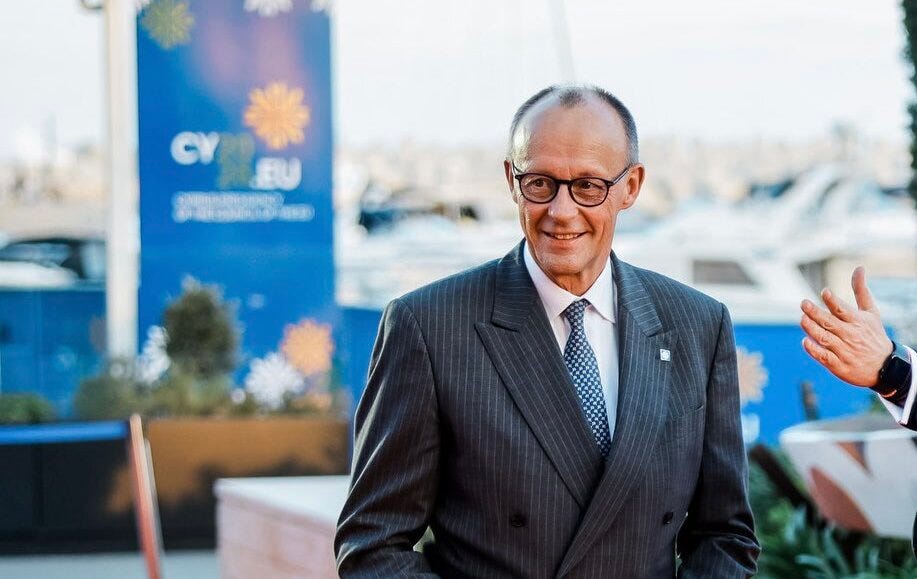
This image is used for illustrative purposes only.
An unprecedented defeat for Berlin
On June 3, 2026, the UN General Assembly assigned two non-permanent seats on the Security Council to the Western European and Others Group for the 2027–2028 term. Austria received 131 votes, Portugal 134. Germany, with only 104 votes, was shut out — a first in decades.
The UN Security Council, the United Nations’ primary body responsible for international peace and security, consists of five permanent members with veto power (the United States, Russia, China, France, and the United Kingdom) and ten non-permanent members elected for two-year terms by the General Assembly, with seats allocated by regional group. For decades, Germany had secured one of these rotating seats roughly every eight years — a near-institutionalized pattern within the Western European group.
Foreign Minister Johann Wadephul had run an intensive lobbying campaign, personally reaching out to approximately 80 ministers and ambassadors around the world. The result stings all the harder for it.
Berlin points the finger at Russia — and defends its positions
The German government wasted little time in offering an explanation. For Wadephul, the loss is the price of principled diplomacy: unwavering support for Ukraine since Russia’s invasion in February 2022, and political solidarity with Israel rooted in Germany’s historical responsibility for the Holocaust.
“We have always taken clear positions on certain issues, and these are positions not shared by all member states,” the minister said. He explicitly implicated Russia — a permanent Security Council member — arguing that Moscow “does not want such a voice” in favor of Ukraine at the Council. Moscow did not immediately respond to the German accusations.
Germany’s alignment on Israel was also cited as a potential cost: the country’s close ties with Israel, rooted in its post-Holocaust responsibility, may have cost it votes in a General Assembly where the Gaza conflict has deepened divisions. This dual stance — on Ukraine and on Israel — appears to have crystallized resistance among member states with more ambivalent views on both issues.
This interpretation of the vote, while plausible, cannot be formally confirmed: General Assembly ballots are secret, and Russian influence in the diplomatic corridors can only be inferred, not established.
A diplomatic calculation that divides
The “price of conviction” narrative has a certain coherence. But it deserves closer scrutiny.
Germany is not the only Western power to support Ukraine or maintain close ties with Israel. France and the United Kingdom — both permanent Security Council members — share broadly similar positions without facing an equivalent electoral penalty. What sets Germany apart in this vote is that it ran in direct competition against two candidates, Austria and Portugal, who ran quieter, less geopolitically exposed campaigns.
It is plausible that Berlin’s high-profile visibility on Ukraine and the Gaza conflict may have alienated a portion of the Global South — Africa, Latin America, Southeast Asia — whose member states vote according to their own priorities: development aid, non-interference, and equidistance from the great powers’ conflicts. For these countries, a German seat on the Security Council could represent one more Western-aligned voice in a body already widely perceived as imbalanced.
This hypothesis, unconfirmed by any attributed statement at this stage, nonetheless offers a more complete lens through which to read the result.
Friedrich Merz: a leadership already under pressure
The UN setback comes at a difficult moment for Chancellor Friedrich Merz domestically. His governing coalition has been strained by persistent disagreements over economic and fiscal policy. Merz had made the restoration of Germany’s European leadership role a central pillar of both his campaign and his early months in office.
This diplomatic defeat now feeds two distinct — and diametrically opposed — lines of criticism.
The Greens attributed the loss to a failure of vision. “The German government did far too little last year to back this candidacy with modern ideas,” said Agnieszka Brugger, deputy chair of the Greens group in the Bundestag, Germany’s federal parliament. For them, it was a lack of ambition, not strong convictions, that cost Germany the seat.
The Alternative für Deutschland (AfD), Germany’s far-right party, framed the result as the predictable consequence of “years of an ideologically blind and unrealistic foreign policy” — a statement from AfD member of parliament Markus Frohnmaier, delivered from an economic forum organized by Vladimir Putin. The setting for that remark says as much about its author as about its content.
Merz himself adopted a measured tone, acknowledging that “we did not achieve our goal” while reaffirming that Germany remains committed to the multilateral system.
“Germany remains a reliable pillar of the multilateral system.” — Chancellor Friedrich Merz, June 3, 2026
Analysis: when principled positioning becomes a liability
This UN vote illustrates a deep tension in Germany’s post-2022 diplomacy: Berlin has chosen to be a convictions-first actor in an international system where majorities are often built on quiet maneuvering and carefully brokered compromise.
Support for Ukraine is a matter of principle — and it carries an electoral cost at the UN. Support for Israel, in the context of the Gaza conflict, has fractured global opinion in ways that many see as tilting Germany’s position unfairly. These choices are defensible on their merits; they are diplomatically costly in a 193-member vote.
The precedent is worth examining: when Germany last sat on the Security Council, in 2011–2012, it had not yet assumed the geopolitical exposure that its post-2022 posture entails. The question is not whether Berlin should abandon its positions — that would be an unacceptable retreat. The real question is whether the Merz government has built sufficient diplomatic capital in the Global South to offset its controversial commitments. Wednesday’s answer was clearly no.
The Bottom Line
Germany claims the mantle of responsible European power — and may now be paying for that claim in an international forum that does not uniformly share its definition of responsibility. The deeper question before Friedrich Merz is not about the lost seat: in a world where geopolitical alignments are shifting and the Global South carries growing weight in UN dynamics, can Germany sustain its positions without investing far more heavily in the diplomacy of non-aligned states? Or must Berlin accept that certain value-based choices carry a structural cost — and own that publicly?
Sources: L’Express · Politico