
German car factories: between China and rearmament
As Germany's auto giants idle, the factories that once symbolized Europe's industrial power may soon produce EVs for Chinese brands — or armored vehicles.

A crisis that reveals Europe’s industrial policy vacuum.
At a Glance
Germany’s major auto plants are running well below capacity: the shift to electric vehicles has failed to produce the volumes that manufacturers and policymakers had predicted, and Volkswagen alone is cutting 35,000 jobs in Germany by 2030.
Two reconversion options have emerged: subcontracting production to Chinese brands like BYD, or converting assembly lines to manufacture defense equipment — armored vehicles, generators for missile defense systems.
Both options expose the same underlying failure: Europe has not produced an industrial policy capable of offering a third way between dependence on Beijing and dependence on military budgets.
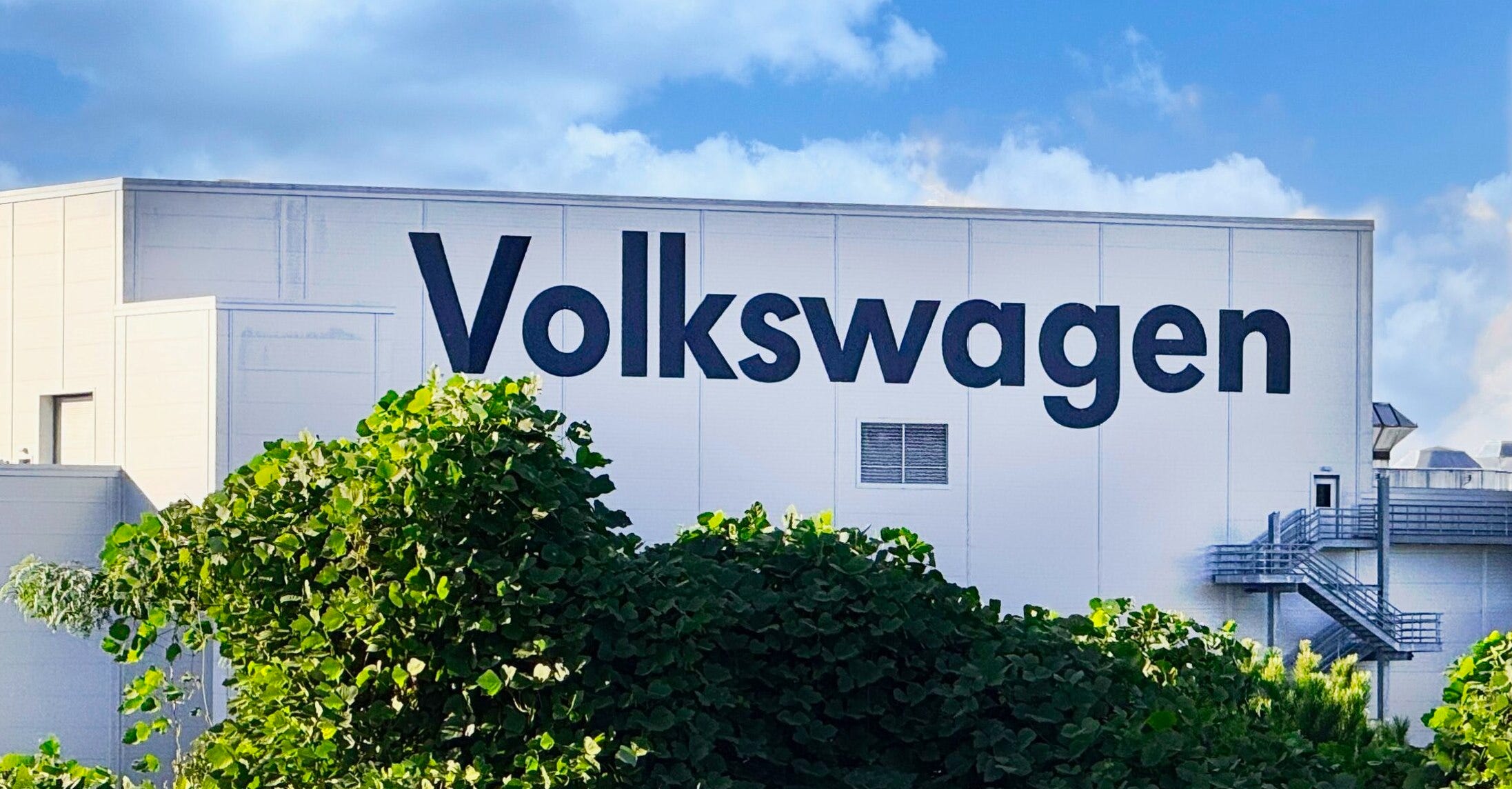
This image is used for illustrative purposes only.
The factories the EV transition left behind
A few years ago, Zwickau was held up as proof that Germany’s auto industry could reinvent itself. Volkswagen had converted the Saxon city’s plant into a facility dedicated entirely to electric vehicles — a showpiece for the green transition the company promised to lead.
Today, the site is under threat. Orders never matched forecasts. European EVs, more expensive to produce than their Chinese counterparts, have struggled to find buyers at affordable price points. Volkswagen is cutting 35,000 jobs in Germany by 2030 and looking to reduce its global production capacity by approximately 700,000 vehicles. In Osnabrück, car production is simply being wound down. In Ludwigsfelde, south of Berlin, Mercedes-Benz says it is looking for what it calls a “sustainable solution for the site’s future.”
This isn’t a temporary dip. Eurostat data on industrial capacity utilization in the European auto sector shows a structural deterioration since 2022. The EV transition, designed to drive premium positioning and volume recovery, collided with a market reality that neither manufacturers nor regulators had properly anticipated: European consumers, facing high sticker prices and an inadequate charging infrastructure, did not shift to electric vehicles at the expected pace.
The China option: what Brussels’s tariffs actually protected
In October 2024, the European Commission adopted countervailing duties on electric vehicles imported from China — reaching up to 35%, and in some cases up to 45% depending on the manufacturer, according to the Commission. The official rationale: protecting Europe’s auto industry against what Brussels deemed unfair Chinese state subsidies. The vote was close. Germany abstained, well aware of its deep exposure to the Chinese market.
Less than two years later, the same Volkswagen group that had lobbied against those tariffs says it is open to “partnerships” with Chinese manufacturers to fill its underused factories. Stellantis — the parent company of Peugeot, Fiat, and Jeep — has already moved in that direction, signing an agreement with Dongfeng to produce vehicles in Europe, in Spain and France for now, not Germany.
The contradiction is structural. The tariffs were designed to buy time for an industry expected to adapt. That time was not used to produce competitive electric vehicles. It could have funded a genuine industrial reconversion — that is precisely what the Draghi report on European competitiveness, delivered to the Commission in September 2024, had recommended. Instead, the temptation is to subcontract production to the very competitors the tariffs were meant to keep at bay.
Chinese manufacturers, led by BYD, now account for roughly 9% of total vehicle sales in Europe, according to the advisory firm Dataforce. To grow that share while circumventing import duties, they need to manufacture on the continent. Idle European plants are an opportunity that industry analysts describe as difficult to pass up — on the Chinese side. On the European side, resistance remains real. Negotiations that Volkswagen reportedly entered into with Chinese manufacturers as early as 2024 did not result in any major agreement on German soil, according to the company. No such deal has been concluded to date, though pressure from industrial states — Saxony and Lower Saxony chief among them — continues to shape the internal debate.
The rearmament option: when the defense budget rescues the auto sector
Alongside the Chinese option, another solution has surfaced. Since 2022, Germany has committed to a major rearmament push, institutionalized through the creation of a Sondervermögen — a special fund outside the regular budget, initially endowed with €100 billion and since expanded, dedicated to modernizing the armed forces and the defense industrial base. The fund reflects both the perceived threat from a more aggressive Russia and growing uncertainty about the United States’ continued commitment to NATO.
Demand for military equipment is growing sharply. Defense manufacturers are looking for production capacity that their own facilities cannot meet alone. Automotive plants — with their heavy-duty assembly lines, industrial robotics, and proven logistics — represent a natural resource for this kind of output.
According to press reports, KNDS — the Franco-German group that manufactures the Leclerc tank and the Boxer armored personnel carrier, two of Europe’s most widely deployed heavy military vehicles — is reportedly in talks to take over the Mercedes-Benz plant in Ludwigsfelde to produce armored vehicles. Volkswagen has confirmed it is in discussions with defense companies about its Osnabrück site, where car production is set to end. Reports suggest negotiations are underway with Israeli firm Rafael Advanced Defence Systems — the developer of the Iron Dome missile defense system — to produce trucks and generators there. Neither party has confirmed these talks in detail, and the situation remains fluid.
This defense reconversion carries a historical dimension that German decision-makers cannot set aside. Volkswagen was founded under the Nazi regime. The group produced military equipment during World War II and made extensive use of forced labor. These facts do not make a defense reconversion legally or morally impermissible — but they create real political sensitivity that the company itself acknowledges. “Historically, this is not a simple matter for Volkswagen when it comes to sharing its sites with defense companies,” notes Stefan Bratzel, an automotive sector expert at Germany’s Center of Automotive Management.
Europe’s industrial policy vacuum
This dilemma — China or guns — is not inevitable. It is the result of a planning failure at multiple levels.
The 2024 Draghi report, commissioned by the European Commission, had identified the problem clearly: Europe spends heavily on industrial subsidies without coordinating its policies, without building competitive ecosystems at continental scale, and without investing in breakthrough technologies at anywhere near the level of the United States’ Inflation Reduction Act or China’s five-year industrial plans. In the automotive sector specifically, the report flagged the absence of a competitive European battery supply chain as a structural weakness.
Two years after that diagnosis, German factories are choosing between two forms of external dependency. The first — China — involves a transfer of industrial know-how to competitors who have already demonstrated their ability to absorb it and move beyond it. The second — rearmament — creates a dependency on military budget cycles, which are by nature volatile and politically determined.
For workers in industrial basins across Saxony and Lower Saxony, the question is primarily social: maintaining skilled employment in regions where the closure of a major auto plant can destabilize entire local economies. “To secure the future of the automotive industry in Saxony and Germany, it is essential not to ignore this reality,” says Dirk Panter, minister of economic affairs of the state of Saxony [translated from German], where the Zwickau VW plant is under threat. That phrase captures the impasse precisely: “not ignoring reality” means accepting solutions that European industrial policy was supposed to render unnecessary.
Analysis
① The precedent exists — and wasn’t absorbed. After German reunification in 1990, the eastern Länder experienced rapid and massive deindustrialization. The factories of the former East Germany — automotive, textile, chemical — did not survive exposure to western competitive markets. The trauma left entire regions dependent on public transfers for two decades. Zwickau is one of those cities that rebuilt its industrial base around Volkswagen. History may be repeating itself in a different register.
② The decision-making structure is fragmented. Who actually decides here? Volkswagen’s management, negotiating simultaneously with Chinese manufacturers and defense firms without a clear political framework. The Länder, which prefer any buyer to closure. The federal government, torn between industrial sovereignty and economic pragmatism. And the European Commission, which imposed anti-Chinese tariffs without building the conditions for a credible reconversion. These actors are not operating within any coordinated framework. Every negotiation is bilateral, opaque, and potentially contradictory to the others.
③ The impact on workers is the real stakes. Volkswagen is cutting 35,000 jobs in Germany alone. Each plant closure in a region economically centered on a single employer generates a multiplied shock: economists in the sector generally estimate that between two and three indirect jobs — suppliers, services, logistics — are at risk for every direct job cut. Defense or Chinese reconversions do not necessarily replicate the same employment volumes or skill profiles. A line operator in automotive assembly is not automatically retrained as a defense systems technician.
④ The core question is sovereignty. European political discourse since 2020 has made “strategic autonomy” a central objective. In the automotive sector — one of the most symbolic of European industrial power — that autonomy would mean conditioning the survival of major plants on two forms of external dependency: Chinese orders or military budgets. Neither resembles what the architects of European industrial policy had in mind.
⑤ The American parallel illuminates without resolving. In the United States, dozens of Rust Belt plants — in Ohio, Michigan, Pennsylvania — have followed similar trajectories since the 1980s: deindustrialization, closures, attempted reconversions. The 2022 Inflation Reduction Act injected massive public capital to reshore battery and EV production. Some results are visible; others are now threatened by the instability of U.S. trade policy. Europe is watching that model with interest — but has yet to produce the equivalent of a federal industrial policy willing to pick winners and defend that choice politically.
The bottom line
If a factory can only survive by producing for Beijing or for NATO, is it still a sovereign industrial asset — or simply available capacity for the highest bidder?
Germany’s auto industry faces a question that neither Berlin, nor Brussels, nor the boards of the major manufacturers seem able to articulate clearly. The answer will not be found in the negotiations currently underway. It requires a political decision — European, not merely German — about whether Europe wants an automotive industry, and at what cost it is prepared to sustain one. That decision has not been made. And in the vacuum it leaves behind, the factories are looking for takers.
Sources: European Commission (EV countervailing duties regulation, October 2024) · Draghi report on European competitiveness (September 2024) · German Federal Government (Sondervermögen defense fund) · Eurostat (automotive industrial capacity data) · AFP / TV5Monde (June 7, 2026)
This article reflects information available as of June 7, 2026. Several negotiations cited remain unconfirmed by the companies involved and may have evolved since publication.