
G7 in Évian: Trump's Ukraine shift

After months of diplomatic turbulence, the world’s seven leading democracies left their Évian summit with something unexpected — a unified, unambiguous statement of support for Ukraine, signed by the United States.
The Group of Seven summit in the French Alpine resort of Évian-les-Bains concluded Wednesday, June 17, 2026, with French President Emmanuel Macron declaring the gathering “objectively a success” — a carefully chosen phrase that says as much about the months of diplomatic disarray that preceded it as about what was actually achieved.
For the first time since Donald Trump returned to the White House, all seven members of the G7 — the United States, France, Germany, the United Kingdom, Italy, Japan, and Canada — adopted shared conclusions on Ukraine: an explicit recognition of the country’s territorial integrity, an “unwavering commitment” to Kyiv, and a collective pledge to step up pressure on Moscow. Ukrainian President Volodymyr Zelensky attended as a guest, joining a trilateral meeting with Trump and Macron on the summit’s sidelines.
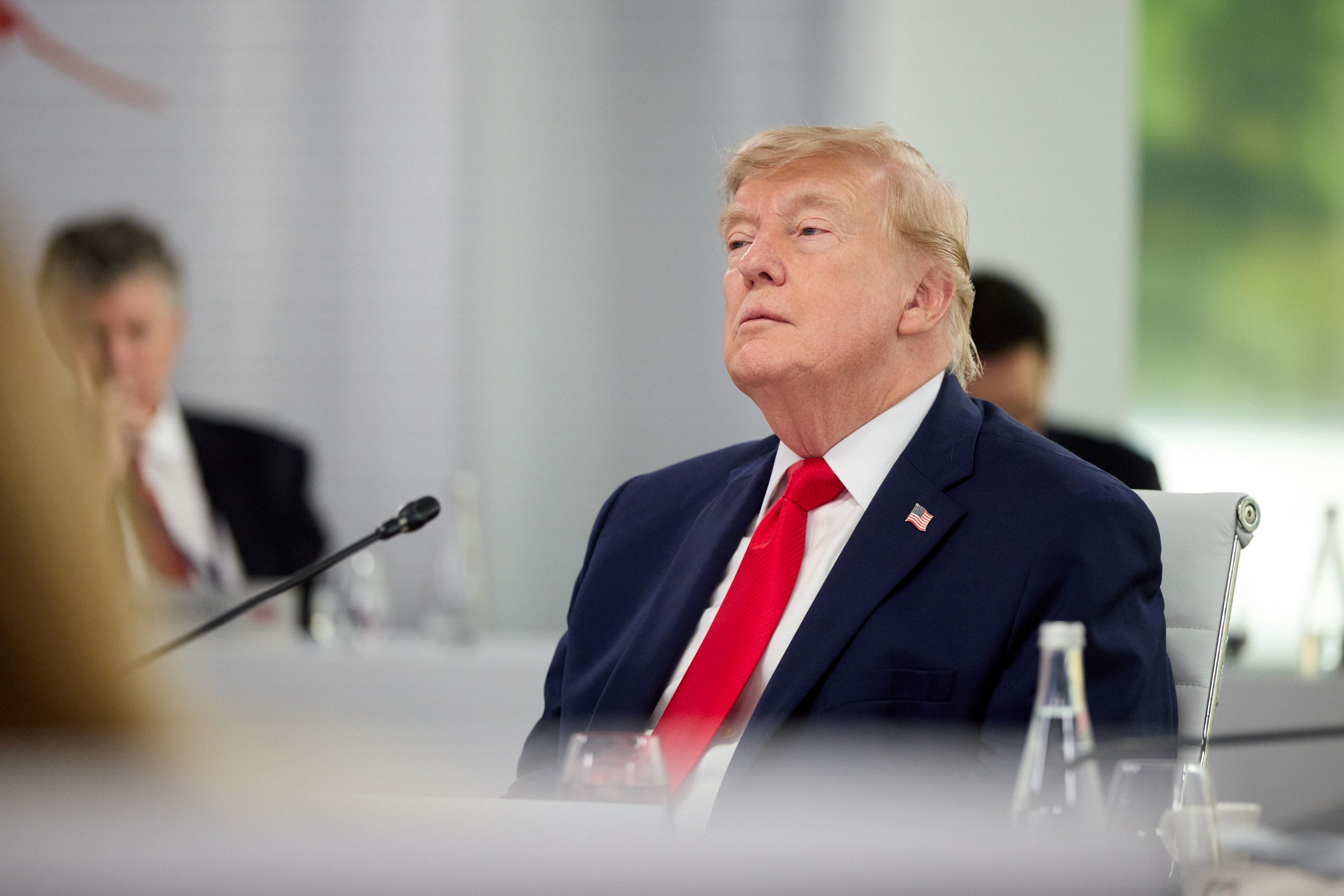
This image is used for illustrative purposes only.
At a Glance
The G7 adopted a joint declaration on Wednesday, June 17, recognizing Ukraine’s territorial integrity and reaffirming unconditional support for the country in its war against Russia’s invasion.
Trump announced that Washington could “soon restore” U.S. sanctions against Russia’s energy sector — a move his administration had frozen since early 2025.
The United States and European G7 members are reportedly considering allowing the licensed production of long-range missiles and air defense systems directly on Ukrainian soil.
A “resynchronization” after months of fracture
The Évian summit was shadowed by an unprecedented degree of transatlantic drift. Since returning to the White House in January 2025, Trump had reportedly eased U.S. military support for Ukraine and engaged in bilateral conversations with Moscow without systematically coordinating with European partners — a posture that had badly frayed G7 cohesion on the Ukrainian file.
In Évian, that dynamic appeared to shift. Macron described a “resynchronization” among G7 leaders on Russia, saying the group had collectively recognized “no serious willingness on Russia’s part” to end the conflict, clearing the way for stronger collective pressure on Moscow. That convergence is all the more notable for including Washington — which had been the most unpredictable variable in the Western diplomatic equation for the past 18 months.
The most concrete measure under discussion at Évian involves a structural shift in military support: the United States and European members would explore allowing Ukraine to produce long-range missiles and air defense systems domestically under license — a move that would transfer not just weapons, but the capacity to manufacture them.
The Trump gamble: tactical alignment or genuine shift?
Trump left Évian in upbeat form, calling the summit “a very special event” and publicly thanking Macron for “an extremely successful G7.” He said he had held “a very good conversation” with Russian President Vladimir Putin and “an excellent conversation” with Zelensky, adding that both leaders “want to do something” about the conflict “but don’t know how.”
That framing — casting the war as a problem of method rather than Russian political will — sits in notable tension with the collective declaration his administration had just signed, which explicitly acknowledges Russia’s lack of serious intent to negotiate. That gap between Trump’s public rhetoric and the text he endorsed remains the unresolved diplomatic knot of Évian.
Trump also floated the prospect of restoring U.S. sanctions on Russia’s energy sector and confirmed that the United States would take possession of enriched Iranian uranium under the recently signed U.S.-Iran agreement, adding, with characteristic nonchalance, that the material was “worthless.”
The power mechanics behind the consensus
The question the official communiqués don’t ask: why did Trump agree, in Évian, to sign conclusions his administration had refused to endorse at previous G7 meetings?
Several factors could explain the repositioning. The U.S.-Iran deal, finalized days before the summit, may have freed up diplomatic bandwidth in Washington — the two crises had been competing for American attention. The steady deterioration of Ukraine’s military situation, combined with growing European defense spending commitments, may also have made sustained U.S. isolation within the G7 politically costly for Trump.
Macron, who hosted the summit, clearly played the role of facilitator — convening the trilateral meeting with Trump and Zelensky, offering each party a face-saving exit. That posture is consistent with France’s broader strategy over the past 18 months: keep Washington anchored in multilateral structures while simultaneously building greater European strategic autonomy.
The bottom line
Will Évian prove a genuine turning point in American re-engagement on Ukraine — or a diplomatic backdrop that gives Trump rhetorical cover before the next reversal?
The answer may come quickly. If U.S. energy sanctions against Russia are restored in the coming weeks, the Évian summit will have been a real inflection point. If they are not, it risks becoming what G7 gatherings have sometimes turned into in the Trump era: a well-staged photo opportunity with no lasting architecture behind it.
Sources: Euronews