
G7 in Evian: Macron's legacy bet on borrowed time
Macron is using the G7 in Evian to cement his "independence" doctrine. But his ability to guarantee it is fading, in Paris and in Washington alike.

French President Emmanuel Macron is hosting the leaders of the world’s seven most powerful economies this week on the shores of Lake Geneva, in the same town where France hosted the G8 back in 2003. Twenty-three years later, the setting is identical, but the host is not: with ten months left before he leaves the Élysée Palace, and his approval rating at its lowest point yet, Macron arrives at this summit in a position of apparent diplomatic strength — the man who sets the agenda — and genuine political weakness, both at home and with his most important partner.
The question this summit raises isn’t simply “what will the G7 decide?” It’s whether a president with ten months left in office, low domestic approval, and whose relevance was publicly questioned by Donald Trump himself only months ago, can still lock in a European doctrine meant to shape the decade ahead.
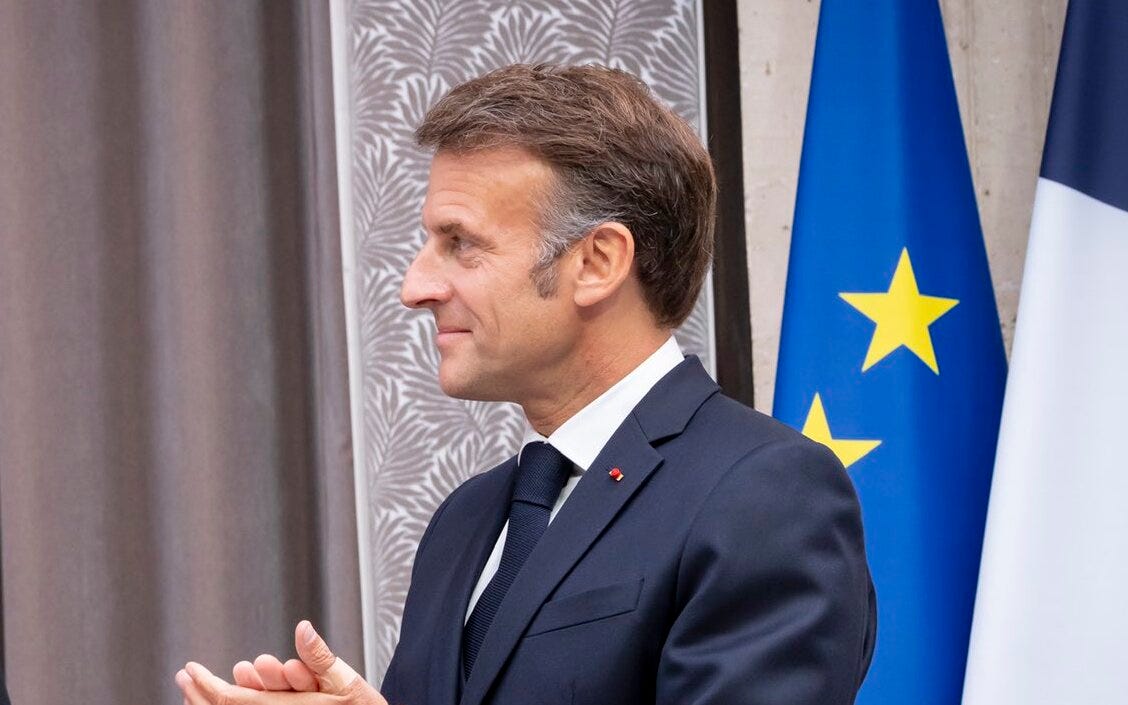
This image is used for illustrative purposes only.
At a Glance
Macron is using the G7 in Evian to reinforce the “independence” narrative — military, energy, and European — that he wants to leave as the legacy of his second term.
Official data shows this doctrine carries a documented budgetary cost: deficits, debt, and exemptions from European fiscal rules that come with it.
The summit takes place as the president’s approval rating hits a new low, while his own governing coalition is already, openly, preparing for life after Macron.
What the G7 in Evian formally established
The 52nd G7 summit runs from June 15 to 17, 2026, in Evian-les-Bains, in the French Alps, under France’s rotating presidency. Participants include the leaders of Canada, France, Germany, Italy, Japan, the United Kingdom, and the United States, as well as the European Union, represented by the president of the European Commission, the EU’s executive arm, and the president of the European Council, the body representing EU member states’ governments. France’s presidency has also invited several non-member countries to take part in select sessions.
The official agenda focuses on global economic imbalances, trade tensions, and the need to reaffirm multilateralism amid geopolitical uncertainty. Ukrainian President Volodymyr Zelensky is expected on the sidelines of the summit, continuing discussions on security guarantees for Ukraine that have been underway since earlier this year as part of the so-called coalition of the willing. Ahead of the summit, France’s presidency organized a videoconference bringing together a senior Chinese official and representatives from several emerging economies — since China is not a G7 member, this parallel format aims to broaden the conversation on global imbalances without formally folding it into the summit’s own proceedings.
On Ukraine, Macron said on the eve of the summit that the G7 needed to rebuild a common position — the stated goal being to bring American and European positions closer together on support for Kyiv and on the terms of any eventual dialogue with Moscow.
The mechanics behind it: a narrative built since 2017, tested in Evian
The choice of Evian isn’t just symbolic because of its history — the timing matters too. Since his 2017 speech at Paris’s Sorbonne University, Macron has made “European strategic autonomy” a recurring theme of his foreign policy. That line has produced concrete steps: a permanent structured cooperation framework among European militaries, a European Defense Fund to finance joint industrial programs, and, after Russia’s 2022 invasion of Ukraine, the launch of a European “strategic compass” and a call for continent-wide rearmament delivered before the European Parliament, the EU’s directly elected legislative body.
As 2027 approaches, this line has become, in presidential messaging, the declared throughline of his entire second term: military independence through a defense buildup, energy independence through a nuclear power revival, European independence through the idea of a common budgetary response to major shocks, and economic independence through industrial reshoring. This narrative has a certain political coherence — it ties together decisions made separately into a single storyline, useful for a president seeking to leave a mark.
But this narrative is being built just as the real power to enforce it is shrinking on both fronts. At home, a poll by Elabe published in May 2026 by the French business daily Les Échos put Macron’s approval rating at 20% — a level near multi-year lows, and down several points in a matter of weeks. At the same time, figures within his own political camp have begun distancing themselves from defining decisions of his second term, notably the 2024 dissolution of the National Assembly, France’s lower house of parliament, as part of early positioning ahead of the 2027 presidential election.
Abroad, the relationship with Washington tells a similar story. In January 2026, Trump refused to attend an emergency G7 meeting proposed by France — an initiative Macron floated on the sidelines of the World Economic Forum in Davos. Trump justified the refusal by suggesting Macron’s leadership role was, in his view, coming to an end. The entire setup in Evian appears designed to avoid a repeat of an earlier incident: at the previous year’s summit in Canada, Trump left before the talks concluded while openly criticizing his French host.
In other words: the host who wants Evian to showcase his European legacy is negotiating that showcase with a partner who, only months earlier, publicly questioned whether that host has any lasting role to play at all.
This dynamic isn’t confined to the relationship with Washington, though. Just over a week before the summit, Macron met in London with German Chancellor Friedrich Merz and British Prime Minister Keir Starmer, alongside Zelensky, in the so-called “E3 plus Ukraine” format, agreeing on a joint set of principles for ending the war — a sign that, on the issues that matter most at Evian, Macron remains an operationally central partner for Europe’s other major powers. But neither Merz nor Starmer arrives at the table from a position of strength either: Starmer has faced calls to resign amid a domestic political crisis in Britain, and early-2026 polling placed him among the least popular prime ministers in modern British history, according to The Economist. If this is the start of Macron’s farewell tour, he’s making it alongside counterparts whose own authority is being questioned at home too.
What the numbers show: independence has a price, and it’s already being paid
The “independence” narrative rests on a budgetary reality that official data now make possible to measure precisely — and the picture extends well beyond France.
Across the European Union, member states’ defense spending reached 343 billion euros (roughly $370 billion) in 2024, or 1.9% of combined GDP, and is expected to hit roughly 381 billion euros in 2025, or 2.1% of GDP — an 11% increase in a single year and nearly 63% since 2020. The “ReArm Europe” plan, adopted in March 2025, aims to mobilize up to 800 billion euros (roughly $865 billion) by 2030 and allows member states to invoke a national escape clause permitting defense spending increases of up to 1.5 percentage points of GDP per year, without those increases counting against their deficit under EU fiscal rules.
For France specifically, defense spending rose from 1.3% of GDP in 2021 to 2.3% in 2024 — an increase financed by a deterioration in the structural primary balance, which went from roughly zero in 2022 to -1.9% of GDP in 2024. That buildup has occurred as France’s overall public debt climbed to 113.0% of GDP by the end of 2024 and to 115.6% by the end of 2025, according to INSEE — among the highest debt ratios in the eurozone, and a trajectory that gives the “fiscal flexibility” granted for defense spending a sharper edge: it’s being used by a country whose underlying debt position was already deteriorating independent of rearmament.
This budgetary backdrop extends beyond defense alone. The French public deficit stood at 5.1% of GDP in 2025, an improvement from 5.8% in 2024, but still well above the 3% threshold set by EU rules — rules that, paradoxically, are partly suspended for defense spending at the very moment France cites them as a constraint on other budget items.
For readers, here’s what that means: the budgetary flexibility the European Union granted for rearmament isn’t a gift without a cost. It’s a choice of priorities — fiscal space that each country could, in theory, have used to cut its structural deficit or pay down debt, and which is now earmarked for defense for at least four years.
The “independence” doctrine Macron wants to present as his legacy is, in accounting terms, already a commitment made on behalf of his successors.
The stakes beyond France’s borders
For a North American reader, the most consequential element of this moment may not be the G7 itself, but the financial instrument forming its backdrop: the European Union, for the first time in its recent history, borrowed collectively in its own name to finance a recovery plan — a temporary instrument set to expire in 2026. Europe’s rearmament plan follows, to some extent, the same logic: a coordinated, partly pooled effort in an area — defense — that remains, formally, a national responsibility.
To put the shift in perspective: imagine if each of the fifty U.S. states had always funded its own National Guard separately, and Washington began, for the first time, issuing common debt to equip the whole system — without creating a unified federal army. The European Union has been experimenting with that kind of step, gradually, since 2020, and the G7 in Evian is taking place at the exact moment when that instrument must either be extended in a new form or be allowed to lapse.
That debate is already live in Brussels. Repayments on the EU’s pandemic-era joint borrowing are due to begin in 2028, and several member states — France among them — are pushing to spread those repayments out or refinance them through new common borrowing rather than absorb the cost into the regular EU budget. Macron has argued that paying down this debt too quickly would undercut Europe’s capacity to invest at a moment it can least afford to pull back — a position that, deliberately or not, would also extend the life of the very financing architecture his defense and energy ambitions rely on.
This is the backdrop for the discussions on security guarantees for Ukraine, whose president is expected in Evian: their financing and shape depend directly on the durability of these shared European mechanisms — and therefore on the ability of today’s leaders to lock them in before a generational political shift, in France and potentially elsewhere.
Analysis
The overlooked precedent. Since 2017, every step of Macron’s “strategic autonomy” doctrine has been presented as a decisive breakthrough — permanent structured cooperation, the European Defense Fund, the strategic compass, post-2022 rearmament. The G7 in Evian fits the same pattern of accumulation. But recent European diplomatic history shows these institutional advances rarely survive a change of presidency intact — and the live debate over what replaces the EU’s pandemic-era joint borrowing, with repayments looming in 2028, illustrates exactly that risk.
The power dynamics. What makes this summit unusual isn’t its agenda, but the position of the person running it. A G7 host normally enjoys a clear advantage: setting the calendar, the priorities, the format of discussions. But that advantage here plays out within a degraded balance of power — an American partner who, only months earlier, publicly questioned the very legitimacy of his counterpart to pursue any long-term project, and European counterparts who are themselves navigating fragile domestic mandates. It’s plausible that this fragility, shared across the table, is pushing French diplomacy toward symbolic commitments — joint statements, roadmaps — rather than immediately binding decisions, given the lack of any guarantee they would survive a change of leadership in Paris, London, or elsewhere.
The real question. Can a president with ten months left in office, an approval rating near multi-year lows, and a governing coalition already preparing its own succession still commit the European Union — and France in particular — to a multi-year budgetary and strategic course? The answer isn’t binary. European instruments — escape clauses, multi-year plans, joint funds — have an institutional life of their own, independent of national presidential cycles. But their extension, funding, and ambition depend on political decisions that will, in fact, change hands. The G7 in Evian may mark less the culmination of a doctrine than its tipping point — the moment it either becomes embedded enough in European institutions to outlast its author, or remains identified closely enough with him to be revisited by his successors.
The Bottom Line
In ten months, Macron will have left the Élysée. The instruments he helped put in place — fiscal escape clauses, multi-year rearmament plans, shared European debt mechanisms — will still be in force for years afterward, carried by European institutions that don’t change on the same schedule as national elections. The question Evian raises isn’t whether Macron will have a successor who shares his doctrine — it’s almost certain he won’t, whatever the outcome in 2027. It’s whether, by then, that doctrine will have changed status: from a personal project carried by one president to an entrenched European reality that even a hostile successor couldn’t easily undo without paying a real political price. That’s the shift — invisible in the official communiqués — actually playing out on the shores of Lake Geneva.
Sources: European Council · INSEE · European Defence Agency (via European Council) · France’s High Commission for Strategy and Planning (France Stratégie) · Institut Montaigne · French Ministry for Europe and Foreign Affairs · Euronews