
G7 at Évian: the West rallies behind Ukraine
The group of major industrialized democracies sent a strong signal from the shores of Lake Geneva: more weapons, tighter sanctions, and Trump back in the game.

But will the commitments made on June 17, 2026 survive the test of implementation?
The Évian-les-Bains summit turned out to be, at least in form, a moment of unexpected cohesion. Gathered for their 52nd annual meeting in a French Alpine spa town on the southern shore of Lake Geneva, facing Switzerland, the leaders of the Group of Seven (Canada, France, Germany, Italy, Japan, the United Kingdom, and the United States) adopted a joint declaration in the early hours of June 17, 2026, reaffirming their “unwavering support” for Ukraine and pledging to intensify military and economic pressure on Moscow. France’s President Emmanuel Macron, who hosted the summit, described the gathering as “a moment of strategic awakening.”
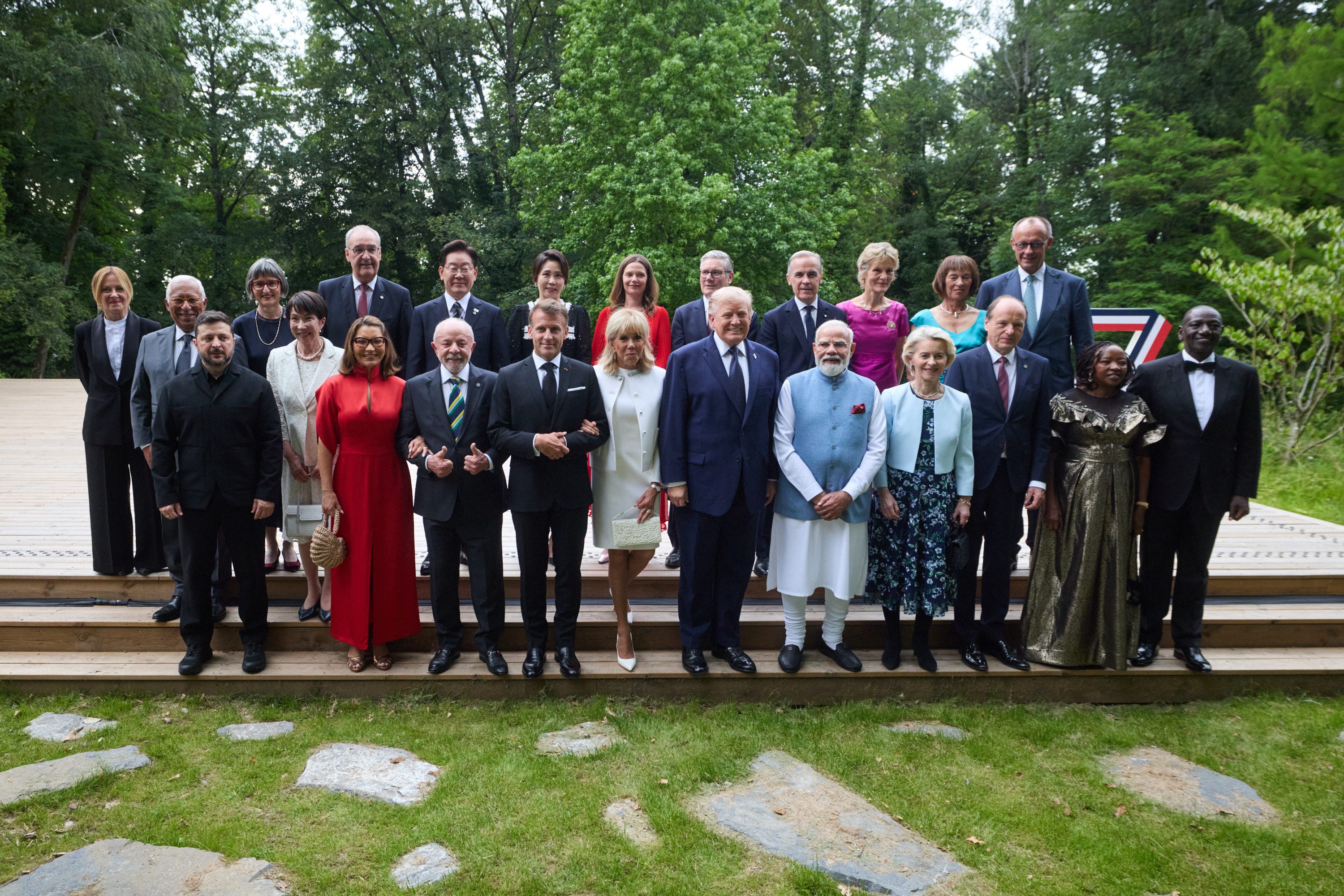
This image is used for illustrative purposes only.
At a Glance
The G7 committed to delivering more air defense systems, interceptors, and long-range military capabilities to Ukraine, and signaled openness to granting Kyiv licenses to expand its own weapons production.
President Donald Trump announced the imminent restoration of U.S. sanctions on Russian oil shipments — suspended in March 2026 to contain the price spike triggered by the conflict with Iran.
The European Union has already adopted 21 rounds of sanctions against Russia, the most recent in early June 2026, targeting Moscow’s shadow fleet and oil revenues.
A Ukrainian agenda overshadowed by the Iran crisis
The Évian summit opened under the sign of geopolitical paradox. With the war in Ukraine approaching the fifth anniversary of Russia’s full-scale invasion, it was the announcement on Sunday, June 15, of a U.S.-Iran agreement on reopening the Strait of Hormuz — a critical chokepoint for global energy shipments — that initially dominated diplomatic attention. The logic was direct: by easing the energy stranglehold on the Persian Gulf, the deal mechanically enabled the restoration of sanctions on Russian oil that Washington had been forced to lift in March 2026 to prevent a global energy price crisis.
Only on the summit’s second day did leaders convene a working session on Ukraine, with Ukrainian President Volodymyr Zelensky present as a special guest. The session lasted 75 minutes — a compressed format for a conflict of this scale. Zelensky told reporters that the entire Group of Seven supports Ukraine unanimously, and confirmed that leaders discussed Ukraine’s need for additional Patriot missile systems — air defense batteries capable of intercepting Russian ballistic missile attacks on power grids and cities.
What the joint declaration actually contains
The declaration adopted at Évian contains three distinct commitments on Ukraine.
First pillar — military support. The G7 pledged to increase deliveries of air defense systems, interceptors, and long-range capabilities. Leaders also signaled readiness to grant Kyiv licenses enabling it to scale up its own military production — a measure that, based on available sources, will require further technical discussions in the coming weeks.
Second pillar — energy resilience. Leaders committed to providing additional support to help Ukraine withstand the coming winter, in the face of Russia’s sustained attacks on its energy infrastructure.
Third pillar — sanctions. The text is unambiguous, committing to strengthen sanctions “including those targeting the oil and gas sectors.” Trump indicated that the restoration of U.S. energy sanctions on Russia would come “soon,” without specifying which measures or on what timeline.
Why Trump’s return to the Ukraine file matters
The central variable at this summit was not the declaration itself — the G7 issues pledges of this kind regularly — but the posture of the U.S. president. Trump had described himself as “focused on Iran” since the Gulf crisis began. His active participation in the Ukraine discussions at Évian, including a bilateral meeting with Zelensky that he characterized as “a good meeting,” and his announcement on sanctions, represent a tangible American re-engagement on the issue, even if the precise contours remain undefined.
This shift could suggest that the Iran agreement freed up diplomatic bandwidth that Washington had been deliberately holding in reserve. Without being able to establish this formally, it is plausible that the Trump administration implicitly conditioned its return to the Ukraine file on first resolving the Gulf energy crisis.
Canada, for its part, announced on the sidelines of the summit a new round of sanctions targeting 162 individuals, entities, and vessels connected to Russia’s war machine — including the shadow fleet, energy revenues, the defense industry, and disinformation networks. In 2026, Ottawa has provided C$2.8 billion in military aid to Ukraine.
What the summit leaves unresolved
The architecture of the declaration rests on a tension that remains unaddressed. On one hand, leaders described what the joint declaration calls “new momentum” in Ukraine’s favor, pointing to battlefield developments in recent weeks. On the other, no enforcement mechanism ensures that the military commitments will actually be fulfilled on the timelines that matter.
The licensing provision for weapons production illustrates this ambiguity: presented as progress, the measure is explicitly conditioned on subsequent technical negotiations. It looks more like a direction than a decision.
The declaration also remains silent on any negotiating framework with Moscow. Trump pressured Russia to “make a deal,” but without specifying conditions or a viable exit mechanism.
The Bottom Line
Évian 2026 produced something rare in recent years: a convergence between Washington and its allies on Ukraine. But the real question is not what the G7 signed on June 17 — it is what it will have delivered by December 17. Ukraine is heading into a sixth winter of war.
Pledges of weapons and sanctions are only as good as their implementation timeline.
And that part, no joint declaration can write on behalf of governments.
Sources: Élysée (G7 official declaration) · France Info · Le Devoir · PBS News