
Fuel prices in France: TotalEnergies calls the shots, Paris complies
France's largest oil company caps prices at the pump, books billions for shareholders — and keeps the government in check with the threat of pulling the plug.

A power dynamic that reveals more about the state of French sovereignty than any energy policy speech.
At a Glance
TotalEnergies posted a net profit of €5.4 billion ($5.8 billion under international accounting standards) in the first quarter of 2026, up more than 50% year-on-year, and raised its dividend by 5.9% — while capping gasoline at €1.99/liter across its 3,300 French stations.
The company has signaled it would lift the price cap if the government imposes a windfall tax on its profits, leaving France’s Prime Minister with little room to maneuver.
TotalEnergies declares financial losses in France and has effectively paid no corporate income tax there since 2019 — while a significant share of its global profits flows through low-tax jurisdictions.
The pump as podium
A major oil company capping gas prices: it looks like a social gesture. It functions primarily as a masterclass in corporate communication.
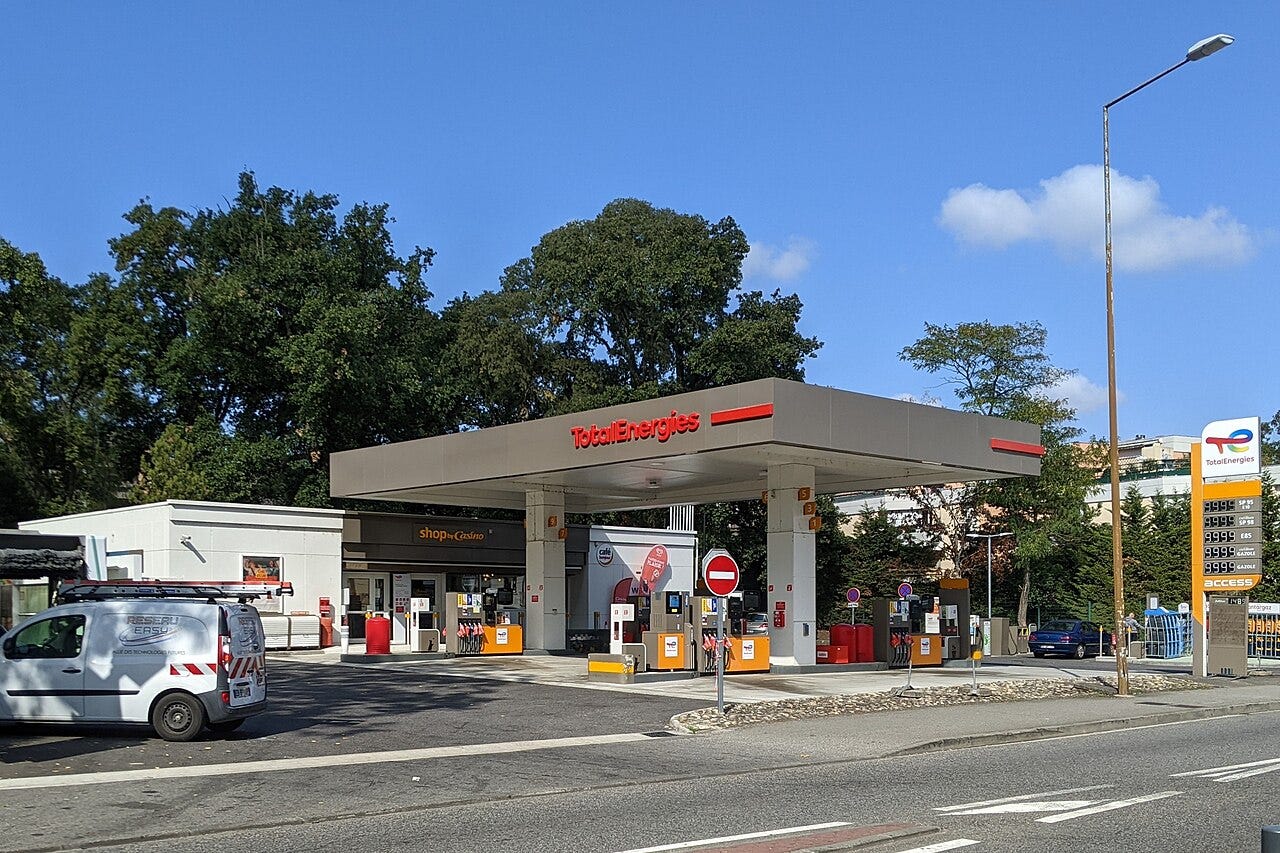
Since March 13, 2026, TotalEnergies has enforced a price ceiling across all 3,300 of its French service stations — €1.99 per liter for gasoline, €2.25 for diesel. The company extended the measure through May, citing the ongoing Middle East conflict and the daily appreciation of crude oil prices. The government applauded. France’s Prime Minister Sébastien Lecornu welcomed the decision. Maud Bregeon, France’s government spokesperson and junior minister for energy, called on critics to stop what she termed “Total bashing.”
What received less attention: Lecornu had, just days earlier, publicly called on the company to consider a “generous” price cap. TotalEnergies responded with a press release. The sequence matters: it was the company that decided, and the government that celebrated. Not the other way around.
War profits, private redistribution
The numbers released on April 29, 2026 establish the scale. TotalEnergies reported a net profit of €5.4 billion for the first quarter of 2026 — or $5.8 billion under international accounting standards — up more than 50% year-on-year, driven by the surge in crude prices following U.S. and Israeli airstrikes on Iran and the political turmoil in Venezuela. Against that backdrop, the company’s board of directors voted a first interim dividend of €0.90 per share for fiscal year 2026, an increase of 5.9% over the previous year.
The redistribution is real — but it flows primarily to shareholders. The fuel price cap, meanwhile, represents a commercial concession that the company accepts in exchange for a considerable reputational benefit — and, implicitly, a shield against legislative intervention.
TotalEnergies made its position plain. When Lecornu called on the company before the French Senate on April 29 to redistribute its exceptional profits “one way or another,” the group replied through a statement to the AFP newswire: the fuel cap is how it redistributes its profits, a policy it has maintained since February 2023, without waiting to be asked.
The argument is shrewd. It reframes a commercial decision as a social act — without the French state collecting a single euro.
The unspoken threat
What the sequence ultimately reveals is the nature of the underlying power dynamic. TotalEnergies has signaled it could suspend the price cap should the government move to tax its windfall profits. The threat requires no explicit formulation — it doesn’t need one. The message lands.
The result: a government that estimates the war’s cost to French public finances at more than €6 billion in 2026 finds itself defending the company rather than taxing it. Lecornu told lawmakers he had little appetite for criticism of a company that “employs French workers” and represents French strategic interests. His government’s spokesperson indicated the executive “rules nothing out” — a formulation that, in French political practice, typically signals inaction.
The left-wing opposition has not been silent. The French Socialist Party introduced a bill targeting companies with revenues above €750 million whose taxable income exceeds 1.2 times the average of the past three fiscal years. The Greens proposed a windfall tax. The hard-left La France Insoumise (LFI) floated nationalization. Even the Rassemblement National (RN), France’s far-right party, through its MP Thomas Ménagé, called for limits on dividends deemed excessive relative to consumers’ interests. This unusual cross-party convergence has, as of this writing, produced no adopted legislation.
The tax that doesn’t exist
The underlying problem is structural, and predates the current crisis. TotalEnergies declares financial losses in France and has not paid corporate income tax there since 2019 — a fact consistent with the company’s own public accounting, which shows it pays taxes where it books profits, which is generally not France. The mechanism is standard practice in the global extractive industry: multinationals shift profits toward subsidiaries in jurisdictions with more favorable tax treatment.
Gabriel Zucman, an economist and founder of the EU Tax Observatory — an independent research center that tracks corporate tax avoidance — has quantified the sector-wide phenomenon: during oil price booms, extractive companies declare an average of 20% of their windfall profits in tax havens, compared with 12% in normal times. For TotalEnergies specifically, the company’s own accounts show €5.9 billion in 2024 profits booked under an opaque category labeled “rest of the world,” at significantly lower effective tax rates than French law. The company has contested any characterization of tax avoidance, pointing to a global average effective tax rate of 43%.
That accounting dispute is not academic. Researcher Ninon Moreau-Kastler, whose work examined 77 multinationals in the extractive sector, argues that effective taxation would need to be based on companies’ global results, then allocated across countries according to actual economic activity — sales volumes, refining capacity, industrial presence — rather than the profits companies choose to declare in any given territory.
The approach is available to France, according to economists who advocate it. It would require a political choice that the Lecornu government has not made.
A European debate France is sitting out
The question extends beyond France’s borders. Several European Union member states, including Germany, have asked the European Commission — the EU’s executive arm — to reactivate the windfall profit tax mechanism it deployed during the 2022 energy crisis. France has not joined that push. Thirty-three economists signed an open letter urging the French government to align with that coalition. The letter has received no public response.
The 2022 precedent is instructive. Following Russia’s invasion of Ukraine, France introduced an exceptional contribution on the profits of large energy companies. The measure generated €69 million in actual revenue — against an initial projection of €3 billion. The profit-shifting machinery had rendered the tax base largely untouchable.
For North American readers, the parallel is recognizable: the debate over taxing windfall profits of major oil companies has been a recurring feature of U.S. Congressional politics since 2022, consistently blocked by Republican opposition. The notable difference: in France, this protection transcends conventional political lines. It is not a partisan position — it is a cross-party reflex toward a company treated as a national strategic asset.
The bottom line
“This is how we redistribute our profits.” [translated from French] — TotalEnergies, in a statement to AFP, April 29, 2026
The statement functions as an admission. It is not the state that redistributes exceptional revenues during a period of crisis — it is the company that decides, on its own terms, which way the money flows, and for how long.
The real question is not whether TotalEnergies is a responsible or irresponsible actor. It is more uncomfortable than that: in what kind of democracy can a private corporation effectively condition a government’s fiscal policy by threatening to withdraw a service deemed socially necessary? And if the answer is “this one” — what does that say about the actual sovereignty that Matignon, France’s prime ministerial offices, invokes to justify its inaction?
Sources: LCP Assemblée nationale · France Info · RTBF · TotalEnergies (official press releases) · EU Tax Observatory