
French wine: Trump's tariff threat outlasts Versailles
Trump called Macron a "special friend" at Versailles — then flew home without withdrawing his 100% tariff threat on French wine. The GAFAM tax dispute remains unresolved.

At a Glance
On June 15, 2026, Donald Trump threatened 100% tariffs on all French wines and champagne unless Paris scraps its 3% digital services tax on U.S. tech giants — an ultimatum he said he had conveyed directly to Macron.
Macron refused to yield: “The United States does not get to decide European law.” The G7 closed June 17 without resolving the dispute; the seven members formally acknowledged their divergence on digital taxation.
French wine and spirits exports to the United States have already fallen 21.2% in 2025 — the U.S. market accounts for 21% of total French wine exports, worth roughly €3 billion ($3.3 billion).
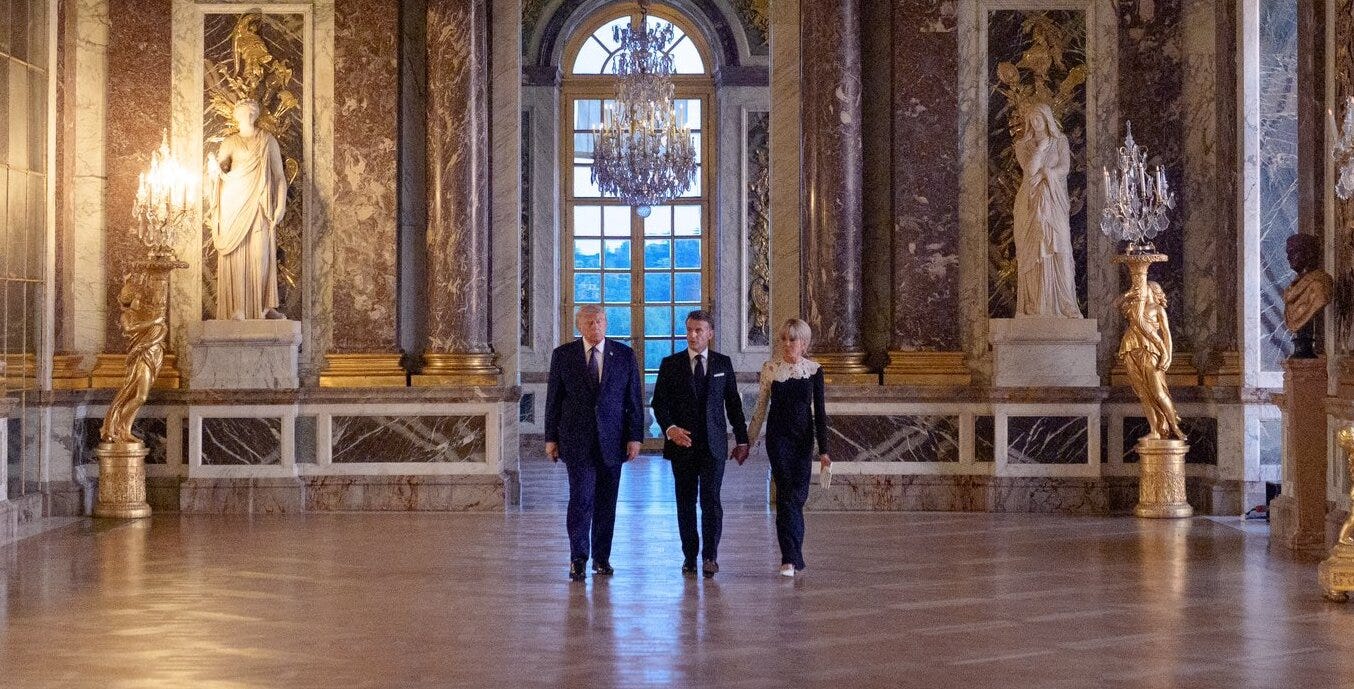
This image is used for illustrative purposes only.
On the evening of June 17, 2026, Donald Trump was welcomed at the Palace of Versailles for a dinner celebrating 250 years of Franco-American friendship. He kissed Brigitte Macron on the cheek, called Emmanuel Macron a “special friend” and “a very nice man,” and declared the Évian G7 “extremely successful.” Two days earlier, he had threatened to impose 100% tariffs on every bottle of French wine and champagne entering the United States. That threat has not been withdrawn. France’s wine industry begins June 18 without knowing whether it will be the target of the next early-morning post on Truth Social.
The tax that has strained relations since 2019
France’s digital services tax — quickly nicknamed the “GAFAM tax,” after the French acronym for Google, Amazon, Facebook, Apple, and Microsoft — was enacted in 2019. It applies to companies with global revenues exceeding €750 million and French revenues above €25 million from certain digital services, taxing their French-generated income at a 3% rate. Washington has viewed the measure as discriminatory from the start.
The dispute nearly escalated in the fall of 2025: the French National Assembly voted on October 28 to double the rate from 3% to 6%, but the government blocked the increase in the final version of the 2026 budget law. Roland Lescure, then France’s economy minister, had explicitly warned lawmakers against “disproportionate retaliation.” The rate stayed at 3%. That partial retreat was not enough to defuse Washington.
The threat, the refusal, the dinner
On June 15, in an interview with the New York Post before arriving in France, Trump declared he had “no other choice” but to impose 100% tariffs on “all champagne and all wine” from France if Paris did not scrap the tax. Asked about it on French television that same day, Macron was unambiguous: “No, because that is not how this works.” He added that he wanted a “respectful but firm discussion” and that tariffs “help no one, especially between G7 countries.” [translated from French]
The summit closed June 17. On digital taxation, the final communiqué acknowledged a divergence among the seven members — no agreement, no French commitment to change the tax, no American withdrawal of the threat. Trump left Évian, went to dinner at Versailles, complimented his host, and flew home. The threat stayed.
A wine industry held hostage for the third time
For France’s wine sector, this is the third iteration of the same scenario in 18 months. In January 2026, Trump had threatened 200% tariffs on European wines and spirits to force Macron to join his “Peace Council” initiative. In March 2025, a similar threat accompanied tensions over U.S. auto tariffs. Each time, France’s winemakers find themselves exposed to a conflict they did not start and cannot resolve.
The numbers reflect the damage already done. According to the Federation of French Wine and Spirits Exporters (FEVS — Fédération des Exportateurs de Vins et Spiritueux), exports to the United States fell 21.2% in 2025, driven by existing tariffs — already raised from 10% to 15% — an unfavorable exchange rate, and persistent commercial uncertainty. The U.S. market nonetheless remains the sector’s largest export destination, at €3 billion ($3.3 billion), or 21% of total exports.
A 100% tariff would double the price of a bottle of French wine or champagne for the American consumer overnight, making French products instantly uncompetitive against California, Italian, or Chilean wines. For smaller producers dependent on U.S. market access, the consequences could be structural, not just cyclical.
Gabriel Picard, president of the FEVS, called for “responsibility” ahead of the summit, hoping discussions would “help ease things.” They did not settle them.
Analysis: the Versailles paradox
What makes the situation on June 18 particularly unstable is precisely the warmth on display between the two leaders. Trump as Macron’s “special friend” and Trump threatening 100% tariffs on French wine are the same man, in the same week. This is not a contradiction — it is a method.
The tariff threat is a bilateral pressure tool, not the expression of personal hostility.
It can coexist with a dinner at Versailles and resurface at the next available moment: a budget vote, a careless statement, a European ally who folds and weakens France’s position.
France’s stance remains what it was before the summit: the tax is part of European law, several countries apply it, and fiscal sovereignty is not negotiated under threat. But the terrain is shifting. Canada abandoned its digital services tax in 2025. Italy is reportedly considering a similar retreat. France is increasingly isolated among the nations still maintaining the measure against Washington’s pressure — a fact Trump will not hesitate to leverage next time.
The bottom line
The real question raised by this sequence is not about wine. It is this: at what point does repeated tariff pressure on France’s most symbolically charged export sector — politically visible, economically real, and impossible to defend at the negotiating table — start shaping French budget decisions? Macron is holding firm. Will his successor in 2027? The next budget cycle, the next French presidential election, the next threat from Washington: each will be a test. Versailles was one evening. The GAFAM tax is a structural question, and it has no expiration date.
Sources: AFP · France 24 · France Info · FEVS · Le Temps