
France's Senate derails defense budget in surprise revolt
France's upper house rejected €36 billion in new military funding, freezing the country's defense trajectory — and exposing a rift between the government and its own natural allies on the right.

At a Glance
In a late-night vote on June 2–3, 2026, France’s Senate rejected the core article of the country’s military spending law, blocking €36 billion in additional defense funding through 2030.
The center-right Republicans, who were pushing for €50 billion, refused to compromise at the lower figure — partly because the defense minister herself was actively arguing against the larger commitment, not to shrink her ministry, but because the government had no credible plan to finance it.
The €413 billion defense framework approved in 2023 remains the operative baseline — the planned update is now blocked, though the government retains the option of revisiting allocations in the fall budget law, as France approaches — but has not yet formally met — the NATO 2% GDP threshold, with allies pressing for faster progress toward higher targets.
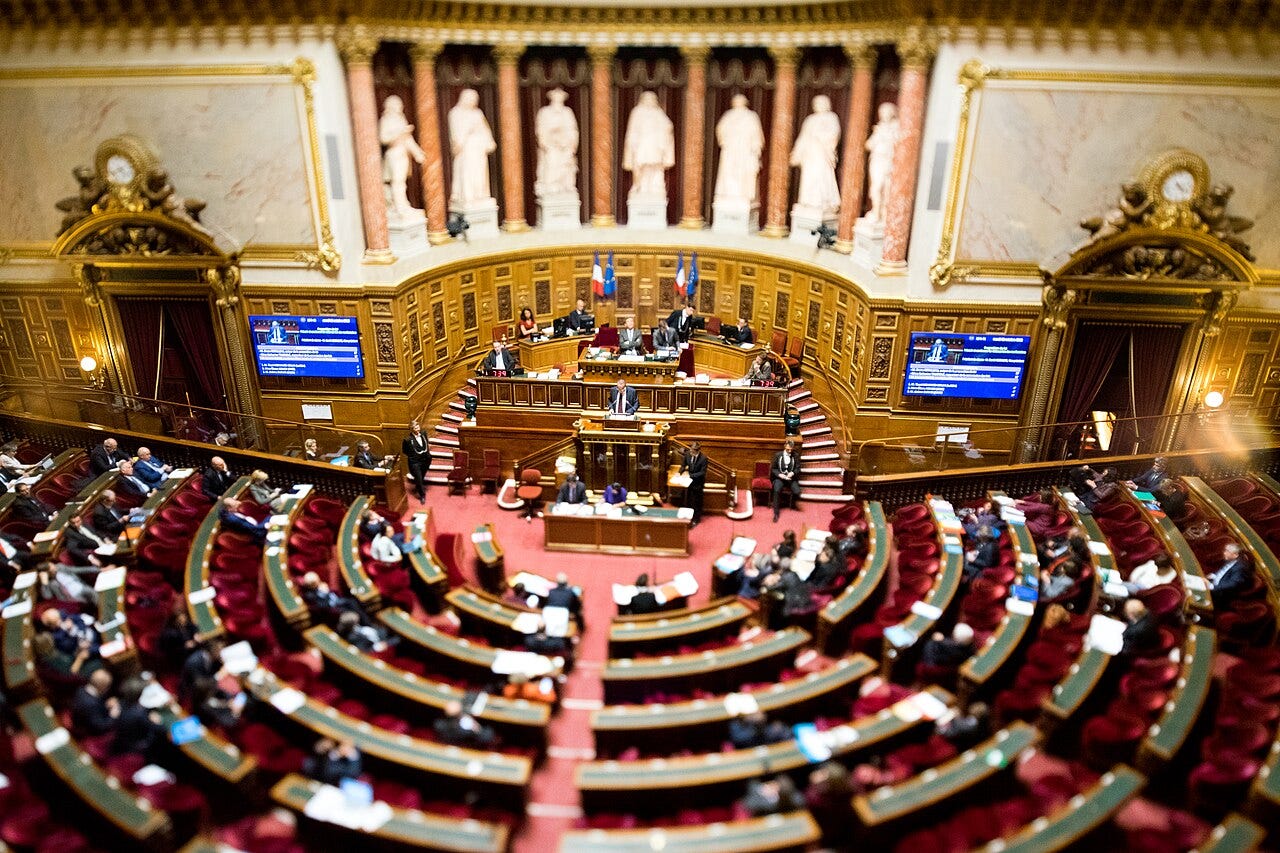
This image is used for illustrative purposes only.
A late-night vote turns into a political embarrassment
Shortly after midnight on June 3, 2026, France’s Senate, the upper house of the French parliament, voted down Article 2 of the loi de programmation militaire (LPM) — the country’s multi-year military planning law. The article would have authorized an additional €36 billion in defense spending between 2024 and 2030, on top of the €413 billion framework passed in 2023. The rejection was decided by a margin of just five votes.
The political mechanics of that night were striking. The center-right Les Républicains (LR) party, joined by a fraction of centrist senators, had been pushing for a more ambitious figure: €50 billion in additional funding, raising the total defense envelope to €463 billion and lifting military spending to 2.7% of GDP. Backed by their leader Bruno Retailleau — a declared candidate in France’s 2027 presidential election — the LR senators held firm. Against them stood Catherine Vautrin, France’s Minister of Armed Forces, who spent the evening actively arguing against the larger commitment — not to shrink her ministry, but because the government had no credible plan to finance it. It is an almost unheard-of situation in democratic budget politics: a minister opposing an expansion of her own budget on fiscal grounds rather than strategic ones.
Why a defense minister fought against her own budget
Vautrin’s position requires context. On the Senate floor, she made the government’s case with unusual candor: committing to €50 billion in new defense spending by 2030, in a period of deep fiscal constraint, appeared to her “extremely difficult to finance.” Behind that caution lies the reality of France’s public finances — a structural deficit that forces painful trade-offs at every level of government.
But the fault lines go deeper. The €14 billion separating the two proposals is not an abstraction. It corresponds to specific procurement decisions: 30 additional Rafale fighter jets and three additional frigates. Cédric Perrin, chair of the Senate’s defense committee, publicly pointed out that these purchases had been explicitly committed to by Sébastien Lecornu — now France’s Prime Minister, formerly its defense minister — in a post he published in February 2025. By rejecting those €14 billion, the government risked repudiating a pledge made by its own head of government. Perrin framed this as a direct contradiction.
Among centrist senators, the split was visible: 28 voted for the €36 billion figure, 22 voted against, and 8 abstained. France’s left-wing opposition, the Parti Socialiste, found itself in rare alignment with the government on this point. Senator Rachid Temal, a Socialist, described the LR strategy as having chosen “to vote zero billion” rather than accept what he called “a sincere effort” [both translated from French].
NATO, Ukraine, and the geopolitics of defense spending
The budget debate quickly moved beyond euros and percentages into the language of geopolitics. Perrin invoked France’s commitment to NATO: the target of dedicating 3.5% of GDP to defense by 2035. The rejected article included €8.4 billion in this trajectory — a figure LR dismissed as insufficient for a credible path toward that goal.
Senator Philippe Folliot, a centrist from the Tarn department in southern France, added a different dimension: the technological transformation of modern warfare. He noted that Ukraine had gone from producing zero drones in 2023 to approximately 9 million units deployed in 2026 — a figure he presented as evidence of a “major strategic shift,” in which low-cost mass-produced drones are upending traditional military procurement models. A partial agreement was reached on co-financing drone interception production capacity, a narrow but concrete step.
For Retailleau, the LR position is inseparable from a broader political project. He framed the push for €50 billion as “a political choice” [translated from French] in an era of what he described as global disorder and U.S. disengagement from Europe — language that may also reflect positioning ahead of the 2027 presidential race.
Analysis — The structural standoff between security ambition and fiscal constraint
The Senate’s late-night session exposed a structural tension that neither the government nor the opposition can resolve in the short term.
On one side, the case for urgency is real. Russia’s ongoing war in Ukraine has fundamentally altered the European security calculus. NATO members have committed to spending at least 2% of GDP on defense — a floor, not a ceiling, for several of them. France is approaching that threshold, but allies are already pushing for faster movement toward the higher targets now circulating within the alliance.
On the other, France’s fiscal constraints are also real. With a public deficit testing the boundaries of European fiscal rules, the government cannot make open-ended spending commitments without credible financing. Promising €50 billion without specifying the source of funds would be, in this context, a political shortcut. Vautrin refused to take it — at the cost of a parliamentary defeat.
Can the continent finance its own security without reforming the fiscal rules that govern its member states?
France, considered the EU’s leading conventional military power since the United Kingdom left the bloc, cannot simultaneously meet NATO’s call and respect the constraints of the European Stability and Growth Pact without a major political trade-off being made explicit. On that night in the Senate, no one was willing to make it.
What happens next
The rejection is not necessarily the final word. Three procedural paths remain. The government can request a second deliberation on the rejected article. Defense appropriations will be debated again in the fall during the annual budget law. And a new military planning law could be submitted to parliament after the 2027 presidential election, making it a campaign issue in its own right.
The executive had hoped to secure a final parliamentary vote before July 14, Bastille Day — France’s national holiday and a symbolically important deadline for projecting national unity on defense. That timeline now looks uncertain.
The Bottom Line
France finds itself in a revealing impasse: its military ambitions exceed its fiscal constraints, and its fiscal constraints are too rigid to accommodate its strategic ambitions. The Senate vote resolved neither tension — it made them visible. The real question is not whether France will spend €36 billion or €50 billion on defense by 2030. It is who will take political ownership of a choice the country has been deferring for years — and whether that moment of clarity will come before or after the next crisis forces it.
Sources: L’Express · AFP · Public Sénat