
France's RN fractures over retirement age
Jordan Bardella just cracked open a fault line his party thought it had sealed — and revealed a succession war no one in the party will name.

At a Glance:
Bardella told a German newspaper that France’s far-right Rassemblement National (RN) party is “examining” its flagship promise to roll back the retirement age to 62 — without confirming or abandoning it.
The ambiguity triggered an immediate backlash from allies of Marine Le Pen, who see it as the work of a newly appointed liberal-leaning adviser with outsized influence over the party’s president.
The two camps rarely talk and trust each other less: a July 7 court ruling — which will determine whether Le Pen is legally eligible to run for president — could reset the entire equation.
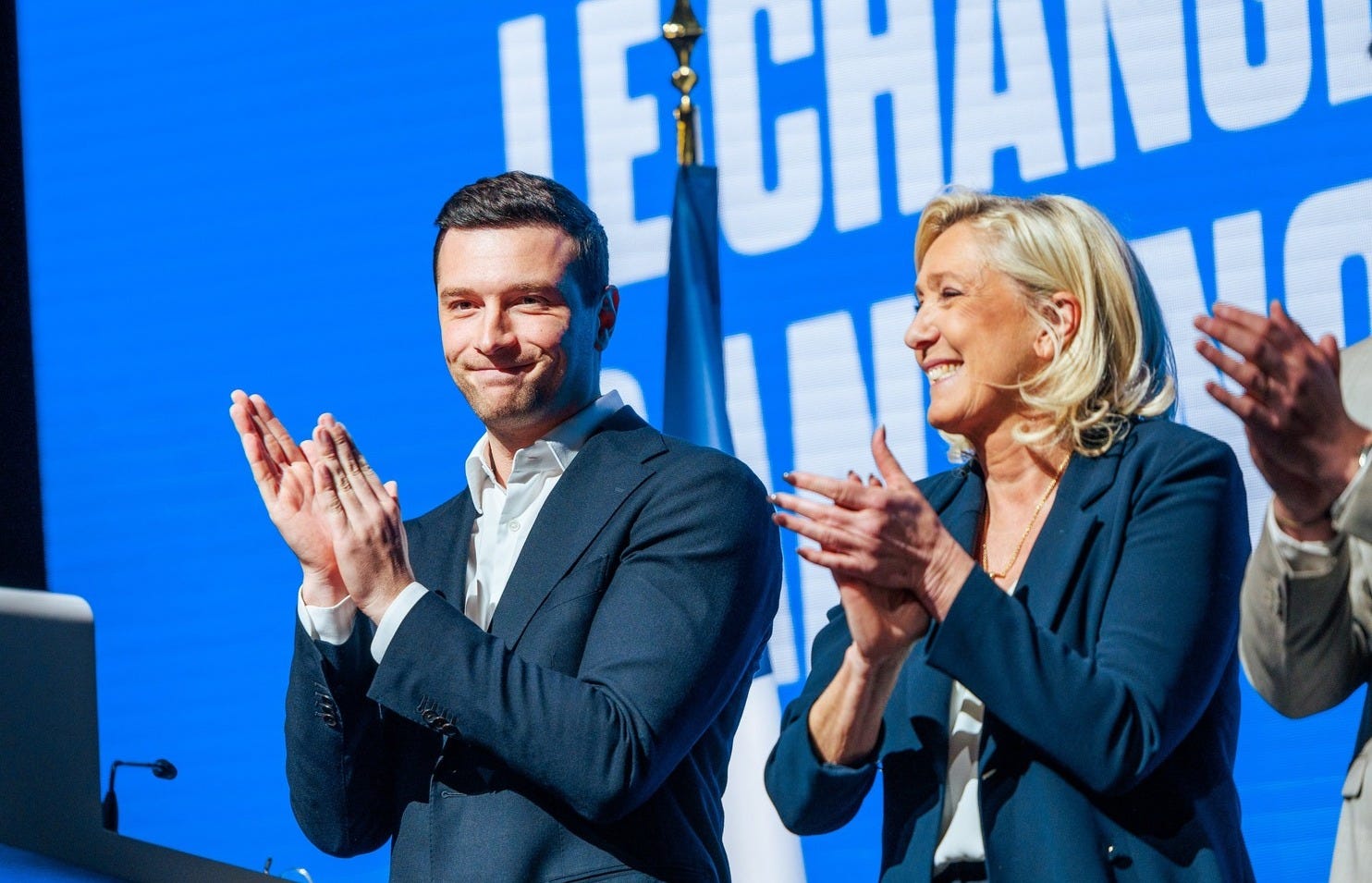
Retirement at the RN: a promise that bends without breaking
France’s pension reform, pushed through parliament by then-Prime Minister Élisabeth Borne in 2023 and raising the legal retirement age from 62 to 64, is currently suspended. In that political vacuum, the question of retirement age has become one of the defining fault lines of the 2027 presidential race — and nowhere more acutely than inside the Rassemblement National (RN), France’s main far-right party.
Marine Le Pen, RN’s longtime leader and three-time presidential candidate, currently serving as head of the party’s parliamentary group, has not shifted her position: she wants to restore the retirement age to 62, with 42 qualifying years of contributions. Jordan Bardella, the 29-year-old president of the RN and a member of the European Parliament, introduced a cloud of ambiguity that quickly turned into a political storm. Asked by a German newspaper whether the party would maintain that commitment, he replied that the RN was “examining the question” [translated from French] — a formulation vague enough to invite multiple readings, explicit enough to set off a chain reaction.
The Durvye factor: a name that crystallizes the tension
The response from Le Pen’s inner circle was swift. One senior RN lawmaker declared he would not follow the party if the legal retirement age were dropped from the platform, calling such a move a betrayal of voters and a concession to big business.
The name drawing the most fire is François Durvye, recently appointed as Bardella’s special adviser and known for his proximity to France’s business establishment. For the self-described guardians of the Mariniste line — Le Pen’s social-conservative tradition — his access to the party’s president is seen as disproportionate. Some also resent what they describe as his readiness to speak to the press, a practice that cuts against the culture of controlled opacity the party has long cultivated.
This configuration — a liberal-leaning adviser, an equivocating president, a founding figure holding firm — could suggest a quiet programmatic reorientation is underway, even if no official decision has been announced.
Silence as a governing style
The deeper concern extends well beyond the pensions debate. Several party insiders describe Bardella as governing through deliberate opacity, rarely revealing his substantive thinking even to close allies. A party lawmaker confided that one could spend an entire lunch with the RN’s president without ever getting a sense of where he actually stands.
Last month, the party held its first presidential strategy seminar, partly designed to bridge the gap between the two camps. The results appear limited: lieutenants in Le Pen’s team acknowledge they still have no direct working relationship with Bardella’s advisers.
This compartmentalization carries real operational risk. For a party positioning itself as a credible governing force ahead of 2027, the absence of coordination on core policy is not an internal management issue — it is a test of institutional seriousness. The dynamic has echoes of factional tensions seen in other populist parties in Europe and North America when an insurgent younger generation begins to pull the movement away from its founding identity — without yet having the authority to say so openly.
Analysis — A succession being written in the dark
The real subject here is not the retirement age. It is who actually leads the RN — and toward what.
Le Pen remains the party’s dominant founding figure. But her legal future directly shapes whether she can run in 2027. The Paris Court of Appeal is expected to deliver its ruling on July 7 in the case involving the alleged misuse of European Parliament staff funds. If the lower court’s conviction is upheld, Le Pen could face ineligibility — and Bardella would become the party’s default candidate. Every actor in this drama knows the scenario. And it creates a situation where both camps have a structural interest in maintaining a surface-level truce, even when the underlying disagreements are real.
The pensions dispute illustrates this tension precisely. Bardella cannot openly break with Le Pen’s line before July 7. But he cannot lock himself into it indefinitely if his ambition is to appeal beyond the party’s existing base.
The ambiguity, then, may not be a communication error — it could be a calculated holding pattern.
Notably, Bardella’s camp has not formally denied the 62-year commitment. The phrase “examining the question” leaves every option open — which, in the language of politics, is also a way of not breaking ranks before you have the means to do so.
The bottom line
The RN is heading into the 2027 presidential cycle with an unfinished platform, two parallel command structures that rarely consult each other, and a potential candidate whose actual convictions remain opaque — including to his own party. In a political environment where programmatic coherence is often the first thing skeptical voters look for, is that opacity a viable tactical posture — or the first visible symptom of a structural fragility that a presidential campaign would only magnify?
Sources: France Info