
France's defense buildup: €36 billion and counting
France just added €36 billion to its defense budget — a decade-long military buildup with major implications for European security and NATO allies.

At a Glance
France’s National Assembly approved a €36 billion supplement to its military spending law, originally passed in 2023 — doubling the defense budget over ten years.
The new funds target munitions (€8 billion alone), combat aircraft and tanks, as the government bets that sustained investment is the only credible deterrent in an unstable world.
France is simultaneously deploying its carrier strike group around the Charles de Gaulle aircraft carrier to the Arabian Peninsula, as part of a 42-nation mission aimed at brokering a ceasefire in the Middle East conflict.
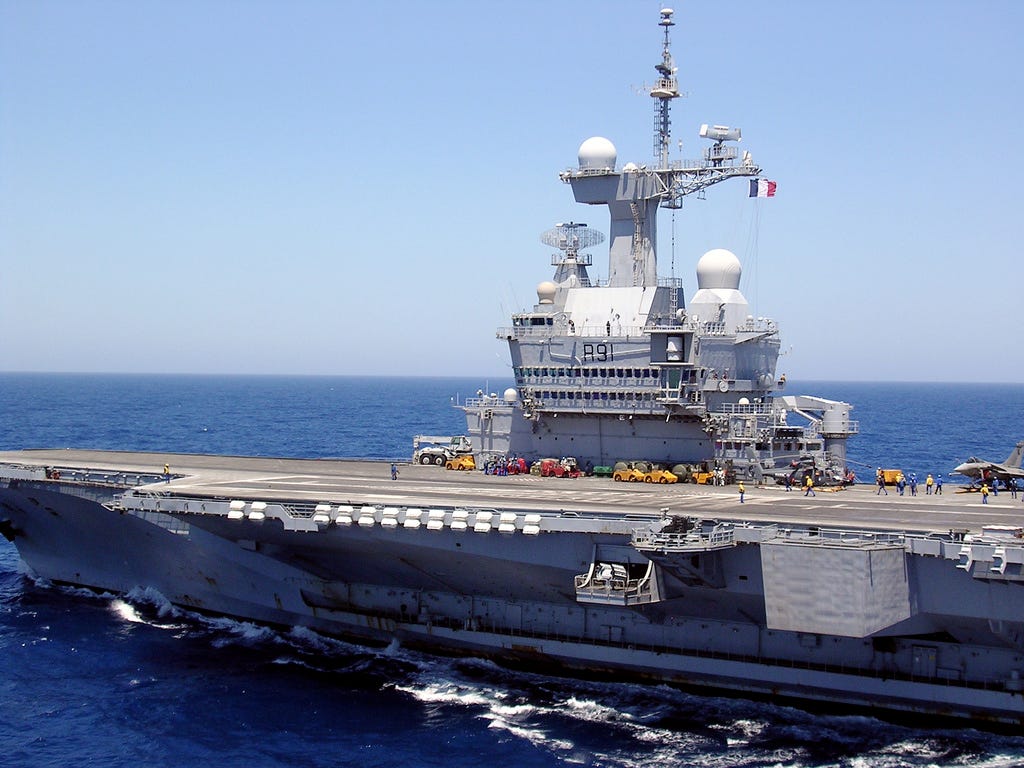
This image is used for illustrative purposes only.
France’s National Assembly voted Tuesday to update the country’s military programming law — a multi-year defense spending framework roughly equivalent to the United States’ National Defense Authorization Act — adding €36 billion (approximately $39.5 billion at current exchange rates) to the original 2023 plan. Catherine Vautrin, France’s Minister of Armed Forces and Veterans Affairs, was direct about the rationale.
Winning a war requires anticipating it.
The numbers tell a structural story. Over a decade, France will have doubled its defense budget. The latest tranche earmarks €8 billion for munitions alone, with additional investment in fighter jets and tanks. And Vautrin was explicit that the effort won’t stop in 2027 — the current law’s horizon. This isn’t a one-time injection; it’s a recalibration of how France sees its role in an era of great-power competition.
A bill the French taxpayer will carry
The strategic case is coherent. The fiscal arithmetic is harder.
France’s defense investment comes against a backdrop of persistent budgetary pressure. Paris has been navigating EU fiscal rules that cap member states’ annual deficits, while managing public debt that has grown steadily since the pandemic. Doubling military spending over a decade is, by definition, a prioritization choice — one that competes with healthcare, infrastructure and social programs for the same limited fiscal headroom. Neither the government nor its critics have yet fully mapped what this long-term commitment crowds out. That question will define the domestic political debate over the next budget cycle, and it is one European voters — not just French ones — will increasingly face as the continent rearranges its spending priorities around security.
Defense exports as diplomatic currency
Military spending isn’t only about what a country fields — it’s also about what it sells.
Sweden’s decision to purchase four FDI frigates (Frégate de Défense et d’Intervention) from French naval defense group Naval Group is more than a commercial win. It is a validation signal: a NATO member that could have turned to American or other allied suppliers chose French hardware. Whether this marks a broader shift in European defense procurement patterns — away from U.S. platforms and toward intra-European sourcing — remains to be seen, but the sequence is worth watching.
The Rafale — France’s domestically built multirole fighter jet — tells a more complicated story. Several European countries continue to prefer the American F-35, and Vautrin acknowledged the gap without minimizing it: France is working to improve the Rafale’s competitiveness, she said, without specifying how or by when. The commercial deficit against the F-35 likely reflects both technological factors and the deep logistical integration that comes with an American platform and its associated support network — advantages that joint European development programs might, over time, begin to offset.
The Charles de Gaulle deployment: deterrence or diplomacy?
Positioned near Djibouti at the entrance to the Gulf of Aden, France’s carrier strike group — the Charles de Gaulle, 20 Rafale Marine fighter jets, frigates and a support vessel — is operating within a 42-nation framework targeting the Middle East conflict. The mission’s stated objective is a ceasefire at minimum, lasting peace if possible. A second phase would focus on securing freedom of navigation through the Strait of Hormuz.
Vautrin was careful with the language: France is not a belligerent. The sequencing she described — diplomacy first, naval escort second — is consistent with a calibrated deterrence posture rather than direct engagement. Yet the presence of a full carrier strike group is, in itself, a statement. It signals that France retains the ability to project military power independently, outside the strict NATO command structure — a capability that carries weight in coalition diplomacy precisely because it doesn’t require Washington’s authorization.
This suggests the deployment serves a dual function: pressing for a negotiated outcome through credible force, while reasserting France’s standing as a military power with genuine reach beyond European waters.
The bottom line
France is spending more, selling more, and deploying farther. The strategic logic is clear. But the harder question goes unanswered: is Europe building a coherent, sustainable defense architecture — or stacking up national capabilities without ever resolving the command-and-control problem that every new crisis puts back on the table?
Sources: France Info · French National Assembly