
France's Bastille Day goes to war
For his final July 14 as president, Emmanuel Macron is turning the Champs-Élysées parade into a display of military strength and European solidarity with Ukraine.

Ukraine will march down the Champs-Élysées on July 14. Not symbolically — literally. Two Ukrainian pilots will take the controls of French Mirage 2000 fighter jets alongside their French counterparts in what will be the most ambitious Bastille Day parade in years. That gesture, carefully choreographed and deliberately provocative, communicates in seconds what hours of speeches cannot: France has tied its military identity to Ukraine’s survival.
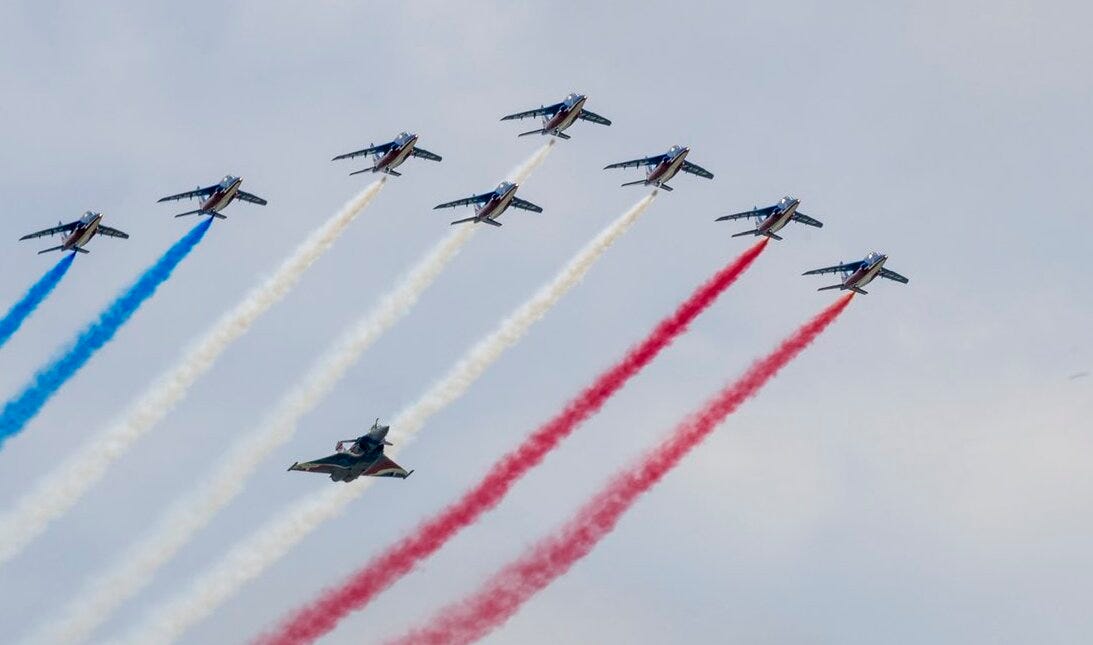
This image is used for illustrative purposes only.
At a Glance
A record-breaking parade: around 10,000 troops will take part — up significantly from the roughly 7,000 who marched last year, with a 30% increase in armored vehicles and aircraft.
Ukraine at the center: two Mirage 2000 jets will be flown in French-Ukrainian tandem; member nations of the Coalition of the Willing have been invited to march.
A deliberate political statement: for his final Bastille Day as head of state, President Macron is staging a ceremony that mirrors his long-standing push for European rearmament.
A parade unlike any other
July 14, 2026 is no ordinary national holiday. It is the last one over which Emmanuel Macron will preside as France’s president — and he intends to make it a statement of doctrine as much as celebration. His chosen theme — to be powerful, united, and free — encapsulates a position he has championed since a landmark 2017 address at the Sorbonne and radicalized since Russia’s full-scale invasion of Ukraine in February 2022: Europe must rearm, and France must lead by example.
The numbers speak to that ambition. Around 10,000 soldiers will march this year, up sharply from roughly 7,000 last year. Armored vehicle and aircraft contingents will each grow by 30%. This is not festive inflation — it is a message of capability directed at allies and potential adversaries alike.
Ukrainian pilots above the Champs-Élysées
The most striking symbol will unfold overhead. Two Mirage 2000s — the French air force’s iconic fighter jet — will be flown as mixed crews: one French pilot, one Ukrainian pilot. One aircraft will bear Ukrainian markings. Together, they will escort the Alpha Jets of the Patrouille de France, France’s aerobatic display team, whose tricolor smoke trails are recognized worldwide.
The choice is deliberate and unprecedented. France has been involved in training Ukrainian pilots on Mirage aircraft as part of its bilateral defense commitments — bringing those pilots above Paris would signal that cooperation has entered an operational phase.
The nations of the Coalition of the Willing — the group of countries that has committed to long-term military support for Kyiv — have also been invited to send contingents. Their presence would transform a national ceremony into a multilateral demonstration of resolve.
Ukraine as a military classroom — and France as instructor
The relationship runs both ways. France is absorbing hard lessons from Ukraine’s experience on the front lines — where drones have partially displaced heavy artillery in reconnaissance and strike missions, and where attack helicopters have become a near-constant presence above the contact line. But France is also bringing something to that exchange: deep expertise in armored warfare, artillery doctrine, and the kind of long-range precision fires that Ukrainian forces have integrated into their tactics.
The parade will reflect that mutual evolution. Combat helicopters — the kind seen in active support roles on modern battlefields — will fly overhead as troops march below. Drone technology will feature prominently. A portion of soldiers will march in combat gear rather than dress uniform, a reminder that these men and women are warfighters first, ceremonial participants second.
That aesthetic shift carries doctrinal weight. By displaying a fighting army rather than a ceremonial one, France tells its allies it is ready — and tells its adversaries it is serious.
The shadow of 2027
The domestic political context is never entirely absent. Macron, whose second and final term ends next year, is presenting this parade as the logical conclusion of a defense policy pursued since 2017: rising military budgets, full reintegration into NATO’s integrated command structure, and active engagement on Europe’s eastern flank.
France’s 2027 presidential election will open in a context of continental rearmament. Whoever succeeds Macron, the country’s military commitments — to Ukraine, to NATO, to European defense — now appear to enjoy a cross-party consensus that no single election is likely to reverse. In that sense, this parade does not close a debate. It consecrates one.
The Bottom Line
Bastille Day has long been a celebration. It is becoming a demonstration. In a Europe where peace is no longer a given, the question is no longer whether France should rearm — but whether it is doing so fast enough, well enough, and with enough allies at its side.
Two Ukrainian pilots above the Champs-Élysées do not answer that question. They ask it, loudly.
Sources: France Info · France 2