
France Libre: $13 Billion for Which War?
France's next nuclear carrier could cost €15 billion over its lifetime, depends on American tech its own president doubts — while the Senate debates who pays for what.

France’s next aircraft carrier is generating record budgets and thousands of jobs. But behind the shipyard ceremony, three realities the official speeches avoid: a cost that has doubled without a clear parliamentary vote, a technological dependency on the United States that the Élysée itself can no longer guarantee, and a strategic question left unanswered — is this ship being built for the threat of 2038, or the one of 2026?
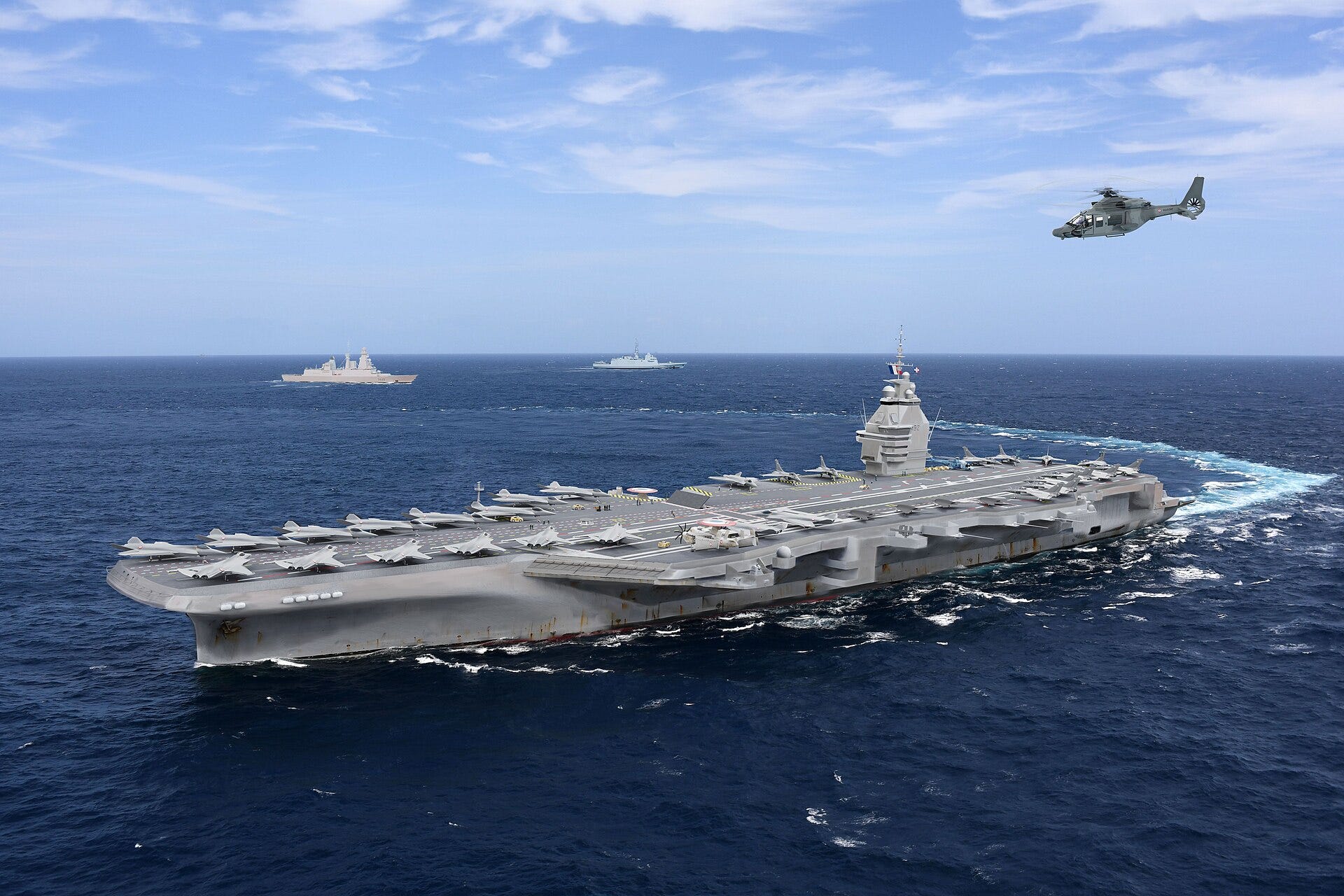
This image is used for illustrative purposes only.
At a Glance
The France Libre’s officially stated cost sits at around €10 billion — but parliamentary analysts and defense experts put the extended estimate, once infrastructure and lifecycle costs are included, at €12–15 billion. Either way, it has roughly doubled since the program’s initial framing in the 2023 LPM, without a dedicated parliamentary vote on that drift.
The ship’s electromagnetic launch system depends on a contract with American firm General Atomics — and the Élysée itself acknowledged in March 2026 that it can no longer guarantee this supplier will deliver by 2038.
The French Senate is debating a military spending overhaul this week that adds €36 billion to the defense budget through 2030, without resolving the central trade-off: can France simultaneously fund the France Libre and prepare its armed forces for a high-intensity conflict within the next three to four years?
What the budget documents actually reveal
On March 18, 2026, President Emmanuel Macron officially named France’s next nuclear-powered aircraft carrier the “France Libre” during a ceremony at Naval Group’s facility in Indret, in the Loire-Atlantique region, where the first components of the nuclear propulsion units are being forged. Macron put the price tag at “around €10 billion” — a figure consistent with the official cost estimate for hull design and construction. But that number excludes port infrastructure upgrades, the nuclear propulsion systems, and the aircraft that will fly from its deck. Parliamentary defense analysts and independent experts, factoring in those elements, put the extended estimate at €12–15 billion. Defense analyst Xavier Tytelman, adding forty years of operational maintenance, reaches approximately €15 billion over the full lifecycle.
The drift from the program’s original framing is real regardless of which figure one uses. When France’s Military Programming Law for 2024–2030 — known as the LPM, roughly equivalent to a U.S. defense authorization act — was passed in 2023, the program was framed at €5–7 billion for design and construction alone. The jump to today’s estimates reflects a combination of inflation, rising industrial complexity, and the addition of scope that was initially excluded. No dedicated parliamentary vote was held on that revised framing — a normal feature of multi-year defense programs in France, where annual budget bills validate spending tranches without requiring a new authorization for each cost revision.
France’s Court of Auditors — roughly equivalent to the U.S. Government Accountability Office — documented in a 2018 report that cutting a defense program’s initial budget by 15 to 20 percent tends to reduce deliveries by 30 to 40 percent. Reversed, the logic applies equally: a program whose costs double before the first steel is cut creates a budgetary draw that future defense cycles will have to absorb.
The precedent set by the Charles de Gaulle, the France Libre’s predecessor and currently the only nuclear-powered aircraft carrier outside the United States, is instructive. That program ran three and a half years behind schedule and came in 18 percent over its 1985 cost estimate. The France Libre is larger, more complex, and is already showing cost overruns — before construction has formally begun. The first steel is not expected to be cut until 2031 or 2032, at the Chantiers de l’Atlantique shipyard in Saint-Nazaire.
The American dependency written into the contracts
The France Libre will be equipped with two electromagnetic aircraft launch systems — EMALS — capable of launching fighter jets and drones with a precision of energy delivery that steam catapults cannot match. This technology exists at one address in the world: General Atomics, a San Diego-based American defense contractor.
The rest of the program is overwhelmingly French. Approximately 90 percent of the France Libre’s industrial content — propulsion, hull, electronics, weapons systems — will be sourced from French suppliers, making it one of the most domestically produced defense platforms in French history. The EMALS dependency is therefore narrow in scope and broad in consequence: a single foreign chokepoint in an otherwise sovereign program.
A contract was awarded to General Atomics for three EMALS systems destined for the France Libre. In February 2026, the Pentagon notified the company of a contract modification worth $43.3 million, via the Foreign Military Sales mechanism, to continue designing a version adapted to the French carrier. Contractual delivery: January 2028.
The commitment is formal. The reservation came from the Élysée itself: at the March 18 ceremony, the French presidency acknowledged that France “could no longer guarantee that its American supplier would be ready by 2038.” That is a remarkable admission — the principal customer publicly doubting its own contractor on launch day.
The Pentagon’s Director of Operational Test and Evaluation has set a reliability target of 4,166 consecutive launch cycles without failure for EMALS. During tests on the USS Gerald R. Ford between 2021 and 2022, the system achieved 460 cycles, then 614 — roughly 15 percent of the contractual requirement. The Ford’s first operational deployment, completed in January 2024, produced 8,725 launch cycles, but the Pentagon’s testing office reported it still lacked sufficient data to update its reliability statistics, and that problems of “reliability and maintainability” continued to “adversely affect” flight operations.
A carrier designed for an aircraft that may not exist on time, equipped with catapults from a country whose contractual reliability is publicly in doubt: this is the industrial reality of the France Libre in June 2026.
It is against this background that two members of the French National Assembly’s Defense Committee, Yannick Chenevard (of President Macron’s Renaissance party) and Jean-Louis Thiériot (of the center-right Republicans), filed Amendment DN480 on April 17, 2026: a single sentence requiring a feasibility study on developing a sovereign electromagnetic catapult system. The amendment does not cancel the General Atomics contract. It opens an emergency exit before the dependency becomes irreversible.
France’s institutional memory on this point is sharp. In 2021, Paris lost a major submarine contract with Australia without warning when Canberra joined the AUKUS pact — a trilateral security agreement with the United States and the United Kingdom. That episode remains a live reference in French defense circles. The France Libre is scheduled for commissioning in 2038. Between now and then, a minimum of two American presidential terms will have elapsed.
What the Senate debate reveals this week
The French Senate began examining an update to the 2024–2030 Military Programming Law on Tuesday, June 3. The bill, presented to France’s cabinet on April 8, raises total defense spending to €436 billion through the end of the decade — €36 billion more than the original LPM — with a target of bringing the defense budget to 2.5 percent of GDP by 2030, up from €47.2 billion in 2024.
The Senate’s center-right majority immediately signaled the figure was insufficient, demanding €14 billion more than the government’s proposal. A government amendment to hold its own line was defeated 201 votes to 140.
The underlying tension is legible in the debate’s margins. General Fabien Mandon, France’s Chief of Defense Staff, has warned of the risk of a military “shock in three or four years” should conflict with Russia materialize. The 2026 defense budget filing itself cites as its top priority making the armed forces capable of “holding in high-intensity warfare.” The unasked question in the Senate chamber is the obvious one: how do you simultaneously fund a carrier whose commissioning is twelve years away and prepare ground forces, drone stockpiles, air defense systems, and munitions reserves for a conflict that could arrive in under five?
François Cornut-Gentille — a former member of the National Assembly who served nearly 30 years as a defense budget rapporteur, and most recently as defense adviser to Prime Minister Michel Barnier — is one of the few voices on the French right to articulate the tension directly: with a constrained budget, the utility of the France Libre deserves scrutiny. This is not a pacifist objection. It is the question of a defense specialist who knows the numbers.
Why this debate extends well beyond France
France is the only country outside the United States to operate a nuclear-powered aircraft carrier. The Charles de Gaulle is operational roughly 65 percent of the time; the rest is maintenance. The France Libre will not be commissioned until 2038. In the interim, France’s carrier-based strike capability remains structurally constrained.
The paradox — the sole non-American nuclear carrier power depending on an American supplier for its launch systems — carries specific weight in 2026. The Trump administration has signaled a preference for returning to steam catapults on U.S. carriers — a political statement that defense experts note would require a complete redesign of the Gerald R. Ford-class blueprints to implement, making it more signal than imminent policy shift. But signals have consequences: the political uncertainty around EMALS’s future at General Atomics is real, and Paris has registered it.
For an American reader, the analogy is direct: imagine the USS Gerald R. Ford — built at a cost of over $13 billion — depending on a foreign supplier for its launch system, at a moment when that supplier’s government was questioning the technology’s future. That is precisely the situation France finds itself in.
The program’s dependencies extend further. The France Libre is designed to eventually embark the SCAF — Système de Combat Aérien du Futur, or Future Combat Air System — a joint fighter development program shared by France, Germany, and Spain, whose schedule and funding remain contested between the partner nations.
Analysis
① The real budgetary question
The France Libre is not financially incompatible with immediate rearmament — provided defense budgets increase fast enough and hold consistently over a decade, without economic disruption, without a change in parliamentary majority, without a shift in strategic priorities. France’s history with military programming laws suggests that kind of stability is rarely guaranteed. The 2019–2025 LPM also projected a steady funding ramp — and its final years had to be defended against general budget pressures year by year.
② The mechanics of irreversibility
The France Libre program is now engaged. Contracts are signed, nuclear reactor components are being machined in Cherbourg, and the Chantiers de l’Atlantique are mobilized. At this stage, the cost of cancellation — contractual penalties, loss of propulsion expertise, rupture of the naval nuclear industrial chain — would likely exceed the cost of continuation. This is the classic mechanism of large defense programs: once a certain threshold of commitment is crossed, the decision to continue is no longer really a decision. It becomes a constraint.
③ The question Cornut-Gentille is raising
When a former defense budget rapporteur with nearly three decades of parliamentary experience publicly questions the utility of the France Libre, this is not a marginal signal. It marks the point where the debate shifts from ideology to concrete trade-offs. The question is no longer “should France have an aircraft carrier?” — it is “at what cost, and at the expense of what?” That question has not yet been formally answered by either the government or Parliament.
The Bottom Line
France is building the most ambitious warship in its history under a technological dependency it acknowledges it cannot guarantee, with a budget that doubled before the first steel was cut, at the moment its own military chiefs are warning of an inability to sustain high-intensity conflict within five years.
The France Libre may well stand as a symbol of a sovereign and powerful France in 2038. It may also prove to be the record of a country that chose long-range power projection on a generational timeline, when the threat is measured in years. Between those two readings, the Senate votes this week on an overall defense spending framework — and the specific question of what the France Libre costs the rest of the armed forces remains, for now, off the official agenda.
Sources: French Ministry of Armed Forces — 2026 Finance Bill · National Assembly — Amendment DN480 · National Assembly — Information Report n°1564 (Gassilloud-Girard, June 2025) · L’Essentiel de l’Éco · AFP · Globalsecurity.org · U.S. DOT&E via specialized press · opex360.com