
France and Germany: Europe's engine is stalling
The Paris-Berlin relationship is at its most fractured in decades — on defense, trade, and debt, structural disagreements are piling up with no resolution in sight.

At a Glance
The SCAF, a joint next-generation combat aircraft program worth €100 billion (approximately $108 billion), is at risk of collapse due to an industrial standoff between France’s Dassault Aviation and Germany’s Airbus — a failure that would mark the gravest setback in Franco-German defense cooperation in a generation.
On the EU-Mercosur free trade agreement, Paris and Berlin voted in opposite directions, putting their commercial and agricultural rift on full public display.
On financing military aid to Ukraine, Germany backed down under French pressure over the use of frozen Russian assets — a confrontation that left lasting damage to the bilateral relationship.
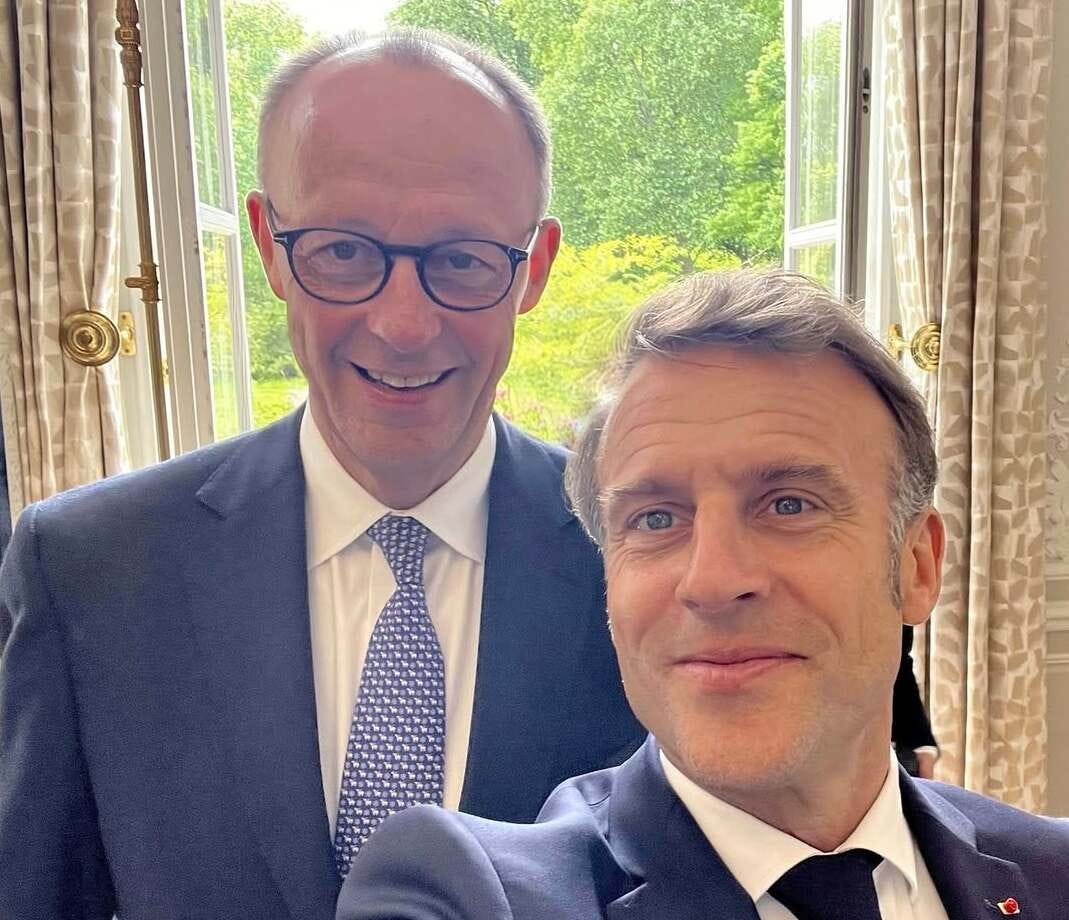
The image of François Mitterrand and Helmut Kohl holding hands at Verdun in 1984 belongs to another era of European politics. Forty years on, Chancellor Friedrich Merz and President Emmanuel Macron embody a fundamentally different Franco-German relationship — two partners who continue to cooperate institutionally while openly clashing on the issues that will define Europe’s future.
This is not a temporary falling-out. It is a structural divergence across at least four critical areas: trade policy, defense, Ukraine financing, and fiscal discipline.
The Mercosur deal, a litmus test for a fractured Europe
The free trade agreement between the European Union and Mercosur — the South American trade bloc comprising Brazil, Argentina, Uruguay, and Paraguay — has crystallized Franco-German tensions with unusual clarity. France opposes the deal, citing the need to protect its agricultural sector and food safety standards. Germany supports it, driven by its export-dependent industrial base — automotive and chemical industries chief among them — which needs open markets to offset slowing demand from China.
Macron drew a hard line, rejecting any agreement he deemed lenient on imports while demanding strict standards of domestic producers. Merz publicly regretted that the two countries had failed to vote together. The disagreement was not merely registered — it was performed, which in European diplomatic terms carries a political signal of its own.
The SCAF: a €100 billion program on life support
The Future Combat Air System — known by its French acronym SCAF — was announced with considerable fanfare in 2017 as the flagship of Franco-German strategic convergence. It may yet become its most visible casualty. The deadlock centers on an incompatibility between the two lead industrial partners: Dassault Aviation for France, Airbus for Germany. What is at stake is not merely technical — it concerns the division of sovereign technologies, intellectual property rights, and ultimately export market positioning.
Éric Trappier, Dassault Aviation’s CEO, stated the diagnosis without diplomatic cushioning: if Airbus maintains its refusal to work with Dassault under the current terms, the project is dead. Berlin, for its part, continues to insist nothing has been buried yet. Thomas Röwekamp, a CDU member of the German Bundestag and chair of the parliamentary defense committee, argues that the investment already made — in competencies as much as in capital — makes abandonment too costly to contemplate, an argument the available facts do not allow us to conclusively assess either way. The gap between that official position and the reality of the industrial standoff could suggest that both governments are managing an impasse they have yet to find a way to resolve.
Ukraine: a battle won by France, at what cost?
When the European Union mobilized €90 billion (approximately $97 billion) in support for Ukraine, Paris and Berlin clashed over how to fund it. Germany sought to leverage frozen Russian sovereign assets to finance military assistance. France refused. Germany relented.
A French win on substance — but an enduring friction on process. Paul Maurice, a Germany specialist and researcher at the French Institute of International Relations (IFRI), France’s leading independent foreign policy think tank, has noted that the episode “seriously damaged the relationship between France and Germany.” This type of confrontation — won by one side, absorbed by the other, without genuine compromise — accumulates as implicit debt in the bilateral relationship.
France’s debt problem: the variable Berlin can’t ignore
There is a fifth factor, less visible in official communiqués but more structurally significant in Brussels backrooms: France’s public finances. Germany has enshrined fiscal restraint into its constitutional order through the so-called Schuldenbremse — a debt brake that makes sustained deficit spending legally difficult, functioning somewhat like a constitutional balanced-budget amendment at the federal level. Facing a France whose deficit has durably exceeded EU thresholds, Berlin may be developing growing skepticism about its partner’s reliability as an anchor of stability within the eurozone.
Former French Foreign Minister Hubert Védrine has framed this without diplomatic hedging: France is now perceived by the European system — Germany first among them — as “a country at risk.” If that characterization were to solidify among Nordic and Baltic capitals, it would mechanically reduce French influence in any future negotiations over EU economic governance.
Analysis — Why this is not a passing crisis
The symmetry of domestic weakness
The Franco-German crisis is, in part, a crisis of domestic politics in both countries. Macron is in the final stretch of his presidency, without an absolute majority in the National Assembly and without a clearly identified successor on his political line. Merz leads a broad coalition government that can be assessed as fragile, navigating pressure from the far-right Alternative for Germany (AfD) on one side. Both leaders have a structural incentive to project strong national postures rather than negotiate bilateral concessions — a dynamic that could extend this impasse well beyond the immediate technical disagreements.
A model of European governance under strain
Since the Maastricht Treaty of 1992, the Franco-German axis has functioned as the EU’s informal engine: France providing political vision, Germany providing economic discipline. The model depends on both countries reaching common positions before European Council meetings. When they vote in opposite directions — as on Mercosur — it is the entire informal architecture of EU governance that wavers.
What it means beyond Europe
For Central and Eastern European member states, a weakened Franco-German engine opens unusual political space — and an opportunity to set agendas the two traditional heavyweights would previously have controlled. For the Trump administration in Washington, this division could facilitate trade negotiations and weaken the coherence of the European position on Ukraine, though the precise operational consequences cannot be established with certainty at this stage. The same applies to Beijing, for which a divided EU is structurally preferable to a coordinated one.
The bottom line
The Franco-German partnership will not dissolve — the institutional architecture of the EU makes that effectively impossible. But a partnership can operate on autopilot, sustained by bureaucratic habit rather than shared vision, with no capacity to resolve Europe’s deepest contradictions.
The real question is not whether Paris and Berlin will reconcile. It is whether Europe can move forward without them doing so first.
Sources: France Info · JT France 2 · French Institute of International Relations (IFRI)