
Eurovision: three points, one resignation, one identity crisis

A Moldovan jury’s decision to award just three points to Romania at the Eurovision 2026 final has forced the resignation of the head of Moldova’s public broadcaster and opened a diplomatic and cultural rift between two countries bound by a shared history.
At a Glance:
Moldova’s professional jury awarded only 3 out of a possible 12 points to Romania’s entry Choke Me, triggering a national backlash and the resignation of the head of Teleradio Moldova, the country’s public broadcaster.
Moldova and Romania share a language, a common history, and nearly 850,000 dual nationals — making the vote feel, to many, like a symbolic betrayal.
The episode exposes a deeper tension between the editorial independence of expert juries and political expectations in a small, EU-aspiring nation under sustained Russian pressure.
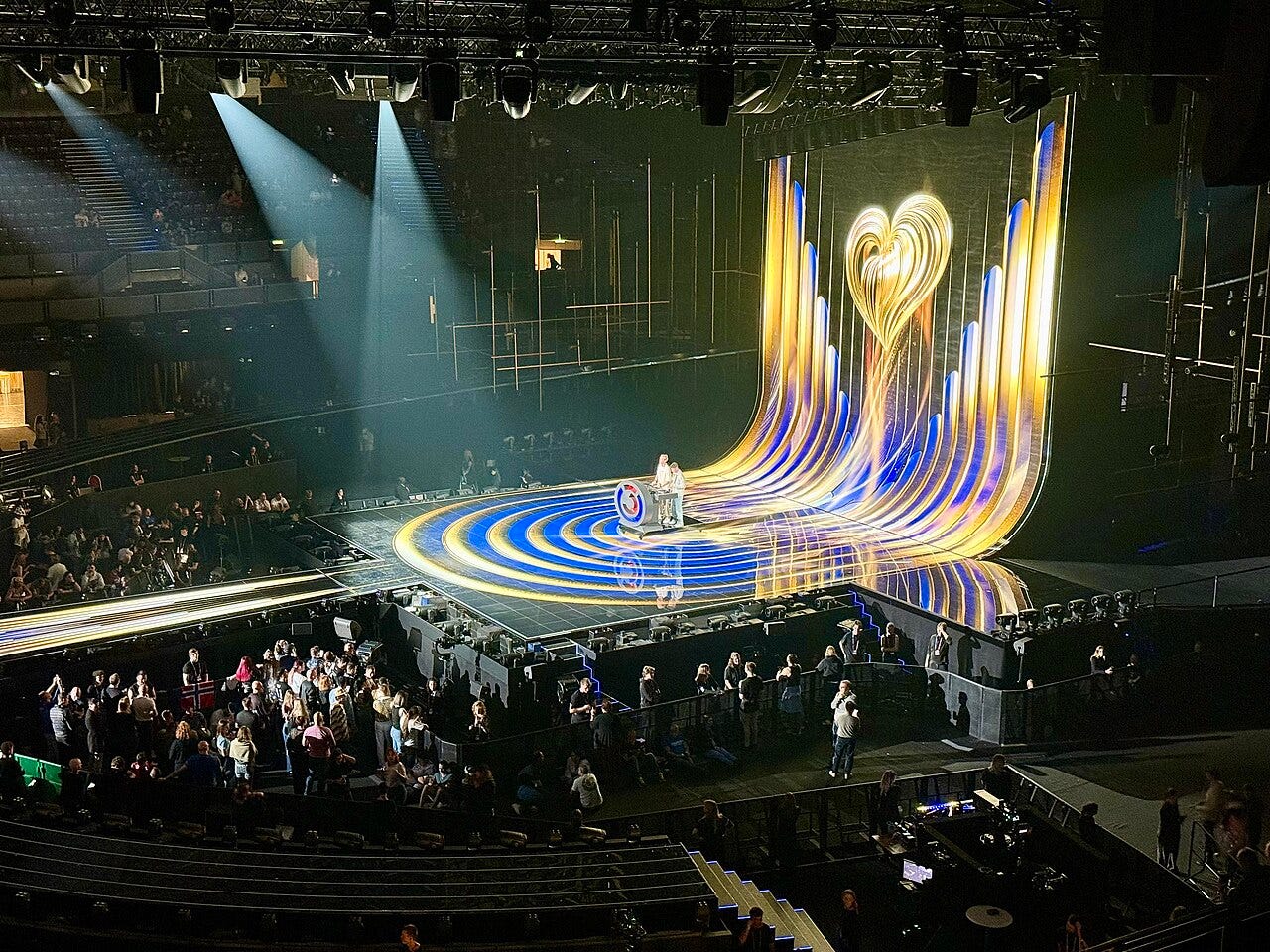
This image is used for illustrative purposes only.
Three points that cost a career
Romania’s entry Choke Me, performed by Alexandra Căpitănescu, finished third at the Eurovision 2026 final, held in Vienna on May 16. A solid result — but not solid enough to prevent a political storm back in neighboring Moldova.
Moldova’s professional jury had awarded the Romanian entry just three points. The Moldovan public, by contrast, sent the maximum twelve points to Bucharest — the traditional expression of solidarity between two nations that share blood, language and history. The gap between the two signals was too wide to go unnoticed.
On May 18, Vlad Țurcanu, president of Teleradio Moldova (TRM), Moldova’s national public broadcaster, submitted his resignation, describing the incident as “serious.” His statement captures the dilemma: his institution had distanced itself from the jury’s vote, he said — but the outcome remained his responsibility as the head of that institution.
A fraternal bond, suddenly exposed
To understand the intensity of the reaction, one needs to appreciate how deep the Moldovan-Romanian relationship runs. Romanian is the official language of both states, which were united as a single country in the early twentieth century. Around 850,000 Moldovans — out of a total population of approximately 2.4 million, excluding the breakaway region of Transnistria — hold dual nationality. Romania’s public audience had awarded Moldova twelve points; Romania’s jury had given ten. The gesture of reciprocity was expected. It did not come from the Moldovan jury.
The controversy escalated quickly online, fueled in part by the jury’s failure to award any points to Ukraine — Moldova’s natural ally in resisting Russian pressure. Moldova’s Minister of Culture demanded an explanation from TRM. The broadcaster responded with a formal statement stressing that it does not influence jury decisions “in any way”, while simultaneously publishing the jurors’ names and professional roles.
The jury’s independence: argument and casualty
Victoria Cusnir, one of the jury members at the center of the storm, pushed back hard against the political reading of her vote. On social media, she condemned what she called a “public lynching” and denied that her decision reflected any “anti-Romanian sentiment.” Her argument: if voting for neighboring countries is to be treated as an obligation, that criterion should be stated upfront — not enforced after the fact.
Romania’s own contestant offered a conciliatory note. Alexandra Căpitănescu said on Instagram that she was not disappointed by the Moldovan jury’s score, and that the jury had evaluated the songs as it saw fit. An act of grace from Bucharest that Chisinau was unable to replicate internally.
When Eurovision becomes a matter of state
What distinguishes this episode from the usual post-Eurovision grievances is the speed at which it climbed the institutional ladder. Maia Sandu, Moldova’s president — who has staked her political career on the country’s westward trajectory — felt compelled to weigh in publicly. “We must not allow anything or anyone to damage relations between our two countries,” she said [translated from French], implicitly siding against her own public broadcaster’s jury.
The context explains the hypersensitivity. Moldova, considered among the most economically fragile countries on the continent, has been on a formal path toward European Union membership since 2022-2023, according to institutional timelines. Bucharest serves as its most natural ally inside the EU’s corridors. And in an environment where every political signal is parsed against a backdrop of Russian pressure that European institutions have documented, even a Eurovision scorecard carries weight.
Sandu had made the stakes explicit as recently as January, when she publicly expressed personal support for potential reunification with Romania.
Analysis — what this vote actually reveals
The Moldovan affair might look like a curiosity. It isn’t — for three reasons.
First, it exposes a structural flaw in Eurovision’s dual-vote system — professional jury versus public audience — when applied to relationships loaded with historical and political meaning. The jury is designed to assess artistic merit; the public votes with its loyalties and emotions. When those two signals diverge as sharply as they did here, in a politically charged context, the institution itself becomes the problem. Think of it as the Eurovision equivalent of an FCC-regulated network being caught between editorial independence and national sentiment — except with a resignation attached.
Second, the sequence of events — a controversial vote, ministerial pressure, a defensive broadcaster statement, a presidential intervention, and a CEO resignation — could signal a troubling precedent for editorial independence in small states navigating EU accession. If a television jury can be called to account at the presidential level for an artistic choice, the question of institutional autonomy in candidate countries deserves scrutiny from Brussels.
Third, Moldova operates in a symbolic space where every gesture carries outsized weight. The three points awarded to Romania, whatever their legitimate artistic rationale, could plausibly be read — rightly or wrongly — as a wobble in the pro-European narrative that Sandu has carefully constructed since taking office in 2021.
If a television jury can be made to answer at the presidential level for an artistic call, what does that say about the independence of public institutions in countries still earning their place in Europe?
The bottom line
Vlad Țurcanu paid with his job for a decision he did not make — one that, by the rules of the contest, was entirely within the jury’s editorial remit. The real question this episode raises is not about Eurovision at all: it is whether a democracy still under construction can afford to hold its public broadcaster politically accountable for cultural choices — and whether the European Union, whose membership Moldova is working to earn, will take note.
Sources: Franceinfo · AFP