
Europe's nuclear reversal: France and the UK rearm — and stop counting
For the first time since 1992, both of Europe's independent nuclear powers are expanding their arsenals — on opposite strategic paths, with dwindling public transparency on warhead numbers.

At a Glance
France has officially announced the first quantitative increase in its nuclear arsenal since 1992, breaking with 34 years of “strict sufficiency” policy — and has stopped disclosing its precise warhead count.
The United Kingdom, which raised its warhead ceiling to 260 in 2021, is now considering reintroducing air-delivered nuclear weapons for the first time since 1998 and is deepening its integration into NATO’s nuclear deterrence mission — using Trident missiles that depend structurally on U.S. maintenance.
Both pivots, announced within months of each other, are officially justified by American strategic retrenchment — creating a fundamental paradox: an assertion of autonomy whose internal logic still depends on decisions made in Washington.
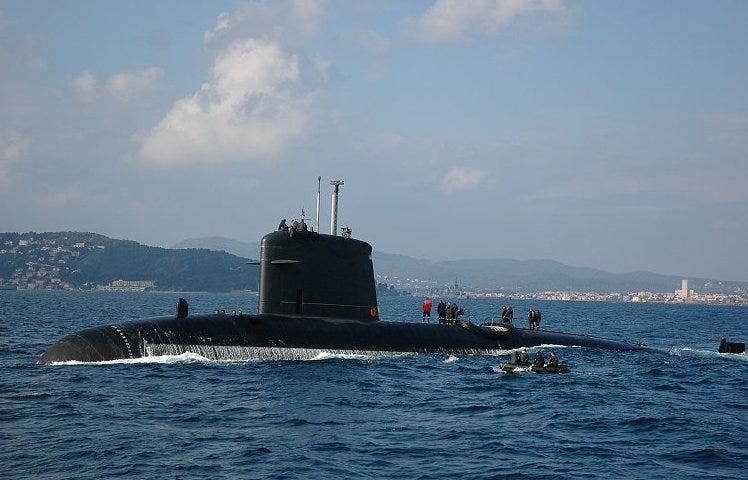
This image is used for illustrative purposes only.
On March 2, 2026, French President Emmanuel Macron delivered a speech at the Île-Longue submarine base in Brest harbor, home to France’s four ballistic missile submarines — the backbone of its nuclear deterrent. He announced, among other things, that France would no longer publish the size of its nuclear arsenal. More significantly, he announced, for the first time since 1992, a quantitative increase in French warheads.
Three months later, on June 8, 2026, the Stockholm International Peace Research Institute (SIPRI) — an independent global security research body — released its annual Yearbook. The finding was unambiguous: all nine nuclear-armed states “continued to modernize and enhance their nuclear arsenals” in 2025, and the post-Cold War trend toward overall reductions in global warhead numbers is on track to reverse.
The headline figure — 12,187 warheads worldwide — dominated news coverage, framed as one more chapter in the chronicle of geopolitical tensions. What that coverage largely missed: for the first time since the end of the Cold War, Europe’s two independent nuclear powers have simultaneously broken, within months of each other, with three decades of progressive disarmament. Not merely by modernizing existing capabilities. By increasing their stockpiles. And by choosing, in parallel, to stop telling their citizens how many warheads they actually hold.
The end of a cycle: what the documents confirm
Two facts are now formally established and uncontested.
On the French side, Macron’s March 2 speech at Île-Longue represents an explicit doctrinal break on two fronts. The president reaffirmed that France calibrates its arsenal strictly to operational deterrence requirements — a formulation that ends the “fewer than 300 warheads” threshold he himself had reaffirmed as recently as 2020. Combined with the announcement of a quantitative increase, it marks the clearest break yet with France’s post-Cold War disarmament trajectory. France also ceased publishing precise stockpile figures — a transparency practice maintained, with variations, since the 1990s. According to SIPRI’s 2026 Yearbook, France’s operational stockpile was estimated at approximately 290 warheads in January 2026, before the March announcements.
On the British side, the trajectory is older but equally significant. The Strategic Defence Review (SDR), published June 2, 2025, commits £15 billion to the sovereign replacement warhead program within the current Parliament (through 2029). It recommends the United Kingdom join NATO’s nuclear deterrence mission — which would involve acquiring 12 dual-capable F-35A fighter jets capable of delivering U.S. nuclear weapons. The UK has not maintained air-delivered nuclear weapons since their withdrawal in 1998. Its operational stockpile ceiling currently stands at 260 warheads — up from 180 under the 2021 Integrated Review, an increase of more than 40%.
For its part, SIPRI notes that the UK’s operational stockpile “is expected to increase in the future,” and that France’s modernization programs “seem likely to increase the size and diversity” of its arsenal going forward.
Two strategies, one structural contradiction
Paris and London both frame their rearmament around the same diagnosis: American strategic disengagement is creating a security vacuum in Europe that European powers must fill on their own terms. From that shared premise, however, the two countries have taken radically divergent paths.
France has chosen the route of declared autonomy and doctrinal expansion. The concept of dissuasion avancée — “forward deterrence” — announced by Macron at Île-Longue would allow European partner nations to participate in French deterrence exercises and, in a crisis, to host deployments of French strategic air assets on their territory. Eight countries immediately agreed to the framework at the time of the March speech: Germany, Poland, the Netherlands, Belgium, Greece, Sweden, Denmark, and the United Kingdom. Norway became the ninth partner on May 27, 2026, with five additional nations reported to be in discussion. Paris retains sole decision-making authority over any use of nuclear weapons — a prerogative that, under the French constitution, belongs exclusively to the president. France does not participate in NATO’s Nuclear Planning Group (the alliance’s consultative body on nuclear weapons policy).
The United Kingdom has taken the opposite route: deeper integration into NATO’s nuclear architecture under U.S. command. The SDR 2025 formally adopts a “NATO First” posture and recommends strengthening the nuclear partnership with Washington — at the very moment that partnership is widely described as uncertain. This choice rests on a structural dependency that is rarely stated plainly. The Trident II D5 ballistic missiles the UK relies on are not British-owned. They belong to a shared U.S.-UK pool, and their servicing runs through U.S. naval facilities. The warheads are sovereign; the delivery vehicles are not.
The contradiction is therefore this. France is building a European deterrence architecture that rests on the exclusive sovereignty of the French president’s finger on the button. Yet the effectiveness of this “forward deterrence” framework requires a level of coordination with nine partners that, some analysts argue, would be difficult to fully separate from an implicit sharing of strategic decision-making. The UK, meanwhile, claims to be reinforcing its strategic autonomy while deliberately deepening a dependence on American delivery systems that its own Strategic Defence Review describes as an “indispensable partnership.”
What the numbers no longer say
The end of nuclear stockpile transparency may be the least-covered development of this period — and one of the most consequential for the international non-proliferation architecture.
The UK announced in its 2021 Integrated Review that it would no longer publish data on its operational stockpile, deployed missiles, or deployed warheads — a decision that drew immediate criticism from disarmament advocates at the time. France followed suit in March 2026. Both countries are signatories and depositary states of the Nuclear Non-Proliferation Treaty (NPT) — the cornerstone of the international non-proliferation regime, signed in 1968, which commits nuclear-armed states to pursuing disarmament in good faith under Article VI.
For the first time since the Cold War, both European nuclear powers are expanding their arsenals while dismantling the very transparency that made their disarmament commitments credible.
The International Campaign to Abolish Nuclear Weapons (ICAN), recipient of the 2017 Nobel Peace Prize, and similar organizations argue that quantitative increases combined with reduced transparency constitute a violation of the spirit — if not the letter — of that commitment. Both the French and British governments dispute this reading. Their position is that their policies remain fully consistent with NPT obligations and continue to reflect a principle of strict sufficiency.
This debate is likely to resurface at the next NPT Review Conference, where the posture of both European nuclear powers will face renewed scrutiny — particularly given that France and the UK had, until recently, been among the few nuclear states maintaining a credible narrative of progressive disarmament.
The American backdrop: a realignment Washington did not order
The central paradox of the 2025-2026 sequence deserves to be named directly.
Both Paris and London justify their rearmament by pointing to uncertainty over U.S. security guarantees — the Trump administration’s threats of NATO disengagement, its territorial rhetoric over Greenland, the erosion of bilateral commitments. That diagnosis is shared by most European capitals.
But the rearmament logic it produces has generated an outcome Washington did not decide and does not fully control: the first reconstruction, since the Cold War, of an autonomous European nuclear architecture — with France as its pivot. The Center for Strategic and International Studies (CSIS), a Washington-based think tank, described the Île-Longue speech as “a watershed moment in continental security” and characterized Macron’s move as breaking with a 34-year trajectory of unilateral disarmament. That break was not the product of formal transatlantic consultation.
For an American reader, the closest analogy might be this: imagine Canada and Mexico simultaneously deciding to expand their own nuclear arsenals and reduce their participation in joint nuclear planning mechanisms with Washington — citing precisely the unreliability of U.S. security guarantees. That, adjusted for the very different scale and context, is roughly the dynamic now unfolding on the European continent.
Analysis
The long arc: 1992–2026, from reduction to expansion
France counted roughly 540 warheads at its Cold War peak in the early 1990s. Under François Mitterrand and then Jacques Chirac, the stockpile was cut nearly in half, the land-based component was entirely dismantled, and nuclear testing was permanently halted in 1996. The Sarkozy era formalized the “fewer than 300 warheads” threshold. This decades-long reduction trajectory is now reversed. In 2025 alone, France spent approximately €7 billion on its nuclear deterrent — roughly 13% of its entire defense budget — according to a question filed before the Assemblée Nationale.
The UK followed a similar curve: from several hundred warheads at the height of the Cold War, it reduced its ceiling to 180 in 2010 before raising it to 260 in 2021. That increase foreshadowed what the SDR 2025 confirmed: the UK has formally adopted a rearmament posture.
This historical context is largely absent from standard media coverage, which frames the 2025-2026 announcements as direct responses to Russian military aggression alone. In reality, the post-Cold War disarmament cycle had already been fracturing since 2021 — and recent events have accelerated a structural trend already underway.
The decision sequence: a coordination that may be more than coincidental
The timeline of decisions is worth examining. A Franco-British declaration signed at Northwood in 2025 preceded both the SDR and the Île-Longue speech. Between 2024 and 2026, the two countries held bilateral consultations on nuclear deterrence at an unusually discreet level. The sequencing of their announcements could suggest a degree of coordination — though no source formally establishes a joint decision-making process, and that inference should be treated as analytical rather than established fact.
The real question
Can a “European” nuclear deterrence architecture be built without a European decision-making mechanism? France offers nine partners inclusion in its exercises while retaining sole control of the trigger. The UK integrates into NATO’s nuclear mission using missiles it does not own outright. Are these two partial architectures complementary — or ultimately competing? And in either case, French and British taxpayers are financing a significant expansion of capabilities whose total volume, deployment criteria, and relationship to alliance structures are not publicly documented.
The Bottom Line
Europe’s 2025-2026 nuclear rearmament is presented by Paris and London as a response to American uncertainty. But if that uncertainty were to dissipate tomorrow — if Washington were to unambiguously reaffirm its security guarantees — the additional warheads, the dual-capable F-35As, the billions committed to sovereign warhead programs would remain. Nuclear arsenals are built over decades and measured in generations.
The question neither Paris nor London is asking publicly may be the most important one: is this rearmament a signal directed at Moscow, intended to deter aggression — or a signal directed at Washington, intended to demonstrate that Europe can exist without it? If it is the latter, the logic of nuclear deterrence has changed its target. And the post-Cold War nuclear order — built on American strategic primacy and the progressive drawdown of secondary arsenals — may already be over.
Sources: SIPRI Yearbook 2026 · Speech by President Macron at Île-Longue, March 2, 2026 (diplomatie.gouv.fr) · UK Strategic Defence Review 2025 (gov.uk) · House of Commons Library, Nuclear weapons profile: France, CBP-9074 (March 2026) · House of Commons Library, Nuclear weapons profile: United Kingdom, CBP-9077 · IFRI, Héloïse Fayet, “La dissuasion nucléaire française à l’épreuve d’un nouvel ordre européen,” April 2, 2026 · CSIS, “Macron’s Île-Longue Speech,” May 2026 · Assemblée Nationale, Question écrite n° 13730