
Europe's grip on the cruise industry
France, Italy, and Germany still build every giant cruise ship on the planet. But for how long, as China sets its sights on the one maritime market it has yet to crack?

At a Glance
The Chantiers de l’Atlantique shipyard in Saint-Nazaire, France — Europe’s largest and the world’s third-biggest cruise ship builder — secured €7 billion ($7.6 billion at current exchange rates) in orders from MSC Cruises in 2025 alone: four mega-ships in the World Class series, each carrying 6,762 passengers, with deliveries scheduled from 2029 through 2031.
A European trio — the Chantiers de l’Atlantique, Italy’s Fincantieri, and Germany’s Meyer Werft — controls the entire global market for large cruise vessels, a segment that neither China nor South Korea has yet penetrated.
EU environmental regulations — tightening emissions standards and dedicated clean-fuel funding — are accelerating the technological upgrade of these shipyards, giving them a competitive edge that China’s industrial scale cannot replicate in the near term.
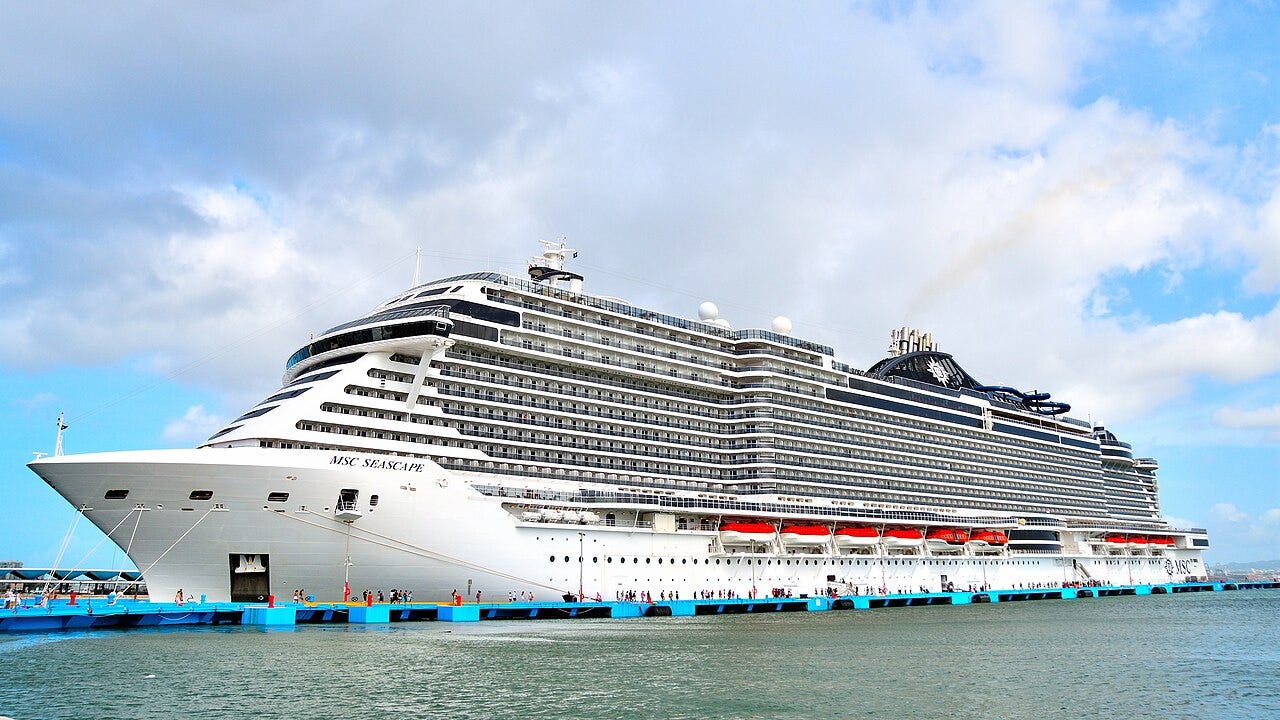
This image is used for illustrative purposes only.
An empire of steel and floating luxury
In 2025, MSC Cruises placed two separate orders with the Chantiers de l’Atlantique, together worth €7 billion — the largest annual commitment in the shipyard’s history. The first, signed on May 19 at the Choose France investment summit in Paris, covered two World Class ships to be delivered in 2029 and 2030. The second, announced on November 12, added two more hulls of the same series, to be delivered in 2030 and 2031. Each vessel measures 333 meters in length and carries 6,762 passengers and 2,138 crew members. Together, the four ships represent more than 40 million hours of work and will sustain over 3,000 jobs at the Saint-Nazaire site and across more than 500 French suppliers.
David Samzun, the mayor of Saint-Nazaire, made no attempt to dress the stakes in diplomatic language: without European expertise, he argued, those contracts would simply go to Chinese shipbuilders.
Behind that statement lies a remarkable industrial reality. In a global shipping market where China now captures roughly 70% of all orders across vessel categories, the market for large cruise ships remains, to date, entirely European. The Chantiers de l’Atlantique, Fincantieri, and Meyer Werft share the entire global production of this type of vessel — accounting for 24%, 31%, and 33% of tonnage respectively between 2017 and 2026, according to a French Senate report on the sector.
The cruise boom feeding the order books
The relentless expansion of the cruise industry is sustaining what amounts to a natural monopoly. In 2025, the sector crossed the historic threshold of 37.2 million passengers, a 7.5% increase over 2024, according to data published by the Cruise Lines International Association (CLIA), the industry’s global trade body. Despite mounting geopolitical tensions, the industry’s target of 40 million passengers by 2027 remains in place.
The order books of Europe’s three main shipyards are packed well past 2030. At Saint-Nazaire alone, major programs are stacked back to back: the eight-ship World Class series for MSC Cruises running through 2031, two Discovery-class vessels for Royal Caribbean International through 2032, four replenishment ships for the French Navy, and the preliminary design phase for France’s next-generation aircraft carrier.
In April 2026, the Saint-Nazaire yard also delivered the Orient Express Corinthian, the largest sailing ship ever built — 220 meters long, 110 passengers, three rigid sails of 1,500 square meters each — emblematic of the technological ambitions that European yards now openly brandish as their primary competitive advantage.
The EU emissions agenda as industrial weapon
The European Union has made decarbonizing maritime transport a regulatory priority. Emissions standards being progressively applied to vessels entering European waters — starting with sulfur oxides, with CO₂ constraints coming next — are forcing shipping operators to order ships powered by alternative fuels. Liquefied natural gas (LNG) dominates current orders: Meyer Werft built the world’s first LNG-powered cruise ship for AIDA Cruises; in April 2026, Fincantieri signed an agreement with Princess Cruises for three LNG vessels of 183,000 gross tons, to be delivered from the Monfalcone shipyard in Italy between 2035 and 2039.
This race toward clean propulsion constitutes a formidable barrier to entry for any competitor attempting to break into the large-cruise segment. Mastering the construction of LNG or hydrogen-hybrid cruise ships requires decades of R&D investment, long-term industrial partnerships, and a network of highly specialized subcontractors — capabilities that Asian shipyards, while fully capable of mass-producing container ships, do not yet possess for this vessel category.
Power dynamics: a fragile oligopoly
The apparent comfort of this European oligopoly should not obscure the structural pressures building beneath it.
The French state holds 84.3% of the Chantiers de l’Atlantique. That position emerged directly from the failed Fincantieri takeover bid of 2020 — blocked by the European Commission, the EU’s executive arm, on competition grounds, but also because Fincantieri had quietly allied itself with China State Shipbuilding Corporation (CSSC), transferring critical technological know-how on large cruise ships in exchange for an order from Carnival Corporation, one of the world’s largest cruise operators. That technology transfer, denounced at the time by local officials and unions, crystallized a broader realization: the cruise shipbuilding sector is a strategic asset, not simply an industrial one.
China’s ambitions are not theoretical. Beijing has stated its intention to break into the premium cruise market before the end of the decade. The industrial means being deployed are real: facilities capable of assembling multiple large vessels simultaneously, according to Philippe Berterottière, CEO of GTT, a French specialist in cryogenic containment systems for LNG carriers, and vice-president of GICAN, France’s naval industrial association. The variable still slowing China’s advance is less industrial than technological: building a large LNG-hybrid cruise ship is not comparable, in complexity, to assembling a container ship.
The Bottom Line
Europe’s dominance in cruise shipbuilding rests on a technological edge built over thirty years.
But technological advantages are not permanent — particularly when the challenger is deploying state-level resources at scale. The real question is not whether Europe can hold this position, but whether it can do so without coordinated industrial policy at the EU level. National shipyards backed by national governments, facing an adversary that thinks and acts at continental scale: that asymmetry deserves to be named clearly.
Sources: France Info · French Senate · CLIA via Ouest-France · Nantes Saint-Nazaire Développement · Usine Nouvelle · Energies de la mer