
Europe's fighter jet dream crashes on the tarmac
Nine years, two mediators, and billions of euros later, France and Germany have buried their joint next-generation combat aircraft.

The real casualty isn’t a weapons program — it’s a model of European defense cooperation.
At a Glance
On June 8, 2026, France and Germany formally abandoned the FCAS (Future Combat Air System), a tri-national fighter jet program that included Spain, after manufacturer Airbus and France’s Dassault Aviation failed to agree on industrial leadership and intellectual property rights.
The jet itself is dead, but not the entire program: the so-called “combat cloud” — a digital network linking aircraft and drones — will continue as a standalone European project.
The collapse weakens Franco-German defense cooperation at a moment when Europe is scrambling to reduce its dependence on the United States in the face of continued Russian aggression.
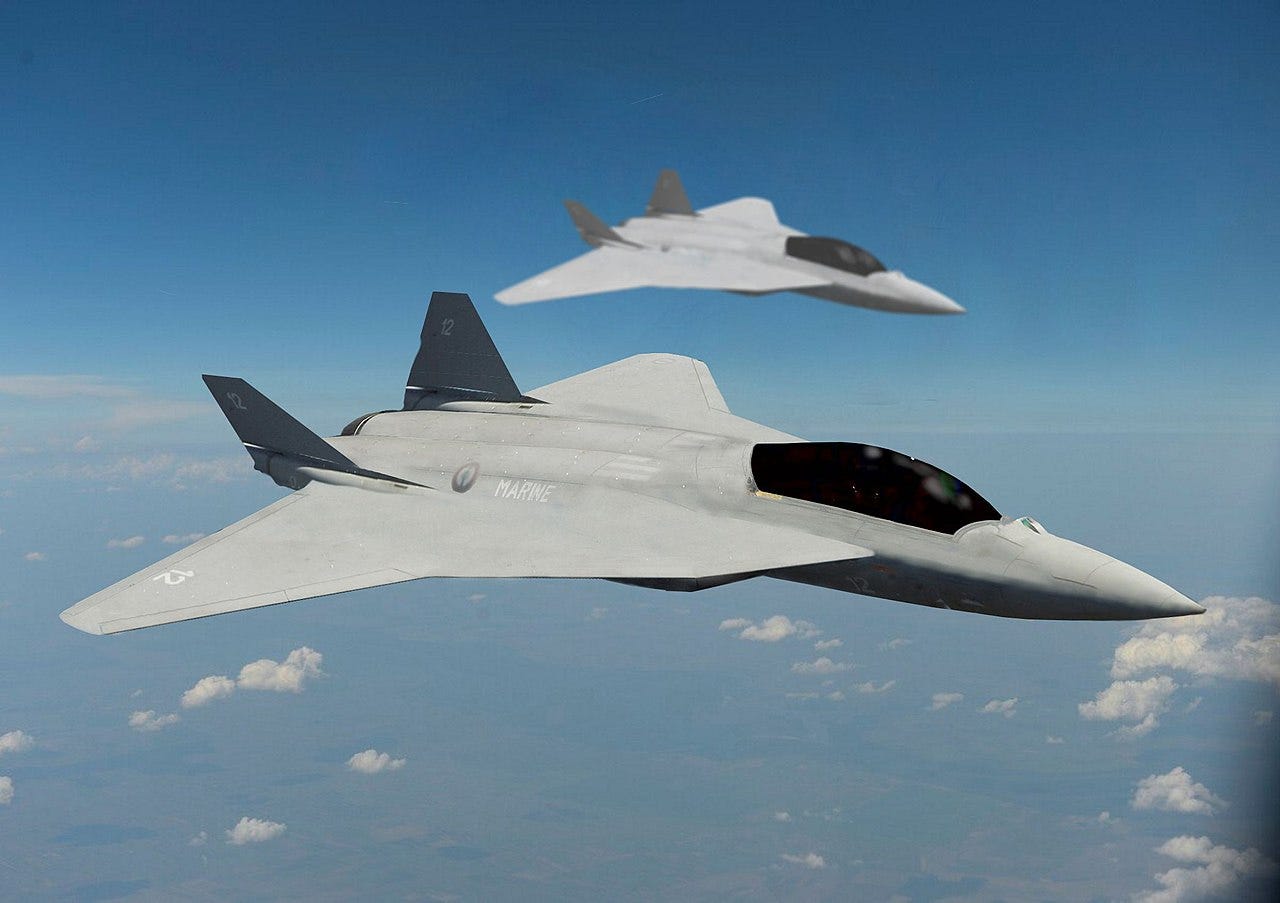
This image is used for illustrative purposes only.
Nine years, one announcement
The FCAS — Future Combat Air System, known in French as the SCAF — was launched in 2017 by French President Emmanuel Macron and German Chancellor Angela Merkel, with Spain joining two years later. The ambition: build a sixth-generation combat aircraft by the 2040s to eventually replace Germany’s Eurofighter Typhoon and France’s Rafale — both workhorse jets that trace their origins to Cold War-era programs. The aircraft was to be accompanied by drones and linked via a digital command network, the so-called “combat cloud.”
Berlin delivered the verdict on the evening of June 8. The German government announced that Macron and Chancellor Friedrich Merz had reached a “shared conclusion that the companies cannot agree on the construction of a joint combat aircraft.” A few hours later, the Élysée Palace confirmed that both leaders regretted “the inability of industrial partners to agree on the continuation of this project” [translated from French].
The breakdown did not come out of nowhere. In February 2026, Merz had already publicly questioned the program’s future. A Franco-German mediation mission was subsequently launched — and failed. Airbus and Dassault could not find common ground on three core issues: program leadership, the division of industrial tasks, and intellectual property rights.
An industrial ego battle that no one could resolve
The conflict between the two aerospace giants is long-running, but it proved fatal. Dassault Aviation — France’s storied jet manufacturer and the maker of the Rafale — insisted on acting as prime contractor for the fighter aircraft component. Airbus, the European aerospace conglomerate headquartered in Toulouse, which was representing Germany and Spain in the consortium, refused to accept a junior partner role. Each company wanted to lead. Neither would follow.
Compounding the standoff were diverging military requirements. France insisted on an aircraft capable of carrying nuclear weapons and operating from aircraft carriers — two requirements that hold no relevance for Germany’s armed forces, which operate under different constitutional and strategic constraints. Proposals to develop two separate variants within the same program went nowhere.
The announcement landed two days before the opening of ILA Berlin, Europe’s major air and space trade show, where Merz was scheduled to appear. Cédric Perrin, chairman of the French Senate’s Defense and Foreign Affairs Committee, told AFP that Macron had been “the last one” still believing in the program’s survival.
What survives — and what doesn’t
The death of the joint aircraft does not mean the entire FCAS framework collapses.
The so-called “combat cloud” — a real-time digital network designed to connect aircraft, drones, and weapons systems across a battlefield — must be preserved as a “European system of systems,” according to Berlin. French and German defense ministries are tasked with drafting a joint cooperation plan for the Franco-German Council of Ministers — a regular bilateral summit of both cabinets — scheduled in Germany in July 2026.
For the industrial players, the post-FCAS landscape remains unsettled. Dassault is widely expected to continue developing the next generation of the Rafale independently. For Airbus, the question of future partners is now open. A partnership with Sweden’s Saab defense group has been floated in industry circles but faces an obvious mismatch: Swedish jets tend to be lightweight platforms, while Germany wants a heavy combat aircraft. Joining the GCAP — the Global Combat Air Programme, a tri-national project led by the United Kingdom, Japan, and Italy to develop a next-generation stealth fighter — appears unlikely. That program is already well advanced structurally, leaving little room for a major new player.
What the failure actually reveals
The collapse of FCAS is not merely an industrial setback. It exposes a structural fault line in how Europe attempts to build defense sovereignty: by relying on consortiums of national champions whose commercial interests and intellectual property strategies routinely collide with political objectives.
European defense cooperation has long operated on a model of geographic industrial sharing — each country gets a slice of production proportional to its financial contribution. This model, which produced the Eurofighter Typhoon across four nations in the 1980s, mechanically generates deadlocks whenever no partner is willing to cede ground. It could suggest that Europe will only succeed in pooling its air power if it abandons the principle of proportional industrial return — something neither Paris nor Berlin has yet been prepared to accept.
The subtle divergence between the two capitals after the announcement is telling. The Élysée stressed that “France remains of the view that Franco-German cooperation is necessary for both our countries and European partners in defense” [translated from French]. Berlin, by contrast, “judged that it was no longer possible to pressure the companies further.” One side sees a temporary industrial deadlock. The other sees a reality to be accepted and moved on from.
The Bottom Line
Europe is not abandoning the idea of common air defense — just this particular iteration of it. But the deeper question raised by the FCAS failure is not technical. It is political: if European governments are unwilling to impose a shared industrial architecture on their national champions, even at the cost of some commercial interests, every future multinational weapons program will hit the same wall. The geopolitical pressure — a Russia still at war, a less predictable United States — makes that choice more urgent than ever. Whether external pressure alone can finally break entrenched industrial habits is the question Europe now has to answer.
Sources: France 24 · Euronews · AFP