
Europe's answer to X goes public — and bets on trust

A Swedish startup is launching the first European alternative to Elon Musk’s X, built on a radical premise: every user is a verified human, data stays on European soil, and disinformation is a design problem. Whether it can scale beyond the Brussels bubble is another question entirely.
On Wednesday, June 17, 2026, W Social opened its doors to the general public. Announced at the World Economic Forum in Davos in January 2026, this Swedish startup positions itself as the European alternative to X — the platform owned by Elon Musk — with a simple, radical premise: every user is a verified human, data stays in Europe, and disinformation is a design problem, not a content moderation afterthought. Behind the sleek pitch, however, one question looms large: can a platform engineered for political elites actually break the grip of a network with 115 million European users?
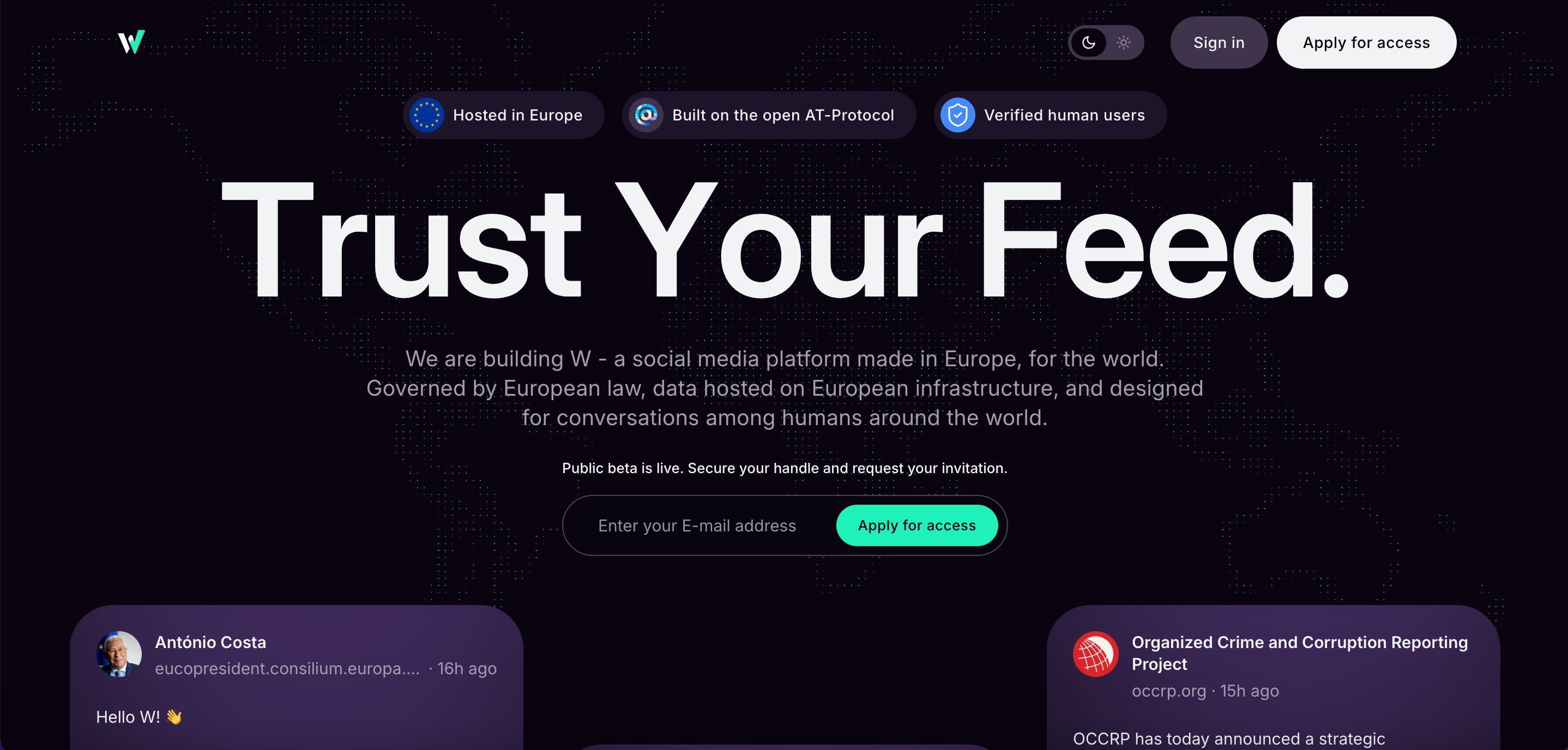
This image is used for illustrative purposes only.
At a Glance
W Social (wsocial.eu), a private company incorporated in Sweden and led by CEO Anna Zeiter, launched its first public beta on June 17, 2026. Antonio Costa, president of the European Council — the EU body that defines the bloc’s political priorities — published his first post on the platform on launch day, lending it high-profile visibility.
The platform requires mandatory identity verification at sign-up — users must scan a passport or national ID through a separate app called W Identity — while allowing publication under a pseudonym.
W is not funded by the European Union, despite viral claims to the contrary formally denied by the European Commission: the company is privately financed by Nordic investors, with Swedish climate-media startup We Don’t Have Time holding a 25% stake.
A launch engineered for the Brussels crowd
At an event held at the Brussels Press Club on June 17, W rolled out a remarkable show of institutional support. Antonio Costa published his first post on the platform, celebrating a network where data is entirely hosted in Europe, combating disinformation is a stated priority, and all users are verified humans. Ursula von der Leyen, president of the European Commission — the EU’s executive arm — Christine Lagarde, president of the European Central Bank (ECB), along with dozens of EU institutions and major European media groups, were all present on W from day one.
This top-down endorsement is not incidental. It reflects W’s explicit strategy. Anna Zeiter — a German data-protection lawyer, former vice president at eBay, and professor of data and AI law at the University of Bern — has stated publicly that her primary target is not the general public but decision-makers, regulators, and newsrooms. Her thesis: if Europe’s political class migrates from X to W, a broader audience will follow. Whether that theory of change holds is precisely what the next eighteen months will test.
Identity verification: trust engine or barrier to entry?
W’s defining feature is its zero-bot guarantee. At sign-up, every user must verify their identity by scanning a government-issued ID through W Identity, a separate companion app. To address privacy concerns, the platform says it applies a data-minimization principle: only two anonymized attributes are retained — country of origin and confirmation of legal age. Users may then publish freely under a pseudonym, their real identity sealed on their device.
Technically, W is built on the AT Protocol — the same open, decentralized standard that underpins Bluesky, the social network that has attracted millions of users migrating away from X. The protocol allows different platforms to interoperate, meaning a W post can in principle be visible to users on other AT Protocol-compatible services. In practice, W has diverged from Bluesky’s fully open-source approach: the platform’s source code was reportedly removed from GitHub shortly before the public beta launched, raising questions about long-term transparency that the company has not yet formally addressed.
This architecture is a direct response to the failures widely attributed to X since Musk’s takeover in 2022: a surge in automated accounts, the collapse of systematic fact-checking, and the transfer of European user data to American servers. W is designed from the ground up to comply with the General Data Protection Regulation (GDPR) and the Digital Services Act (DSA) — the EU’s landmark digital regulation requiring large platforms to combat illegal content, operate transparently, and give users meaningful control over their data.
The trade-off is real. Civil liberties advocates have raised a legitimate concern: asking users to hand over government ID to access a private, for-profit social network — even a European one — may prove a harder sell than its founders anticipate.
Digital sovereignty: the political bet behind the platform
W’s timing is not accidental. Since Donald Trump’s return to the White House in January 2025, transatlantic tensions have reignited Europe’s long-standing debate about dependency on American tech platforms. The numbers illustrate the scale of the challenge: Facebook and Instagram, owned by Meta, count 259 million users in the EU; TikTok reaches 135.9 million; X has 115.1 million — figures declared by the platforms themselves to the European Commission under DSA reporting obligations.
This dependency has measurable consequences. Revenue from European users flows to American shareholders. Data generated by European citizens circulates outside EU jurisdiction. The algorithms that shape public debate across the continent are designed — and can be adjusted — thousands of miles away.
W is not alone in this space. A wave of European alternatives has emerged in parallel: eYou, which closed a €300,000 funding round in late 2025; Monnett, a hybrid between TikTok and Instagram with 65,000 beta users and a full launch expected in early July; Bulle, which describes itself as a “healthy social network” and launched in January; and Eurosky, an open-access platform that went live in mid-April. Grégoire Vigroux, founder of eYou, is blunt about the odds: the social network graveyard is vast — 99% of European social platforms launched over the past decade have failed.
Analysis: can trust beat the network effect?
W’s proposition is intellectually coherent. A network without bots, without systemic disinformation, under European regulatory control: polls consistently show this is exactly what a substantial share of European users say they want. The structural problem lies elsewhere.
Social networks run on what economists call the network effect: their value grows with the number of users. No one leaves a platform as long as their contacts remain on it. This dynamic has killed dozens of self-described “Facebook killers” and “Twitter alternatives” over the past fifteen years. W’s founders are aware of this trap and have designed a different entry strategy: consolidate a high-value user base first — political elites, media organizations, EU institutions — and rely on gravitational pull from there.
The strategy is coherent with the platform’s advisory board, which includes former European policymakers and senior figures from the digital regulation world. It may well work within the institutional and journalistic bubble. What it requires, however, is that Europe’s political class sustain its commitment publicly — and that this migration be perceived by ordinary citizens as a genuine democratic choice rather than an elite relocation.
The real question is not whether W is better than X — on democratic guarantees and regulatory compliance, it almost certainly is. The real question is whether a social network can be built top-down, seeded in the corridors of Brussels before it reaches the streets of Berlin, Lisbon, or Warsaw.
The bottom line
W Social has the institutional endorsements, the regulatory design, and the right political moment. What it does not yet have is the one thing that makes a social network worth using: everyone else. No platform at scale has ever been built top-down, from institutions to citizens. W is betting it can be the first.
Sources: France Info · AFP · France 24 · Euronews · RTBF · European Commission (DSA declarations)