
Europe or Silicon Valley: Madrid asks the question Brussels keeps dodging
The South Summit 2026 brings start-ups and investors to Madrid with one demand: Europe must become one market, not 27, or keep losing companies to the U.S.

At a Glance
The South Summit 2026, running June 3–5 in Madrid, is expected to bring together more than 20,000 participants, nearly 4,900 start-ups, over 2,000 investors and some 600 speakers, according to organizers — making it one of Europe’s largest annual innovation gatherings.
The event’s founder warned that European companies are being pushed to relocate to the U.S. — not because America is better at innovation, but because Europe still operates as 27 separate regulatory markets instead of one.
Spain is positioning itself as the EU’s frontrunner on trustworthy AI, backed by €1.5 billion ($1.6 billion at current exchange rates) in national AI investment and one of the continent’s most advanced digital infrastructures.
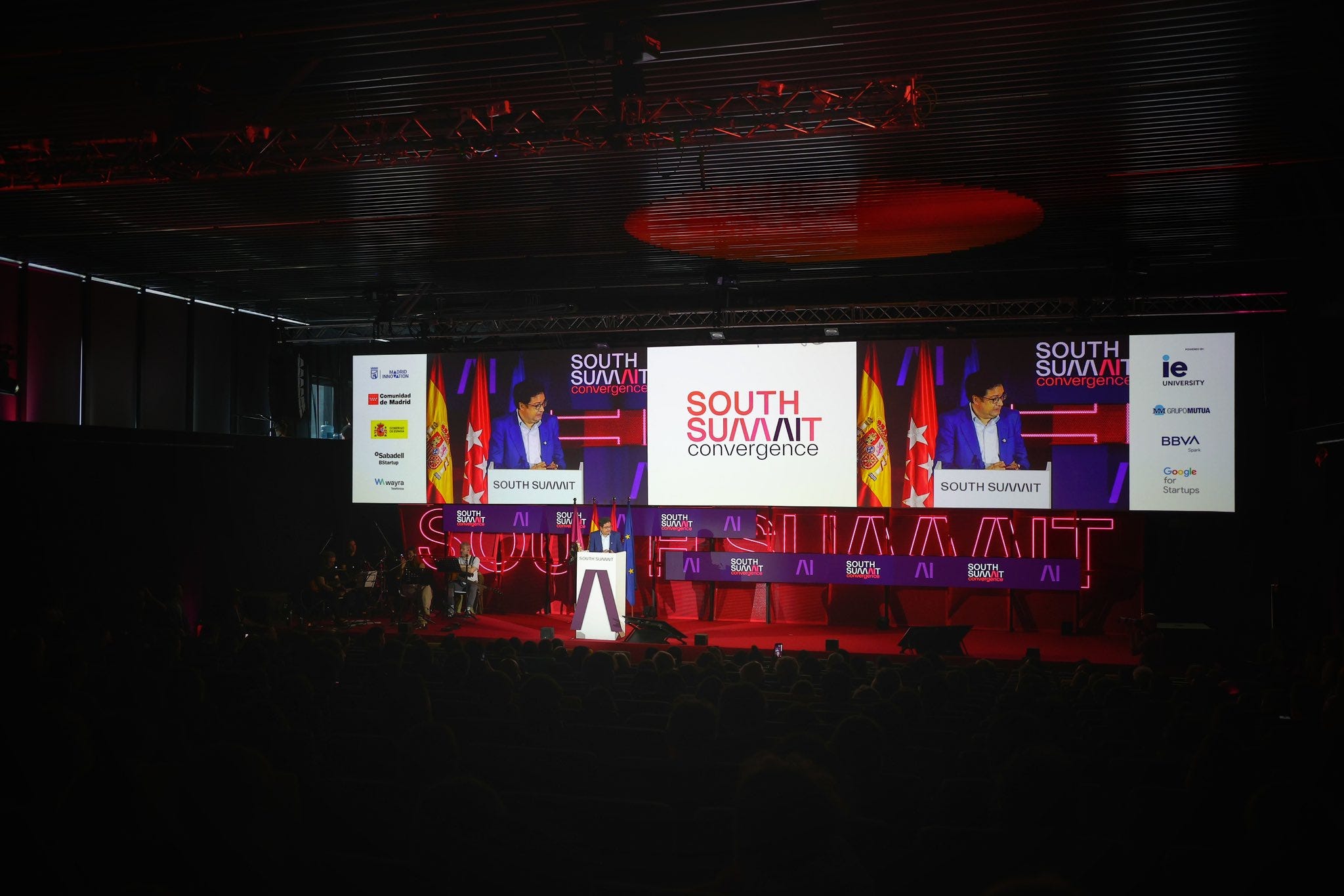
This image is used for illustrative purposes only.
Europe’s technology paradox
Madrid, June 3, 2026. While the European Union fine-tunes its EU AI Act — the world’s first comprehensive legal framework regulating artificial intelligence, adopted in 2024 — its own entrepreneurs are sounding the alarm from Spain’s capital: regulating without unifying means losing the race before it starts.
The opening of the 15th edition of South Summit, one of Europe’s largest innovation and entrepreneurship conferences, put this paradox in unusually direct terms. María Benjumea, the event’s president and founder, delivered a line that captures the structural gridlock facing Europe’s start-up ecosystem:
“A start-up born in Spain should be able to treat Europe as its natural home — not as 27 different borders.” [translated from Spanish]
Unlike the U.S., where companies operate under a single federal framework, EU businesses must comply with separate national regulations in each of the bloc’s 27 member states — even for online services. That gap is what forces thousands of young companies to choose San Francisco or New York instead.
The argument is not new. What is new is the urgency. According to figures presented at the summit’s opening, AI’s share of global venture capital investment jumped from 30% to 61% in just three years — a pace that leaves little room for regulatory hesitation.
Spain’s digital moment — and its limits
Óscar López, Spain’s Minister of Digital Transformation and Civil Service, used the occasion to showcase his country’s numbers. Spain’s growth forecast has been revised upward to 2.2% by the OECD, the Paris-based international economic organization. The country boasts fiber optic coverage exceeding 96% of its territory and 5G coverage approaching 94%. Spain also claims to be the leading EU country in overseeing the development of “trustworthy and open” AI, supported by €1.5 billion in national strategy funding. Over one million small businesses and self-employed workers have received assistance to digitize their operations, he added.
Those numbers deserve context. Spain’s digital competitiveness is real and recognized — but it operates within a European framework that remains fragmented. Having the best national infrastructure does not help much if access to the European market still requires navigating 27 different regulatory environments. That tension is precisely what Benjumea placed at the center of South Summit’s agenda.
AI as a great equalizer — for whom?
South Summit 2026 debuts an “AI Forum” developed in partnership with IE University, one of Spain’s leading private business universities, designed to help entrepreneurs build AI-based prototypes and business models within hours. Lee Newman, dean of IE Business School, framed the stakes plainly: AI gives small teams capabilities that once required large organizations. That rebalancing could theoretically benefit Europe, whose start-up ecosystem is dominated by leaner structures than American or Chinese tech giants.
But the opportunity is conditional. It requires that European entrepreneurs be able to operate at continental scale — not company by company, country by country. That is the implicit challenge the Madrid forum is laying at Brussels’ door: AI can drive European competitiveness, but only if Europe finally builds a level playing field.
The power dynamics behind the messaging
The announced attendance of King Felipe VI of Spain, Madrid Mayor José Luis Martínez-Almeida and Madrid regional president Isabel Díaz Ayuso signals the political weight Spain attaches to this event. Madrid is positioning itself as Southern Europe’s leading technology hub — a bid that puts it in direct competition with Barcelona, Lisbon and Berlin for attracting Europe’s fastest-growing companies.
It is no coincidence that Benjumea’s remarks address both entrepreneurs and the policymakers in the room. The South Summit founder is running two tracks simultaneously: she validates the urgency of digital market unification for investors, and she confronts governments with the concrete cost of inaction — measured in talent and companies lost to the United States.
The summit’s international lineup reinforces the ambition: speakers include former Italian Prime Minister Enrico Letta, Google X founder Sebastian Thrun, Female Invest co-founder Anna Hartvigsen, and Kim Perell, a Silicon Valley entrepreneur and investor involved in more than a hundred start-ups.
The bottom line
The equation Madrid is presenting is straightforward in its premise and daunting in its implications: Europe produces world-class talent and ideas; it loses world-class companies because it cannot offer them a world-class market. Generative AI is compressing timelines at a speed that European legislative calendars have not yet absorbed. The real question is not whether artificial intelligence is a threat or an opportunity. It is whether Europe will still be in a position to answer that question in five years — or whether the answer will have been given on its behalf, from the West Coast of the United States.
Sources: Euronews