
Europe and Russia: to talk or not to talk?

France’s Europe Minister Benjamin Haddad is calling for a diplomatic channel with Moscow — but on Europe’s terms, not Russia’s. His nuanced position exposes a continent still searching for a common strategy.
On May 27–28, EU foreign ministers gathered in Limassol, Cyprus, for a Gymnich — the informal, twice-yearly meeting of the bloc’s top diplomats, co-chaired this time by Kaja Kallas, the EU’s High Representative for Foreign Affairs. No binding decisions emerge from a Gymnich, but strategic directions do. This one had an unusually charged agenda: the war in Ukraine, with the foreign ministers of Ukraine, India, and Saudi Arabia invited to join specific sessions. At its center lay a question the continent has been circling since Russia’s full-scale invasion in 2022: should Europe open a direct diplomatic channel with Moscow? France’s answer, as articulated by Benjamin Haddad, France’s Minister Delegate for European Affairs, in an interview with Euronews on the sidelines of the meeting, is a carefully calibrated yes — but only from a position of strength, and only after tightening the screws on Moscow.
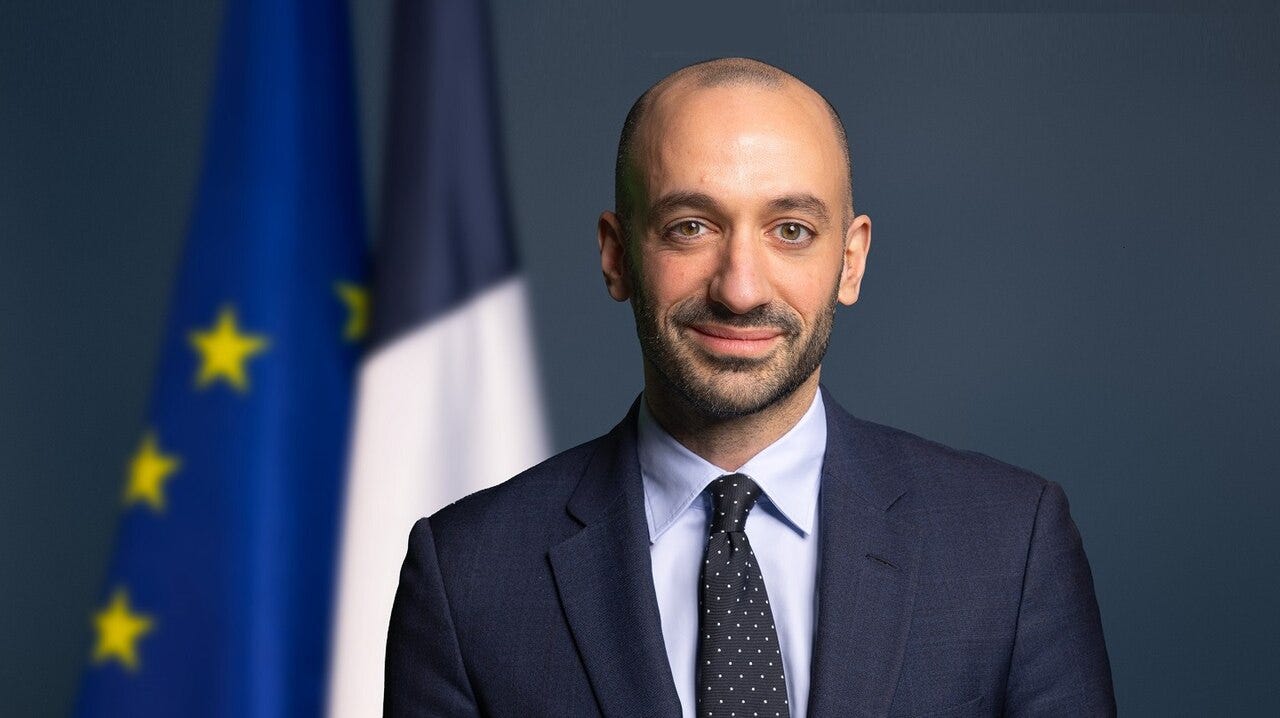
This image is used for illustrative purposes only.
At a Glance
EU foreign ministers gathered May 27–28 in Limassol, Cyprus, for an informal Gymnich meeting co-chaired by EU foreign policy chief Kaja Kallas, with Ukraine’s war and a possible European diplomatic channel to Moscow as the central agenda items.
Benjamin Haddad, France’s Minister Delegate for European Affairs, told Euronews on the sidelines that Europe must be ready to open its own channel to Moscow — but only after sustaining pressure on Russia and support for Ukraine.
His position reflects a broader European shift: less appetite for unconditional engagement, more insistence that any dialogue must serve European interests, not legitimize Russian ones.
How the EU lost its seat at the table
Washington led the talks. Europe watched. That sequence — U.S.-Russia negotiations conducted without the Europeans, now stalled — sent shockwaves through European capitals. The question is no longer whether Europe should be involved in shaping the end of the war in Ukraine, but on what terms and with what safeguards.
Speaking to Euronews in Limassol, Haddad structured his answer around a clear sequence: pressure first, dialogue second. In his view, Russia “is not seriously engaged in diplomacy” and “is not interested in a ceasefire or peace.” Far from using that assessment to close the door entirely, he draws the opposite conclusion — Europe should prepare its own channel precisely because it cannot afford to be sidelined again. But that channel, he insists, must open from a position of strength, not accommodation.
France has not been passive in trying to maintain lines of communication with Moscow. Discrete diplomatic contacts at various levels have been reported since 2022, though their scope and outcomes remain largely unconfirmed by official sources. What is clear is that those efforts have not yielded any meaningful Russian engagement — and that this failure appears to have hardened rather than softened Haddad’s posture. His framing — sustain Ukraine, maintain pressure, then talk — is less an olive branch than a set of preconditions.
He also points to what he reads as a shift in the broader balance of power: Russia, he argues, is losing ground not only on Ukrainian battlefields but across its former zones of influence, citing Armenia’s visible drift toward Europe since 2022. The diplomatic window, in his reading, belongs to Europe — not to Moscow.
The East-West fracture: a geography of trauma
That framing puts Haddad’s position closer to Eastern Europe’s instincts than some earlier French signals might have suggested. In the days leading up to the Limassol meeting, the temperature from the east had been unambiguous. Estonian Foreign Minister Margus Tsahkna warned that direct negotiations risk turning the EU into a “neutral mediator” expected to ease sanctions on Russia. Latvian President Edgars Rinkēvičs put it more bluntly: Moscow would exploit any opening as a public relations exercise, leaving the EU “more or less empty-handed.”
These are not abstract diplomatic cautions — they are the product of lived experience. For countries that lived under Soviet occupation until the early 1990s, the credibility of Russian commitments is an existential question, not a procedural one. The 1994 Budapest Memorandum — under which Ukraine surrendered its nuclear arsenal in exchange for security guarantees signed by Russia — remains the defining symbol of what agreements with Moscow are worth when they are not backed by hard military constraints. On this, Haddad and the Baltic states are reading from the same page.
Ukraine as variable, not as central actor
Ukrainian Foreign Minister Andrii Sybiha attended the Gymnich dinner on the evening of May 27, a visible signal that Kyiv was present in the room if not yet at the table on its own terms. President Volodymyr Zelensky has presented EU membership as a cornerstone of his country’s future security guarantees, a position Haddad reaffirmed France’s support for while acknowledging the complexity of delivering on it quickly. German Chancellor Friedrich Merz has proposed granting Kyiv “associate” status — essentially a seat at EU Council discussions without full voting rights — but the idea has met more skepticism than enthusiasm. France, while expressing openness to refining a step-by-step integration process, has not moved from its long-standing commitment to strict accession criteria.
What is striking about this debate is Ukraine’s structural absence from its center. Kyiv is simultaneously the central stake and the actor least able to dictate its terms — an asymmetry that could suggest, though it cannot be established with certainty, that European leaders are managing their own internal cohesion more than they are building a strategy in Ukraine’s interest.
Analysis: the geometry of dialogue
Haddad’s position is analytically coherent — and politically shrewd. By insisting on pressure as a precondition for dialogue, he avoids the trap of appearing to reward Russian aggression while keeping open the option that most European publics privately want: a path toward ending the war. It threads a needle between the unconditional-engagement camp and those who refuse any contact with the Kremlin.
Whether that needle can be threaded in practice is a different question. The pessimistic reading remains plausible: if Russia is genuinely not interested in a ceasefire, as Haddad himself contends, then a European envoy dispatched to the Kremlin would be less an instrument of peace than a signal of premature normalization — offering Putin diplomatic legitimacy without concrete concessions in return.
The deeper question his position raises, and does not resolve, is institutional: who speaks for Europe in that channel? The EU has no single foreign minister with binding authority, no unified military command, and no consensus beyond what its 27 members can agree on. A French minister making the case for conditional engagement in Limassol is not the same as Europe making that case in Moscow.
Europe’s member states are not divided on peace. They are divided on what they are prepared to sacrifice to get there.
The bottom line
Benjamin Haddad’s argument — talk to Moscow, but only once Europe has leverage — is the most intellectually honest position on the table in Limassol. The harder test is whether 27 governments, with 27 threat perceptions and 27 domestic audiences, can sustain the unity required to make that leverage real. If they cannot, the diplomatic channel Haddad envisions risks becoming not a tool of European power, but a substitute for it.
Sources: Euronews · Cyprus EU Presidency · European External Action Service