
EU Trade Deal With the U.S. Clears Key Vote — With Strings Attached
The European Parliament's trade committee backed the Turnberry Agreement on Tuesday, but key safeguards championed by lawmakers were watered down.

Ten months after its signing in Scotland, the EU–U.S. trade agreement has cleared a major institutional hurdle — but not without shedding several of the protections that the European Parliament had fought hard to secure.
On Tuesday, June 2, the International Trade Committee of the European Parliament — known by its French acronym INTA — approved both legislative texts required to implement the Turnberry Agreement, named for the Scottish resort where Donald Trump and the president of the European Commission, the EU’s executive arm, concluded the deal on July 27, 2025. Each text passed 31 to 6, with three abstentions. A plenary vote before the full Parliament is now scheduled for the June 15–18 session, putting the EU on track to meet Trump’s July 4 deadline.
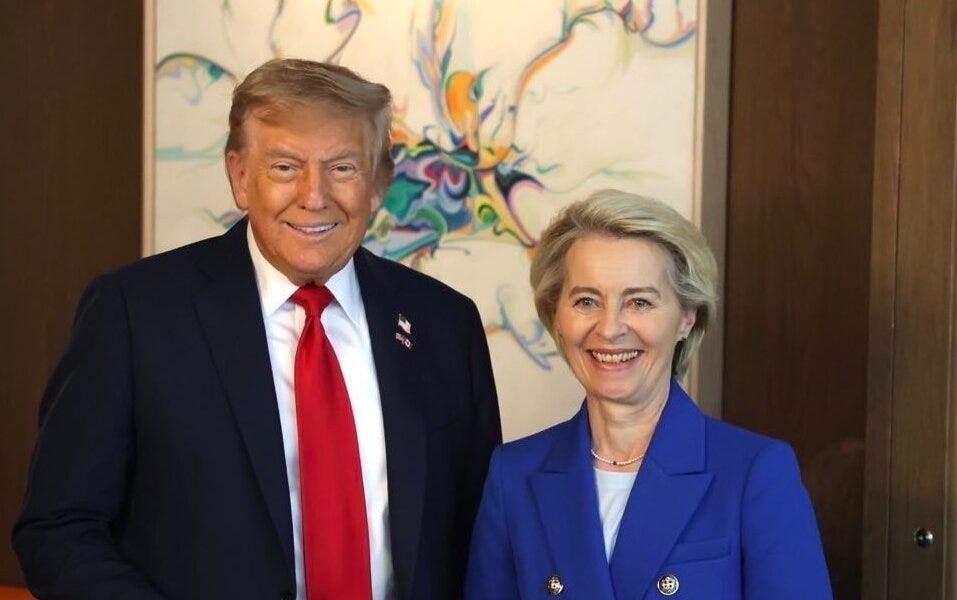
This image is used for illustrative purposes only.
At a Glance
The European Parliament’s trade committee approved both implementing texts of the Turnberry Agreement by 31 votes to 6, clearing the path to a full parliamentary vote on June 15–18, 2026.
Key safeguards were weakened: a clause that would have terminated the agreement in March 2028 was pushed back to December 2029, and a “sunrise” provision that would have conditioned the EU’s tariff cuts on U.S. compliance was dropped entirely.
One protection survived: the European Commission may suspend the agreement — at the request of Parliament or a member state — if the U.S. fails to lift its tariffs on European steel and aluminum by the end of 2026. Several Members of the European Parliament (MEPs) who voted “yes” in committee have already signaled concerns over the weakened terms.
A 15% deal — but not for everyone
The Turnberry Agreement rests on a form of controlled asymmetry: the EU agreed to eliminate tariffs on most American industrial goods and to grant preferential access for U.S. agricultural and seafood products. In exchange, the U.S. capped its tariffs at 15% on the majority of European exports — what Brussels presented as a manageable cost to avoid a full-blown transatlantic trade war.
One glaring exception remains: European steel and aluminum continue to face a 50% U.S. tariff. That unresolved flashpoint became the anchor around which Parliament’s main surviving safeguard was built.
The safeguards that survived — and those that didn’t
During months of three-way negotiations between Parliament, EU member states, and the Commission — a process known in Brussels as a trilogue, roughly analogous to a House-Senate conference committee in the U.S. — European lawmakers had pushed for provisions that would tie the EU’s concessions to concrete U.S. compliance.
The sunrise clause, which would have required the U.S. to fulfill its obligations before EU tariff cuts took effect, was dropped entirely from the final text.
The sunset clause — a built-in expiration mechanism that would have forced a renewal or termination — survived, but in a weaker form. Rather than expiring in March 2028 as Parliament had originally demanded, the agreement now runs until December 31, 2029. That means the deal will operate for at least three and a half years without an automatic review trigger.
What lawmakers did retain is concrete, if conditional: the European Commission may suspend the trade agreement if the U.S. does not lift its tariffs on European steel and aluminum by end of 2026. That suspension can be triggered by either Parliament or a member state — a mechanism that preserves institutional leverage, though its actual use would depend on political will.
Racing against a July 4 deadline
Tuesday’s vote unfolded under significant pressure. Trump has publicly warned that he would impose “far higher” tariffs if the Turnberry terms were not met by July 4, 2026 — a symbolic date. Ten months after the agreement’s signature, the EU had still not completed ratification.
That institutional lag has fueled frustration in Washington. The ratification process was frozen outright in January 2026, when Bernd Lange, the German Social Democrat who chairs INTA, announced a suspension after Trump threatened tariffs on EU member states that opposed his stated ambitions over Greenland — a Danish territory and therefore tied to EU alliance structures. Work only resumed in February once those threats were temporarily dialed back. Further delays accumulated through the trilogue negotiations, during which Parliament fought, with mixed success, to strengthen the deal’s safeguards.
Analysis: a vote under duress
Tuesday’s committee vote is less a victory than a concession. Parliament exits this trilogue with a significantly weaker version of the agreement than it had been defending. The sunrise clause — conditioning the EU’s tariff reductions on prior U.S. implementation — would have constituted a genuine reciprocity mechanism; its removal leaves the EU exposed to a one-sided application of the deal.
What Parliament secured — the steel and aluminum suspension clause — is real, but its reach depends entirely on the political readiness to use it. Triggering a suspension would risk a new escalation with Washington at a moment when a sectoral deadline is already looming.
The deeper question the vote raises without answering: how far can the EU negotiate under an American-set deadline without compromising its standing as a sovereign actor capable of conditioning its own concessions?
The bottom line
The June 15–18 plenary vote will be telling. A committee majority of 31 does not automatically translate into a majority of the full Parliament, where the threshold is higher. Several MEPs who voted “yes” in committee have signaled publicly that the safeguards were stripped too far — and a plenary defeat would reopen a trade standoff that neither Brussels nor Washington can easily afford.
Sources: Euronews · Reuters · European Parliament