
EU talks with Russia: Von der Leyen crosses the line

Von der Leyen calls on EU leaders to prepare a negotiating mandate for Russia. Council President Costa’s back-channel to the Kremlin divides the bloc — raising the question of who actually speaks for Europe.
At a Glance
Ursula von der Leyen, president of the European Commission (the EU’s executive arm), urged European leaders to start planning a negotiating mandate with Russia on Ukraine, stressing that Kyiv must remain in control of any diplomatic process.
António Costa, president of the European Council (the body that coordinates the EU’s 27 heads of state and government), tasked his chief of staff with contacting a senior Kremlin adviser to open a back channel — a move most EU leaders only learned about through the press.
Ukrainian President Volodymyr Zelensky reaffirmed that a ceasefire without security guarantees would be unacceptable, and that Vladimir Putin is not yet ready to negotiate.
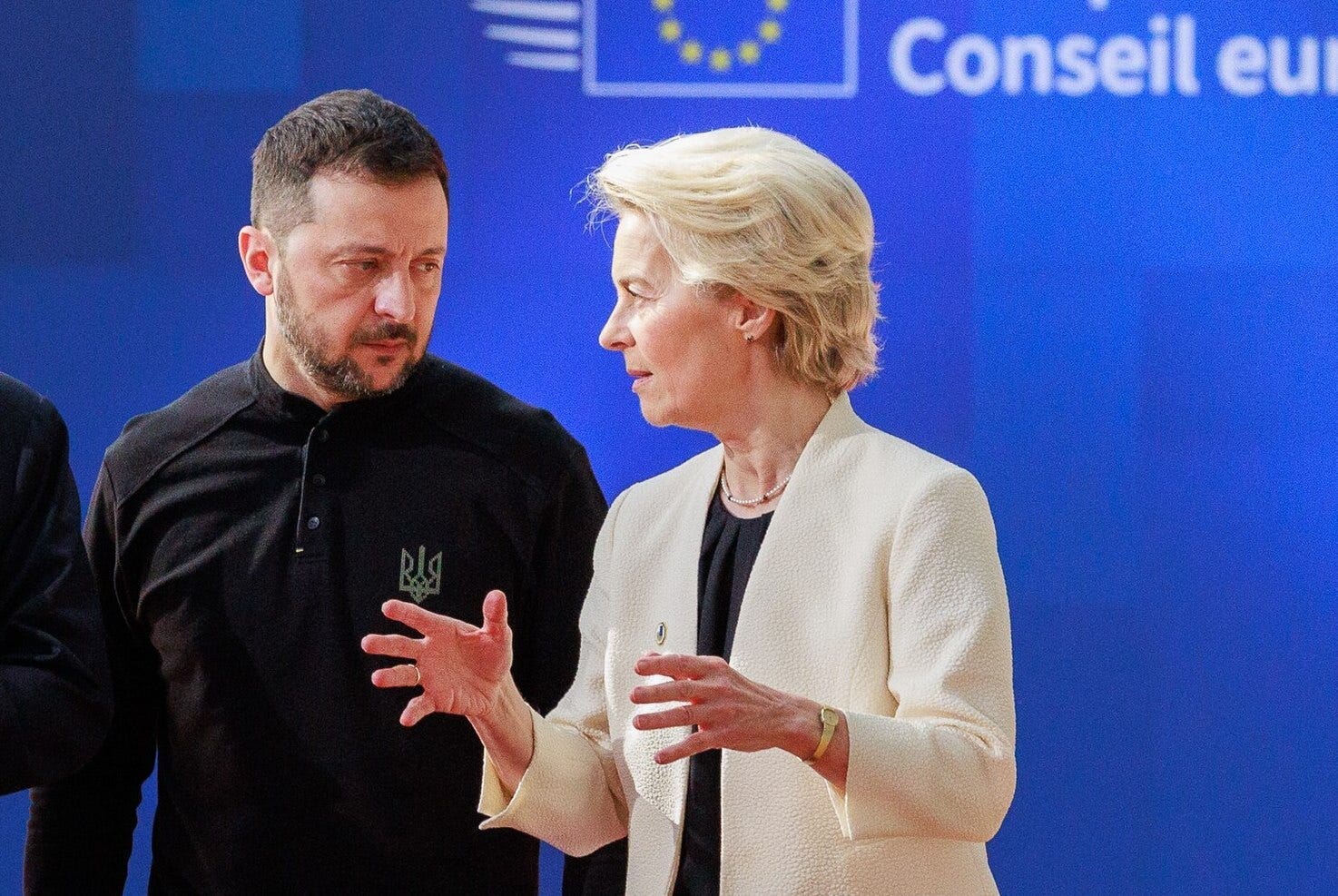
This image is used for illustrative purposes only.
A quiet pivot with major consequences
The scene unfolded behind closed doors at the European Council summit in Brussels on June 18–19, 2026. Ursula von der Leyen told assembled EU leaders that the time had come to prepare a negotiating mandate with Russia over Ukraine.
This was no routine statement. Since Russia’s full-scale invasion of Ukraine in February 2022, the EU had confined itself to a supporting role: sanctions, funding Ukraine’s war effort, diplomatic backing for Kyiv. Contemplating a negotiating mandate means stepping across a threshold — becoming a direct diplomatic actor, seated at a table the bloc had until now refused to join.
Von der Leyen framed her position carefully: Kyiv must remain in charge of the process, sanctions are working against the Russian economy, and the balance of forces on the battlefield is shifting in Ukraine’s favor. But the signal sent to European capitals — and to Moscow — was unambiguous: the EU is preparing for the post-ceasefire phase.
Costa’s back channel: a move that backfired politically
It was against this backdrop that controversy erupted over António Costa, president of the European Council — the institution that brings together and coordinates the EU’s 27 member state leaders, a role loosely comparable to that of a permanent summit chairperson. Costa had instructed his chief of staff to reach out to Yuri Ushakov, a senior adviser to Vladimir Putin at the Kremlin, to open a diplomatic line.
Von der Leyen had been kept informed of the contacts. But the vast majority of EU leaders only found out on Wednesday through press reports — triggering an uproar, particularly among member states on the EU’s eastern flank (Poland, the Baltic states, the Czech Republic), which have historically maintained the firmest stance toward Moscow.
These countries argue that now is not the time for diplomatic outreach, but for tightening the economic screws. Their concern: any uncoordinated contact with the Kremlin, before Russia signals genuine willingness to pursue peace, risks weakening the EU’s negotiating position and projecting disunity — a gift to Moscow.
Costa defended his move at the summit, insisting he had not opened formal negotiations but simply established a communication channel — within his institutional mandate. Von der Leyen backed him publicly, saying he “represents all 27 member states.”
Who negotiates what? The fault line beneath the surface
Behind the question of the mandate lies a structural tension over how diplomatic competence is divided within the EU. According to multiple accounts from the summit, several leaders made clear that Costa holds a mandate covering sanctions, EU enlargement, and frozen Russian assets — but that anything touching on security guarantees falls to individual member states.
That distinction matters. It points to the parallel existence of the “Coalition of the Willing,” an initiative led by France and the United Kingdom that brings together states prepared to deploy security forces in Ukraine as part of any future peace agreement. This group operates outside the EU’s formal framework and would likely serve as Kyiv’s primary partner on post-conflict military guarantees.
What appears to be taking shape could therefore be a two-tier diplomatic architecture: the EU handling economic and institutional matters (sanctions, reconstruction, potential Ukrainian membership), and the Coalition of the Willing managing the military security dimension. A coherent division of labor in theory — but one that requires flawless coordination to prevent Moscow from exploiting any cracks.
Ukraine’s position: no surrender, no illusions
Volodymyr Zelensky participated in the summit discussions and laid out his position with precision. He supports the EU being present at the table alongside Ukraine in any eventual negotiations. But he set non-negotiable conditions: no relinquishment of territory currently under Ukrainian control, and no ceasefire without solid security guarantees.
On timing, Zelensky was blunt: an EU negotiator remains a theoretical construct as long as Russia shows no genuine intent to engage — and Putin, he insisted, is not there yet. On the military front, he reiterated that the only path to ending the war ran through sufficiently weakening Russia to compel real concessions.
Analysis: strategic agility or premature signal?
This summit marks a shift in the EU’s posture toward the war in Ukraine. The bloc is not walking away from its support for Kyiv — von der Leyen said so repeatedly. But it is beginning to build the institutional machinery of negotiation, preparing for a diplomatic moment she believes will eventually come.
That pivot is defensible. Modern wars rarely end in one side’s total military victory; they typically conclude at a table, after the balance of forces has stabilized. Preparing to negotiate is not abandoning Ukraine — it is refusing to arrive unprepared at the decisive moment.
The real test of European unity will not be the summit communiqué, but the moment when all 27 must sit down and agree on what they are willing to accept, and what they are not.
The risk, however, is real. An EU that sends premature signals of diplomatic openness before Moscow has budged may undermine both its own credibility and the leverage created by its sanctions. Russia’s economy is showing signs of strain — but strain is not capitulation. Putin has until now seemed capable of absorbing substantial economic pressure without altering his strategic calculus.
The governance question raised by the Costa episode is equally structural: can a 27-member EU, in which every government is navigating its own domestic politics vis-à-vis Russia, speak with a single voice to Moscow? The answer the European Council provides in the weeks ahead will be decisive.
The bottom line
The EU is preparing to negotiate. The question is no longer whether, but how — and above all, who. That day when all 27 must agree on what they will and will not accept: the fragility of current institutional arrangements will become visible. Moscow knows it.
Sources: Euronews