
EU-Mexico deal: Brussels redraws its trade map
The European Union has signed a modernized trade agreement with Mexico, its second-largest commercial partner in Latin America.

The goal: reduce dependence on the United States and counter Chinese influence, as global alliances shift under the weight of a new Trump presidency.
At a Glance:
The EU and Mexico signed an updated trade agreement on May 21, 2026, in Mexico City, with European Commission President Ursula von der Leyen, António Costa — President of the European Council, the body that brings together EU heads of state and sets the bloc’s political direction — and Mexican President Claudia Sheinbaum all present
The deal modernizes a 20-year-old accord and expands market access for European agricultural and industrial exports, while opening new doors for Mexican products including coffee, chocolate, and agave syrup
The agreement is part of a broader European commercial push in Latin America, coming one month after the provisional entry into force of the EU’s controversial deal with the Mercosur bloc
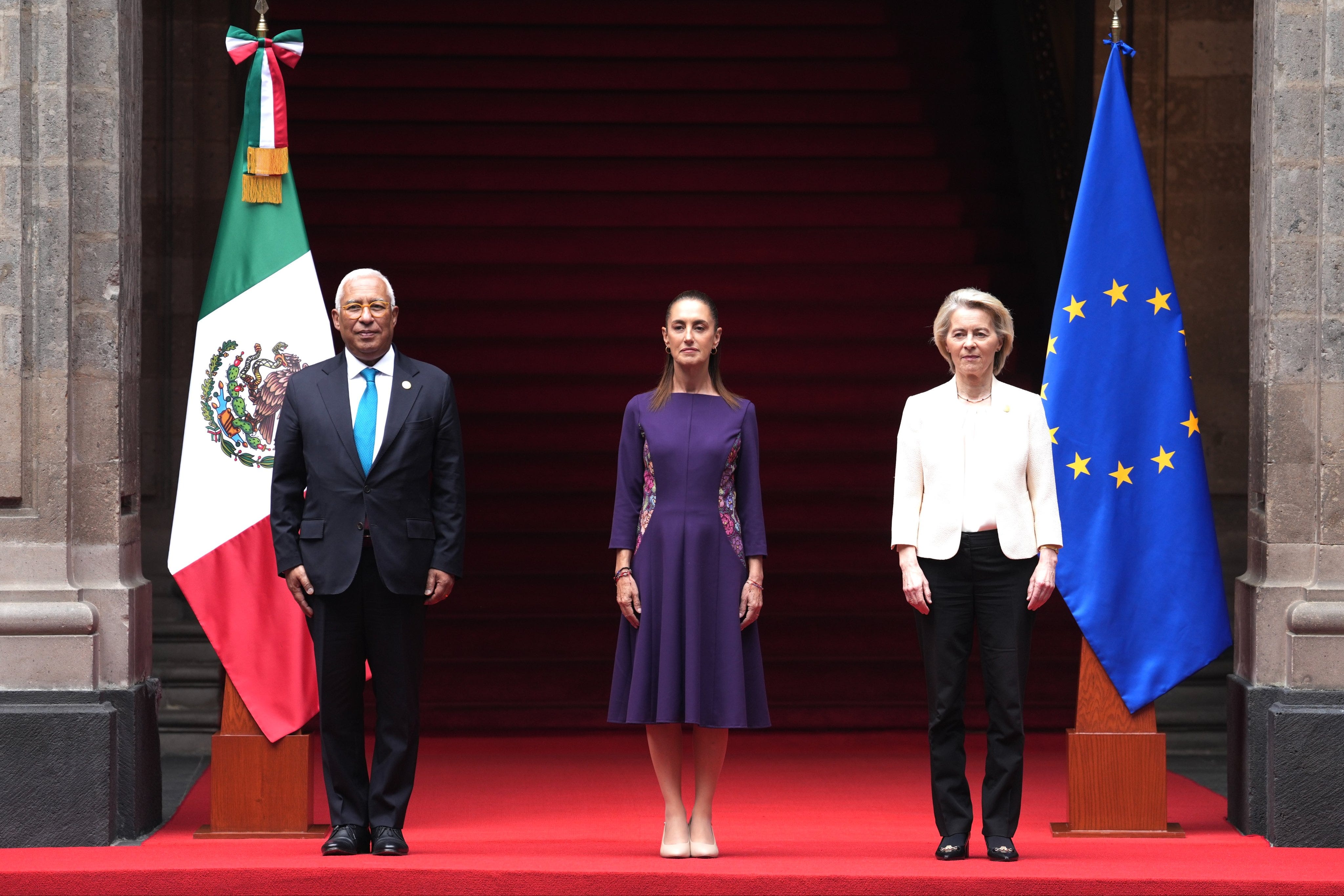
This image is used for illustrative purposes only.
The EU-Mexico trade deal in numbers: €86 billion in the shadow of a $900 billion relationship
The figures reveal both the ambition and its limits. Goods trade between the EU and Mexico reached €86.8 billion in 2025, with an additional €29.7 billion in services in 2024. A substantial commercial relationship — but one that pales against Mexico’s trade with the United States, which surpassed $900 billion in goods and services in 2024.
That gap is precisely what makes the Mexico City deal make sense. Mexico, caught between an increasingly protectionist American neighbor and a growing dependence on China for electric vehicle manufacturing, is looking to diversify its economic anchors. The EU, facing repeated tariff threats from the Trump administration despite a trade deal reached in 2025, is pursuing the same objective.
But shared interests do not mean identical positions. The agreement updates a text that had already eliminated bilateral tariff barriers — which is why the concrete gains are concentrated in specific areas: new European openings in agriculture (pork, dairy, cereals) and industry on one side, high-value Mexican products (coffee, chocolate, agave syrup) on the other. The protection of 568 European geographical indications and 26 Mexican ones — protected designations for region-specific products such as Champagne or Parma ham — reflects this logic of calibrated reciprocity.
Brussels builds its Latin American strategy, one deal at a time
The Mexico deal is not an isolated event. It is part of a deliberate sequence. In early May 2026, the EU brought into provisional force its agreement with Mercosur — the South American bloc comprising Argentina, Brazil, Paraguay, and Uruguay — after years of negotiations and prolonged political paralysis. (Mercosur functions roughly like a customs union, similar in structure to what NAFTA once was for North America, but with deeper political integration ambitions.)
A senior European official present in Mexico City said that 97% of Latin America and the Caribbean’s GDP would now be covered by preferential agreements with the EU — a figure invoked to underscore the exceptional density of the network thus built. “No other region in the world has such a dense and interconnected web of agreements,” the official said.
EU Trade Commissioner Maroš Šefčovič, who represented the Commission’s commercial agenda in Mexico, emphasized that more than 43,000 European companies export to Mexico, while over 11,000 EU firms operate there. Under the von der Leyen Commission, trade has increasingly functioned as an instrument of foreign policy — a tool for projecting European influence in regions where China has been steadily expanding its footprint.
Whether this strategy constitutes a deliberate counter to Beijing’s influence in Latin America is difficult to establish formally. But the timing and geography are suggestive.
The Mercosur shadow hangs over Mexico City
Brussels has clearly drawn lessons from the political storm that accompanied the Mercosur agreement. European farmers — particularly in countries with large agricultural sectors — had denounced what they saw as unfair competition from Latin American imports, and a group of MEPs (Members of the European Parliament) filed a legal challenge before the EU’s top court against the use of provisional implementation, a mechanism that allows the deal to take effect without ratification by all 27 member states.
The Mexico agreement is designed to avoid that scenario: sensitive agricultural imports remain capped through tariff-rate quotas (caps that allow a fixed volume of imports at reduced duties, with higher tariffs applied above that threshold). This legal architecture may be enough to defuse agricultural opposition — though some exposed sectors could yet contest the formula as import volumes grow. That remains an open question at this stage.
On the diplomatic stage, the agreement benefited from favorable political conditions. Signed at a bilateral summit with both presidents front and center, it was framed as a joint act of sovereignty in the face of Trumpian unpredictability. That carefully orchestrated staging reinforces the political readability of the deal well beyond its commercial substance.
Analysis: when trade becomes geopolitics
Three dynamics deserve to be distinguished here, at the risk of conflating the announcement effect with its actual reach.
First, the signal value is real but asymmetric. For the EU, this agreement is one piece of its post-Trump diversification strategy, consistent with its de-risking doctrine — reducing dependency without severing ties. For Mexico, it offers leverage in negotiations with Washington, but cannot — structurally — compensate for a commercial relationship ten times larger with the United States.
Second, the China question runs through the deal without ever being named in it. Mexico has become a production hub for Chinese electric vehicle brands seeking to circumvent American tariffs. In a context where the EU would have imposed additional duties on Chinese-made electric vehicles, both Brussels and Washington share a convergent interest in monitoring that channel — but no provision of the agreement explicitly addresses the issue.
Third, pace matters. The EU concluded the Mercosur deal, then the Mexico deal, within a matter of weeks. This compressed timeline suggests the von der Leyen Commission has decided to capitalize on the political window opened by Trump’s return — a U.S. president who, paradoxically, is the best sales argument for European trade diplomacy.
The bottom line
The real question is not whether the EU needs commercial partners in Latin America — no one disputes that. It is whether free trade agreements, however well constructed, can substitute for an industrial strategy. The EU is diversifying its export markets at the very moment its core industries — automotive, steel, chemicals — face structural challenges that trade policy alone will not resolve.
Brussels has signed an agreement. The harder question is what Europe will have to sell along those new routes in a decade.
Sources: Euronews