
EU growth forecast cut as Strait of Hormuz crisis hits hard
The EU has cut its 2026 growth forecast to 1.1% as the Strait of Hormuz crisis pushes energy costs higher and reignites inflation.

Europe has a conditioned reflex when energy crises strike. On Thursday, May 21, the European Commission — the EU’s executive arm, responsible for its official economic projections — released its spring forecast: growth across the bloc is now expected at just 1.1% for 2026, down from 1.4% projected last autumn. For the eurozone, the group of EU member states sharing the euro, the downward revision is even steeper, to 0.9%. The culprit: mounting disruptions around the Strait of Hormuz, the critical maritime chokepoint separating Iran from the Sultanate of Oman, through which a substantial share of the world’s oil and natural gas flows — and which has come under growing pressure from the ongoing conflict in the Middle East.
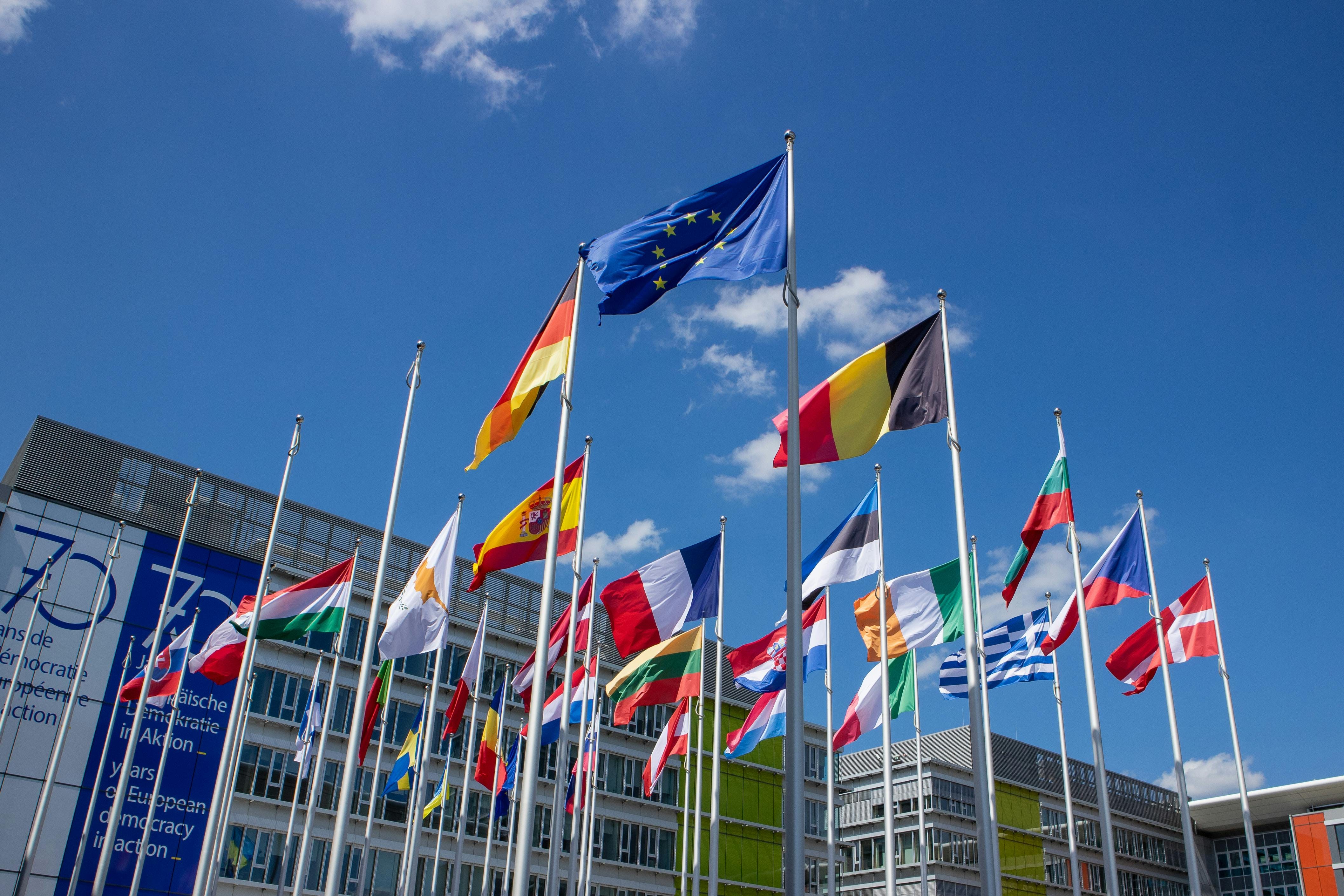
This image is used for illustrative purposes only.
At a Glance
The European Commission has cut its 2026 EU growth forecast to 1.1%, down from 1.4% projected last fall — and to just 0.9% for the eurozone alone.
EU inflation for 2026 is now projected at 3.1%, a full percentage point above earlier estimates, driven by soaring energy costs tied to the Strait of Hormuz crisis.
Italian Prime Minister Giorgia Meloni is pressing Brussels for emergency fiscal flexibility on energy spending, modeled on the budget exemption already granted for defense.
A familiar shock, a painful echo
The Commission’s report is blunt: until late February 2026, Europe’s economic outlook was tracking a trajectory of modest growth alongside continued disinflation. The conflict around the Strait of Hormuz changed everything.
The strait is a narrow waterway separating Iran from the Sultanate of Oman, through which a substantial share of the world’s oil and liquefied natural gas travels each day on its way to European and Asian markets. Any credible threat to this passage is enough to send Brent crude and TTF — Europe’s natural gas benchmark index — sharply higher.
For European officials, the comparison to 2022 is unavoidable: Russia’s invasion of Ukraine triggered one of the most severe energy crises the continent had faced in decades. The Commission now explicitly describes the current situation as “a second shock of this kind in less than five years.”
Inflation back on the rise: what the growth outlook really means
The transmission mechanism is straightforward. Rising energy prices feed directly into inflation — first through transportation and household heating costs, then into industrial production costs, then into food prices through more expensive fertilizers and cold-chain logistics. This cascading effect — what economists call second-round effects — is precisely what the European Central Bank (ECB) spent two years bringing under control after the 2022 shock.
Consumer confidence has already taken a hit, falling to its lowest point in forty months, which could weigh on household spending — one of the primary drivers of growth in most European economies. Business investment is expected to slow as well, caught between rising operating costs and deepening uncertainty. Export growth is also losing steam as global demand softens.
A more resilient Europe — but not an immune one
The Commission is careful to frame this as a different kind of shock from 2022. The intervening years have brought meaningful diversification of gas supply — accelerated by the break from Russian imports — along with a significant expansion of renewable energy capacity. Structural gas consumption across the bloc has also declined since 2021.
These buffers could limit the severity of the blow, but they cannot neutralize it. Risks remain “strongly tilted to the downside,” Brussels acknowledges, warning that a prolonged disruption of the Strait of Hormuz — or broader Middle Eastern supply chains — could trigger shortages of refined petroleum products, fertilizers, and industrial inputs, spreading the economic pain well beyond household energy bills.
Every gigawatt of wind or solar installed diminishes dependence on Gulf oil flows.
Rome sounds the budget alarm
It is against this backdrop that Italian Prime Minister Giorgia Meloni has called on the Commission to loosen European budget rules for member states facing emergency energy spending. Her request rests on a precedent: a national escape clause adopted by the EU that allows member states temporary fiscal flexibility for defense spending under exceptional circumstances.
Rome’s argument deserves to be taken seriously — even if accepting it would raise significant governance questions. Italy, whose public debt ranks among the highest in the eurozone, is precisely the kind of member state for which European fiscal discipline — enshrined in the Stability and Growth Pact, the EU’s fiscal rulebook governing member state borrowing and deficits, which was recently reformed — matters most.
For an American reader, the closest analogy might be a state government asking Congress to suspend PAYGO rules — the automatic budget-balancing mechanisms built into federal law — on grounds of a geopolitical emergency. The argument is politically compelling. It does not make the structural questions it raises any easier to answer.
Analysis: when geopolitics becomes the primary macroeconomic variable
This spring forecast from the Commission illustrates something that standard economic models still struggle to incorporate: in an open economy, geopolitics is a first-order macroeconomic factor — not a residual externality. Europe, as a net importer of fossil fuels, remains structurally exposed to any conflict in transit zones it does not control.
Two readings of this situation are possible. The optimistic one holds that the ongoing energy transition is progressively reducing this exposure: every gigawatt of wind or solar installed diminishes dependence on Gulf oil flows. The more sobering reading is that the transition remains far from complete, and that European economies are, for now, still hostage to a geopolitical equilibrium they do not shape.
The Italian budget request also illustrates a recurring tension at the heart of EU economic governance: how to make common rules designed for stability coexist with asymmetric shocks that hit member states very differently. A country like Germany, with an energy-intensive industrial base, or Italy, with constrained public finances, has far less room to absorb a sudden energy price surge than Sweden or the Netherlands.
The bottom line
Europe has learned from 2022 — that much is clear. It has diversified its sources, expanded renewables, and reduced consumption. But the deeper question raised by the Hormuz crisis goes further: at what pace can the continent genuinely reduce its dependence on imported fossil fuels before the next geopolitical shock — whatever form it takes — arrives? And if that pace proves insufficient, what common fiscal architecture would allow Europe to absorb these shocks without deepening the fractures between member states?
Sources: Euronews · European Commission