
EU farm funds: UAE royal family pockets €71 million in subsidies
The Al Nahyan family, worth over $300 billion, collected €71M in EU farming subsidies over six years. A structural flaw hiding in plain sight.

At a Glance:
The Al Nahyan family — rulers of the United Arab Emirates, with an estimated net worth exceeding $300 billion — collected over €71 million in European agricultural subsidies between 2019 and 2024, through a network of subsidiaries operating in three EU member states.
The mechanism is straightforward: payments under the Common Agricultural Policy (CAP), the EU’s flagship farm subsidy program, are calculated based on cultivated acreage, which structurally favors industrial-scale operations — including the largest single farm in the entire European Union, Agricost, in Romania.
The European Commission has proposed capping these payments at €100,000 per beneficiary per year starting in 2028 — a fraction of what Agricost alone received last year.
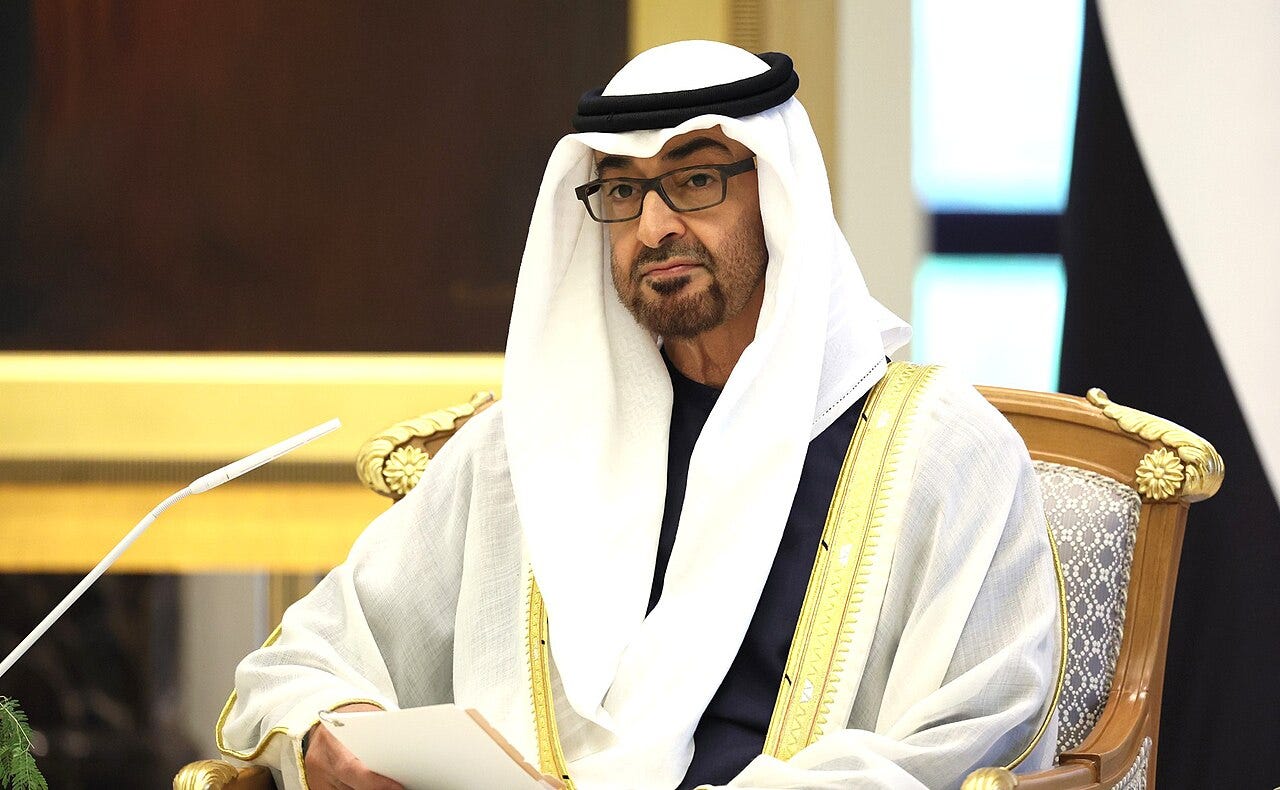
Europe’s largest farm, owned by a Gulf royal family
At the center of the story sits Agricost, a 57,000-hectare operation spread across Romania’s plains — five times the size of Paris — that holds the title of the largest farm in the European Union. In 2024 alone, it received €10.5 million in direct CAP payments, more than 1,600 times the amount collected by the average EU farm.
Agricost is controlled by Al Dahra, a UAE agribusiness conglomerate founded by Sheikh Hamdan bin Zayed Al Nahyan, brother of UAE President Mohamed bin Zayed Al Nahyan. Abu Dhabi’s sovereign wealth fund ADQ acquired a 50 percent stake in Al Dahra in 2020, according to its last disclosed ownership structure. A cross-border investigation by the DeSmog consortium, published in partnership with The Guardian, eldiario.es and G4Media, traced 110 subsidy payments to this corporate network between 2019 and 2024.
In Spain, Al Dahra operates more than 8,000 hectares across several regions, collecting over €5 million in CAP subsidies over the past decade. In Italy, ADQ acquired Unifrutti, a fruit producer valued at approximately $830 million, whose Sicilian farms received at least €186,000 in subsidies in the three years following the acquisition. The produce — primarily alfalfa and other animal feed crops — is largely destined for export to the Gulf, supplying the UAE’s rapidly growing dairy sector. The UAE currently imports up to 90 percent of its food, a structural consequence of the country’s extreme heat, water scarcity and sandy terrain.
Al Dahra, Agricost and the UAE Embassy did not respond to requests for comment. ADQ declined to comment.
A subsidy formula that rewards scale, not purpose
The CAP represents roughly a third of the EU’s total budget — approximately €54 billion distributed annually to farmers and rural areas across the bloc. Think of it as the EU’s equivalent of the USDA’s direct payment programs in the United States: a system designed to stabilize farm incomes by providing predictable annual transfers tied to land use. Its core mechanism — payments indexed to cultivated hectares — was designed in the 1990s to protect European agricultural income. In principle, the larger the productive operation, the higher the entitlement. That rule, neutral on its face, now produces effects that are the near-opposite of the program’s original mission.
The top 0.5 percent of EU landowners capture 16 percent of the entire CAP budget. At the other end, the vast majority of recipients collect modest amounts from the program each year. It is this architecture — conceived for European farming families — that allows a Gulf oil monarchy to collect tens of millions in European public funds without breaching a single rule.
A transparency gap compounds the problem. EU member states are required to publish lists of CAP beneficiaries, but the databases only name the direct recipient, not the ultimate beneficial owner. Tracing the ownership chain back to the Al Nahyan family required months of cross-border investigative work. This suggests the €71 million figure identified by the consortium may represent only a portion of the actual total: Unifrutti’s farms in Sicily and the Almería region of Spain could not be fully traced in official records.
The reform debate: resistance meets political reality
In July 2025, the European Commission — the EU’s executive arm — published a proposal for the 2028–2034 CAP cycle that would cap direct payments at €100,000 per beneficiary per year. If adopted, the measure would reduce what the Al Nahyans’ Romanian operation received in 2024 by a factor of one hundred.
The proposal has run into a broad coalition of opponents, including several EU agriculture ministers, some Members of the European Parliament (MEPs), and the bloc’s main farming industry groups. The case for the status quo is familiar: large farms are the most efficient, and capping their subsidies would penalize European agricultural competitiveness.
This debate is not new — it echoes many others Europe has had with itself about reconciling economic efficiency with equity. The Al Nahyan case, however, gives it a sharper dimension. It is no longer simply a dispute about redistribution within Europe. It raises the question of democratic accountability over the use of public funds. A sovereign wealth fund controlled by a ruling royal family of a non-EU state — one whose human rights record has drawn repeated criticism, which Abu Dhabi has consistently denied — collects tens of millions in European taxpayer money each year. Under current rules, nothing distinguishes it from a family farmer in Poland or Romania.
Marc Valeri, associate professor in political economy of the Middle East at the University of Exeter, notes that the boundary between state funds and the ruling family’s finances is structurally blurred in the UAE. That opacity, layered onto the CAP’s own transparency gaps, could indicate a systemic vulnerability in the European subsidy architecture — one that non-EU actors with divergent national food security objectives are well positioned to exploit.
For local producers, the impact is already tangible. In Fondarella, Catalonia — home to Al Dahra Europe’s regional headquarters — farmers who sell alfalfa to the company describe a situation of near-total commercial dependence: the company dictates both volume and price, leaving local growers with no viable alternative. Proponents of the cap argue that 99 percent of European farmers receive less than €100,000 per year in subsidies — money, they say, that was never meant to flow to petrostate dynasties.
The bottom line
The CAP was built for farmers. It now writes checks to sovereign wealth funds.
The Commission has proposed the fix — Parliament and the Council must now decide. But the question that outlasts any budget negotiation is more fundamental: how far is Europe prepared to let its domestic policy instruments become, by default, food security tools for Gulf monarchies? The coming reform will show whether Brussels is willing to answer it — or whether it would rather not ask.
Sources: DeSmog · France 2 / L’Œil du 20 heures · The Guardian · eldiario.es · G4Media