
Denmark's first majority-women cabinet
After more than two months of negotiations, Mette Frederiksen begins a third term leading a center-left coalition — and makes history with a cabinet where women outnumber men.

Denmark has just written two pages of history at once. On Tuesday, June 3, 2026, Mette Frederiksen, Denmark’s Social Democratic prime minister, presented King Frederik X with a 21-member cabinet in which 11 of the ministers are women — a first in the kingdom’s history. The new government is also the product of the longest coalition negotiations Denmark has ever seen: 69 days — more than two months — compared to six weeks following the 2022 election. Frederiksen, in power since 2019, ultimately prevailed after two right-wing coalition attempts failed.
At a Glance
A historic first: for the first time in Danish history, the cabinet has more women (11) than men (10) among its 21 ministers.
Third term amid geopolitical crisis: Frederiksen consolidates her hold on power as the face of Danish resistance to U.S. pressure over Greenland, the self-governing Arctic territory that President Donald Trump has repeatedly said he wants to acquire.
A fragile minority coalition: the four coalition parties — Social Democrats, the Socialist People’s Party (SF, a green-left party), the Social Liberals, and the Moderates — hold just 82 of the 179 seats in the Folketing (Denmark’s parliament) and will need outside support to pass legislation.
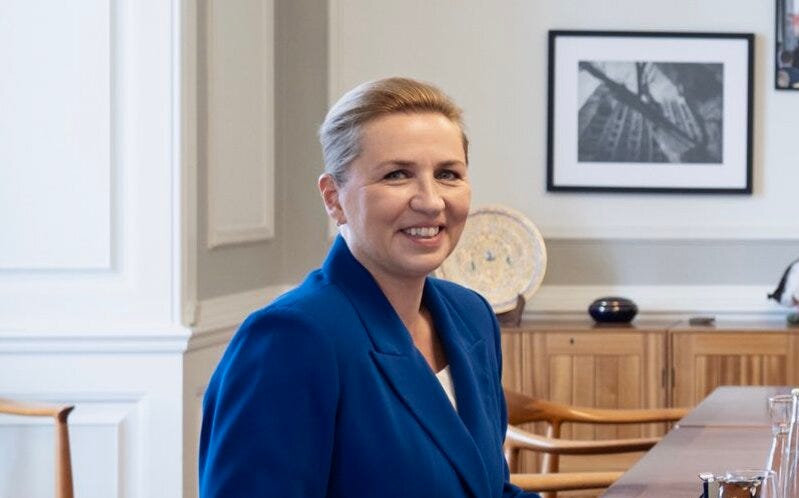
This image is used for illustrative purposes only.
The longest coalition talks in Danish history
Sixty-nine days — more than two months: that is how long it took Denmark to form a government after the March 24, 2026 parliamentary election. A national record, it reflects the unusually fragmented state of Danish politics — 12 parties represented in the Folketing — and the complexity of the ideological trade-offs involved.
Frederiksen’s Social Democrats had suffered their worst election result since 1903 in the March vote, winning only 21.9% of the vote and 38 seats, down 12 from 2022. Yet the party remained the largest in parliament. A first attempt to form a right-wing government, led by Troels Lund Poulsen of Venstre (Denmark’s main center-right liberal party), collapsed last month, clearing the path for Frederiksen.
The coalition she assembled brings together her Social Democrats with three other parties: the Socialist People’s Party (SF), a green-left formation; the Social Liberals (Radikale Venstre), a centrist social-liberal party; and the Moderates, a centrist party led by Lars Løkke Rasmussen, a veteran politician who served as prime minister twice before and who retains his post as foreign minister. Together, the four parties hold approximately 82 seats — short of a majority in the 179-seat Folketing, with the precise count depending on how affiliated and overseas constituencies are allocated. Like most Danish governments, this one is a minority administration that will need to build ad-hoc majorities with other left-leaning parties, including the Red-Green Alliance, to pass legislation.
A government shaped by the Greenland crisis
The Greenland question has dominated both the campaign and Frederiksen’s political comeback. Trump’s repeated statements about acquiring Greenland — a self-governing Danish territory of 56,000 people strategically located in the Arctic — prompted Frederiksen to adopt a posture of firm resistance that analysts credit with sustaining her political standing despite a difficult electoral result.
The geopolitical crisis produced a paradox: it strengthened Frederiksen’s position after months of domestic difficulties, including her party’s loss of the Copenhagen mayoralty in the November 2025 municipal elections for the first time in 87 years.
“She is a unifying figure in a world full of insecurity, and Danes are anxious — there is Greenland, Ukraine, the drones.” — Elisabet Svane, political analyst, Politiken [translated from French via AFP]
The incoming government inherits an ambitious defense posture. Under Frederiksen, Denmark raised defense spending to over 3% of GDP, extended military conscription to women, and — in a landmark 2022 referendum — ended its longstanding opt-out from European Union defense policy, a significant step toward deeper integration in collective European security. These commitments are expected to continue and intensify in the face of Russia’s war in Ukraine and transatlantic tensions.
A platform for animals, climate, and welfare
One of the more unexpected features of Denmark’s 2026 campaign was the prominence of animal welfare as a political issue. The coalition program explicitly includes commitments on the subject — a reflection of growing public demand in a country with a large agricultural sector. Frederiksen herself framed her government’s agenda in notably broad terms: “a government programme for the people who live in Denmark now, for the generations to come, and also for the animals.”
On climate, Denmark maintains one of the most ambitious emissions targets in the European Union: a 70% reduction by 2030, alongside a pioneering tax on agricultural emissions adopted during the previous legislature. The coalition will also face sustained pressure to address the cost-of-living concerns that drove many votes in March.
Analysis: the Frederiksen paradox
Mette Frederiksen’s political trajectory is unusual by European standards. At 48, in power since 2019, she is beginning a third term after her party’s worst election result in more than a century — and in a country where majorities are rare, coalitions are laborious, and no credible successor within the Social Democrats has emerged, as analyst Christine Cordsen of public broadcaster DR has noted.
The explanation lies partly in the structure of Danish democracy itself. Denmark uses proportional representation — a system where parties win seats based on their share of the popular vote, unlike the U.S. winner-takes-all model. That structure rewards coalition-builders over electoral strongmen, and Frederiksen is precisely that: a skilled political operator who has repositioned her party toward a tougher stance on immigration and fiscal discipline while defending the Scandinavian welfare state.
The majority-female composition of her cabinet is not a symbolic accident. It reflects a structural trend in Scandinavian politics: Denmark already elected a record number of women to the Folketing in the 2022 elections. In this respect, the new government mirrors the demographic reality of a country that has made gender equality a marker of institutional modernity.
The Bottom Line
The Frederiksen III government is an instructive anomaly: born out of its own party’s electoral defeat, governing without a majority, confronting a geopolitical crisis without precedent since the Cold War on its own sovereign territory. Yet it may represent the form of leadership best suited to Europe in 2026 — not one that prevails at the ballot box, but one that persists through competence, institutional anchoring, and the ability to hold fragile coalitions together. The real question is not whether Frederiksen will survive a third term. It is whether the Nordic model of governance — consensual, gradualist, firmly rules-based — can hold in a world where Trump covets the Arctic, Putin strikes Ukraine, and fragmented electorates resist any stable majority.
Sources: France 24 · AFP · Reuters · Euronews