
Chinese EVs in Europe: the continent holds, but for how long?
Chinese brands just doubled their share of the EU auto market. Brussels' tariff barriers haven't been enough to stop the advance. An analysis.

The numbers published by the European Automobile Manufacturers’ Association (ACEA) — the EU’s main industry body, equivalent to the Alliance for Automotive Innovation in the U.S. — for the first four months of 2026 tell two simultaneous stories: one of a growing market, and one of a European industry slowly losing ground on its home turf.
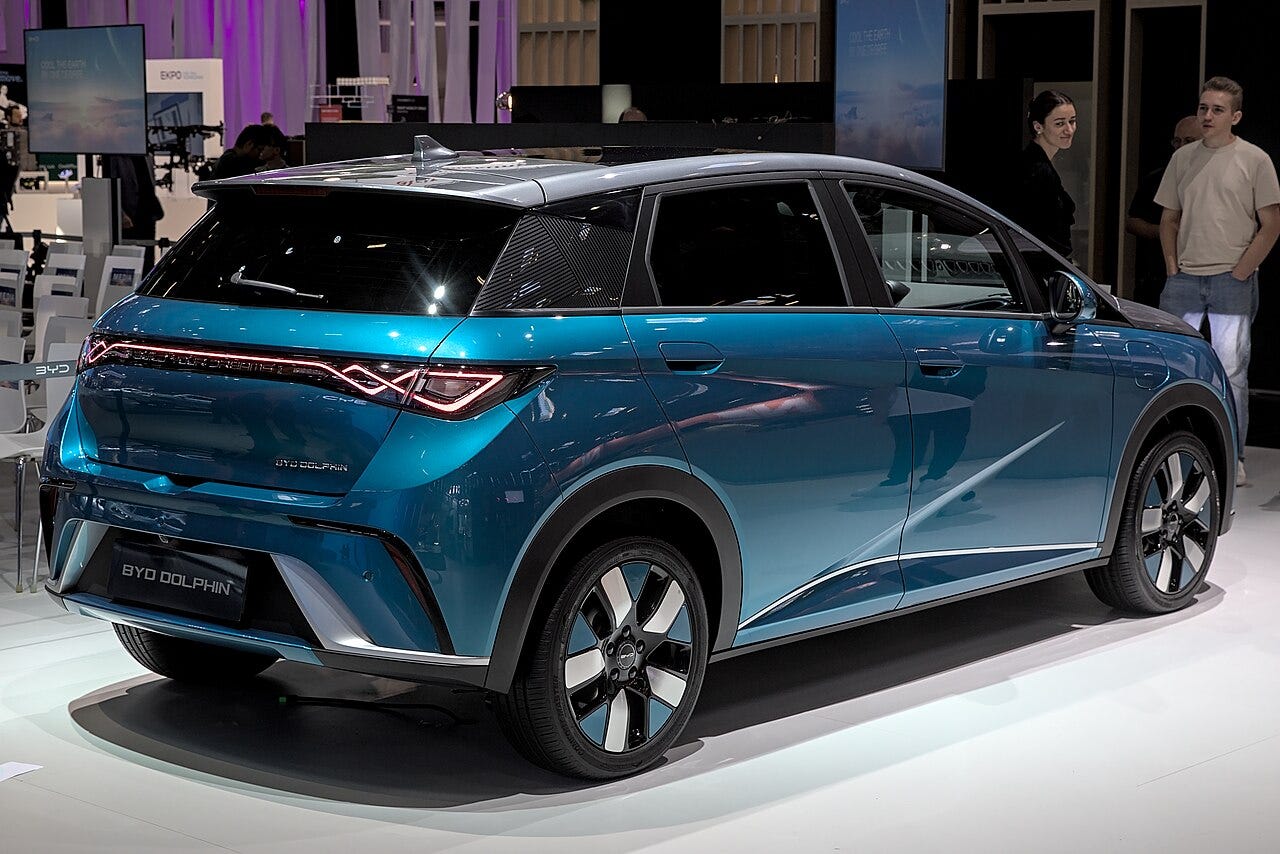
This image is used for illustrative purposes only.
At a Glance
New car registrations in the European Union rose 4.2% in January–April 2026, to nearly 3.8 million vehicles.
Fully electric cars now account for 19.7% of the EU market over the period, up from 15.3% a year earlier.
Chinese brands doubled their market share, climbing from 3.2% to roughly 6% of EU registrations.
A market in accelerated transition
The headline figures look reassuring: +4.2% in cumulative January–April registrations, driven by the bloc’s four largest markets. Italy led electric vehicle sales growth at +25.5%, followed by Spain (+19.7%), Germany (+6.6%), and France (+2.3%). For April alone, battery-electric vehicle sales surged 37.7% year-on-year across the EU, reaching a 20.6% monthly market share.
The transition is also deepening from the base up. Non-plug-in hybrids accounted for 36.9% of April sales, plug-in hybrids for 9.8%. Together, pure gasoline and diesel vehicles fell to less than 30% of monthly sales — down from above 50% just three years ago. That structural shift is effectively irreversible.
What should concern European automakers is not the overall trend — which broadly favors them — but what it reveals about their competitive position. The growth of the European electric market is being captured, in part, by players Brussels believed it had contained.
The Chinese surge: numbers that don’t lie
BYD — China’s leading electric vehicle manufacturer and the world’s largest EV seller by volume — posted a 152.9% increase in EU registrations during the first four months of 2026, surpassing 71,850 units. Chery Automobile, present in Europe through its Omoda, Jaecoo, and Jetour brands, jumped 267.1% to more than 48,350 units. Leapmotor, distributed through a joint venture with Stellantis — the multinational automaker behind Fiat, Peugeot, Citroën, Chrysler, and a dozen other brands — surged 558.8% to over 28,700 units. SAIC Motor, owner of the MG brand and the largest Chinese automaker by volume in Europe, added another 10.4%, exceeding 77,000 units.
In total, Chinese brands captured roughly 6% of EU registrations in the period, up from 3.2% a year earlier. On the broader European market — including the United Kingdom and the four countries of the European Free Trade Association (EFTA: Switzerland, Norway, Iceland, and Liechtenstein) — that share reached 7.3%, compared to 3.7% in 2025.
These figures need context. According to available industry data, Chinese brands held less than 1% of the European market in 2022. In two and a half years, they have multiplied their presence roughly sevenfold on this broader perimeter. The acceleration has occurred despite additional tariffs imposed by the European Commission — estimated at between 7.8% and 35.3% depending on the manufacturer, introduced in 2024 on top of the standard 10% duty. This sequence could suggest that the punitive tariffs have done more to reshape the field of competitors — favoring those who manufacture locally or through European partnerships, like the Leapmotor-Stellantis venture — than to slow overall Chinese volume growth.
European champions: lead maintained, signals mixed
Volkswagen Group retained its position as the EU’s largest automaker, with 26.7% of registrations and just over one million vehicles sold in the period (+2.9%). But that average conceals vulnerabilities: the core Volkswagen brand slipped 3.2%, while Škoda rose 15.5% and Audi climbed 8.6%. The group is compensating at the premium end for what it loses on volume segments — precisely where Chinese competition is sharpest.
Stellantis staged a strong recovery (+7.8%, 648,000 units, 17.1% market share), driven by a rebound of over 32% at Fiat and a 22% combined increase for Opel and Vauxhall. Renault Group fared worse: -7.4%, to roughly 384,250 units, with a particularly sharp drop of over 15% for Dacia — its low-cost brand and the one most directly exposed to Chinese price competition.
BMW and Mercedes-Benz posted modest gains of 3.9% and 3.8% respectively, confirming the relative resilience of the European premium segment. Toyota and Hyundai both recorded moderate declines.
Analysis: the home-field advantage is starting to erode
The European auto industry is not in crisis — not yet. But it faces a structural challenge that aggregate registration figures tend to obscure: the growth of the electric segment, which will be the only engine of market expansion over the next decade, is being contested by players with structurally lower production costs.
The Leapmotor case illustrates the sophistication of the Chinese strategy. By partnering with Stellantis, Leapmotor gains access to European distribution networks, partially circumvents trade barriers, and could potentially benefit from a European assembly designation for some models. This partnership-based infiltration model could become the norm — which suggests that Brussels’ trade protection instruments may be progressively neutralized by industrial geography rather than negotiation.
The retreat of diesel and gasoline to below 30% of monthly sales puts European automakers in a structurally difficult position. Their historical margins rested on those segments. The shift to electric is unavoidable, but it is occurring in a price range where Chinese rivals hold a structural cost advantage — driven by a vertically integrated battery supply chain that Europe has not yet assembled. Industry analysts describe that advantage as significant, though difficult to quantify precisely.
For American readers, the dynamic echoes what Detroit experienced in the 1970s against Japanese automakers: an established, domestically dominant industry confronted by new entrants who operated under different cost structures and different trade rules. History does not repeat — but the parallels are worth naming.
The Bottom Line
Brussels has two main levers: trade policy (tariffs, subsidy investigations) and industrial policy (support for the battery supply chain, technical standards). It has activated the first, with results that appear insufficient. The second is moving slowly, constrained by disagreements among member states over financing.
The question will no longer be how to protect European industry. It will be what Europe is prepared to sacrifice to rebuild it.
Sources: Euronews · ACEA