
China's industrial offensive: EU running out of time
The head of the European Parliament's largest party warns that Beijing's export surge is costing Europe almost a billion euros a day and that Brussels must act before the damage becomes irreversible.

At a Glance
Manfred Weber, president of the European People’s Party (EPP) — the EU Parliament’s dominant center-right bloc — is calling for a wholesale reset of Europe’s relationship with China ahead of the June 18 EU summit, citing a trade deficit approaching a billion euros a day.
The European Commission itself has acknowledged that the current state of EU-China trade is no longer sustainable, joining a France-led coalition pushing for a harder line with Beijing.
Weber demands that European development aid stop indirectly funding Chinese companies, and that access to the EU’s single market be used as a direct bargaining chip against China.
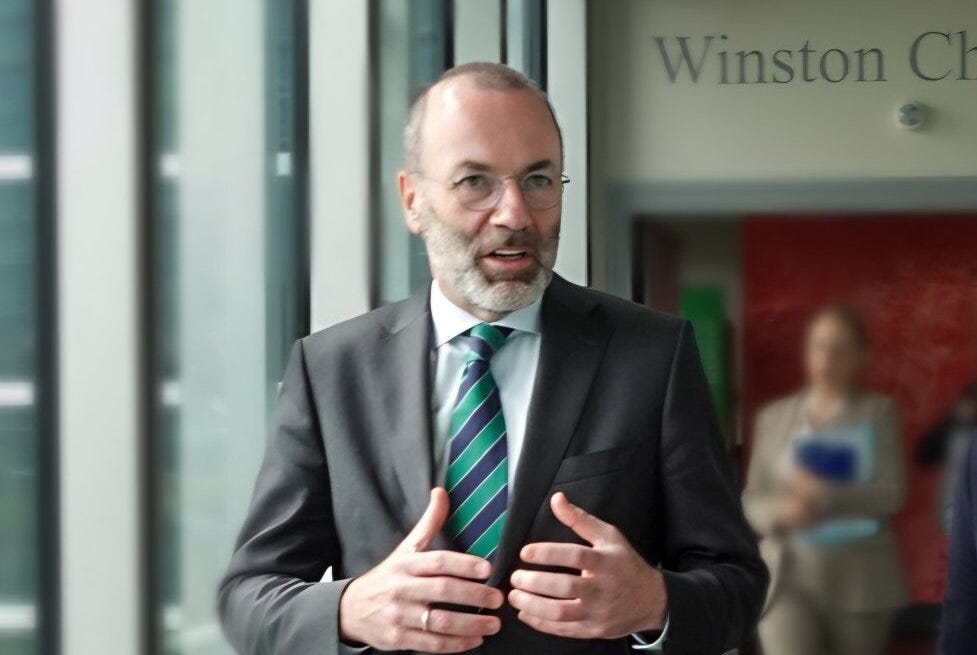
This image is used for illustrative purposes only.
A diagnosis Brussels no longer disputes
For decades, the European Union managed its relationship with China through a framework built on mutual economic dependence and the expectation of gradual political convergence. That framework is now crumbling — and it is not just the conservative wing of the European Parliament saying so. On May 29, the European Commission — the EU’s executive arm — formally acknowledged in an official statement that the current state of EU-China trade and investment relations was no longer viable. The language was unusually blunt for an institution typically steeped in diplomatic hedging.
Maroš Šefčovič, the EU’s Trade Commissioner, reinforced that assessment after meeting with China’s trade envoy Li Chenggang in Paris on Thursday. The two sides agreed to launch a deeper dialogue to address a trade imbalance that had become, in Šefčovič’s words, impossible to sustain. Behind the diplomatic framing lies a stark reality: Chinese overproduction in steel, batteries, solar panels, and electric vehicles is flooding European markets at prices domestic manufacturers cannot match.
Weber’s leverage argument
What distinguishes Manfred Weber’s intervention from standard political posturing is his concrete prescription: turn access to the EU’s single market — the world’s largest consumer bloc — into a pressure tool. “China needs us,” he argued in an interview with the German Sunday newspaper Bild am Sonntag, insisting that this dependency should be actively leveraged to enforce fair competition standards.
Weber pointed to the additional EU tariffs placed on Chinese electric vehicles in recent years following an anti-subsidy investigation as a model to expand. He went further, raising a case that has drawn quiet outrage in Brussels: EU development aid funded with European taxpayer money was used to purchase 380 natural gas buses for Senegal — a contract won by a cheaper Chinese bidder over a European competitor. He stated that European development aid must not benefit Chinese companies, adding that going forward, anyone wanting to sell in Europe will have to follow European rules.
The risks of a harder line
Confrontation carries costs. A more aggressive trade posture toward Beijing could trigger Chinese countermeasures targeting critical raw materials — rare earth elements, lithium, gallium — which China is believed to dominate in terms of global production and refining capacity. These inputs are essential for Germany’s automotive industry, semiconductor manufacturing, and Europe’s own energy transition.
Recent and pending trade agreements with Canada, Mercosur countries, and India could partially redirect supply chains over time. They are not an immediate substitute for a break with China. Europe’s dilemma is acute: it depends on China to source the components needed for decarbonization, while also relying on Chinese demand to absorb some of its own industrial exports. Threading the needle between firmness and rupture may be the most delicate challenge on the June 18 summit agenda.
Analysis: The paradox Europe can no longer ignore
Weber’s intervention reflects a deeper shift within the European center-right, historically one of the EU’s most free-trade-oriented political traditions. The EPP — which dominates the European Parliament and has significant influence over the Commission’s direction — is moving toward a brand of pragmatic protectionism that would have seemed heretical a decade ago.
The industrial logic is not hard to follow. Germany, Europe’s manufacturing engine, is under pressure. Sales of German cars in China are declining as Chinese manufacturers — with BYD appearing to consolidate its position at the front of the pack — gain ground on European soil. The electoral pressure compounds the economic pain: populist parties on both left and right have thrived precisely on the sense of industrial abandonment this dynamic generates.
Whether the rhetoric will produce results is another question. Unanimity in the EU Council — the body where EU member states’ governments negotiate and vote — on trade matters is notoriously difficult to achieve. Hungary maintains close ties with Beijing, and several other member states worry about retaliation against their own export sectors. Weber speaks for the EPP; he does not yet speak for Europe.
The bottom line
Europe has long believed it could be China’s largest trading partner and its primary regulator at the same time. That dual posture may finally be reaching its limits.
The real question is not whether the EU should push back harder — on that, an unusual consensus is forming. It is whether Europe has the political cohesion to back words with coordinated action. A single market without a unified trade strategy remains a half-armed power. The June 18 summit will show whether this emerging consensus is a genuine turning point or, once again, a well-worded communiqué.
Sources: Euronews · Bild am Sonntag · European Commission