
Brave Germany: Berlin joins the drone war
Germany and Ukraine have launched Brave Germany, a joint defense technology program covering AI weapons, long-range drones, and deep-strike systems.

A strategic shift that goes well beyond military aid.
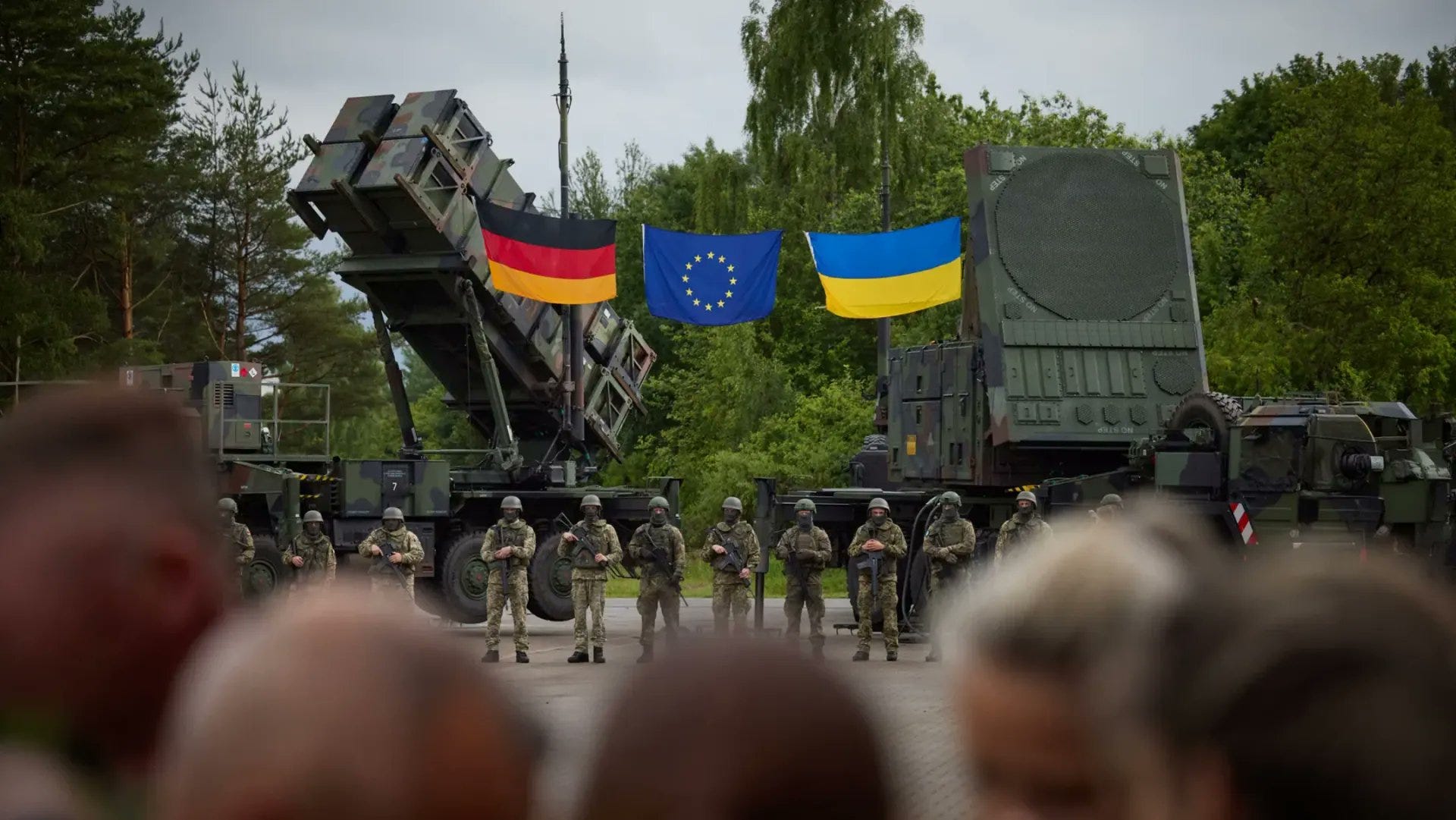
On May 11, 2026, Boris Pistorius landed in Kyiv unannounced. Not for a symbolic solidarity photo op — to sign. Within hours, Germany’s Defense Minister and his Ukrainian counterpart, Mykhailo Fedorov — Ukraine’s Deputy Prime Minister and Minister of Digital Transformation — had formalized the Brave Germany partnership: a bilateral program for co-developing weapons systems that marks Germany’s entry into a new phase of its military commitment to Ukraine, and more broadly, into the reshaping of European security architecture.

At a Glance
Pistorius and Fedorov signed a letter of intent launching Brave Germany, a joint program to develop defense technologies including drones, AI, and long-range strike systems.
The program provides for joint production of drones ranging from under 60 miles to nearly 1,000 miles in range, with a first competitive grant round expected before the end of 2026.
Fedorov stated that Germany now accounts for roughly one-third of all security assistance provided to Ukraine, making it the world’s largest single contributor.
The Brave Germany program: what the agreement actually entails
The deal goes beyond declarations. The initiative establishes a joint grant mechanism targeting Ukrainian and German startups working in sectors considered decisive for the future of warfare — including unmanned systems, artificial intelligence, high-power laser systems, and advanced missile technologies. The first competitive phase is set to launch before the end of 2026.
Brave Germany operates through Brave1, Ukraine’s government-backed defense innovation cluster, which supports military technology developers and enables rapid testing of new systems under real combat conditions. Think of it as a cross between a DARPA challenge grant program and a battlefield-tested defense accelerator — with the critical difference that the testing ground is an active war. Germany brings the industrial capacity and capital; Ukraine brings the laboratory.
On the capabilities side, the ambition is striking. The two countries intend to co-produce drones across a full spectrum of ranges, from under 60 miles to nearly 1,000 miles. The broader defense package also includes €300 million ($330 million at current exchange rates) in investment in Ukrainian deep-strike capabilities — long-range precision strikes capable of hitting high-value military and infrastructure targets far behind the front line — along with funding for 36 IRIS-T surface-to-air missile launchers to reinforce air defense.
What Germany is really after — and can’t buy anywhere else
It would be reductive to read Brave Germany as a simple solidarity gesture. Berlin has its own strategic interest in this deal.
Germany’s Bundeswehr — the country’s federal armed forces — is massively equipped on paper, but it lacks one critical capability: the ability to strike with precision at distances of several hundred to thousands of miles behind enemy lines. This gap matters. Under then-Chancellor Olaf Scholz, Germany had agreed with former President Joe Biden to deploy American Tomahawk cruise missiles on German soil as a deterrent against Russia. President Donald Trump’s subsequent decision to question that deployment — part of a broader reassessment of the U.S. military presence in Europe — left Berlin without a reliable answer to that gap.
Germany is also studying Ukraine’s battlefield command infrastructure, including the DELTA battlefield management network, to draw operational lessons. It is plausible that Berlin is looking to fast-track its own technological capabilities by leveraging combat experience that no NATO exercise can replicate.
A productive asymmetry — and its limits
The partnership rests on a striking complementarity. Ukraine has turned this war into an incubator: rapid iteration cycles, immediate battlefield feedback, high tolerance for operational risk. Germany brings industrial scale, export certification networks, and long-term procurement standards. Several Ukrainian companies have already established joint production facilities with German firms.
This dynamic is not without friction. Russia responded immediately. A Russian Defense Ministry spokesperson characterized the initiative as making Germany complicit in what Moscow called “terrorist attacks” against Russian territory, claiming Berlin was assuming direct responsibility for potential strikes into Russia’s strategic depths.
Berlin is no longer merely supplying equipment. It is co-designing offensive weapons.
That framing, however predictable, reflects a coherent reading — one that goes to the heart of what Brave Germany actually represents.
Analysis — Four readings of a deal that goes beyond Ukraine
① The end of the restraint doctrine. Since the war began, Germany had systematically calibrated its weapons deliveries to avoid any appearance of direct escalation. Co-developing drone systems with close to a 1,000-mile range marks a break with that operational caution. This sequence — the Trump administration’s uncertainty over the Tomahawk deployment, the pressure on European strategic autonomy — could indicate that Berlin has concluded an independent European deterrence capability is no longer optional.
② A model that could go continental. Brave Germany draws structurally on similar British programs and on the logic of the Ukraine Defense Contact Group, the multinational forum coordinating military aid to Kyiv. If the joint grant mechanism proves effective, it is plausible that other European capitals — Paris, Stockholm, Warsaw — will seek to replicate the format, accelerating the formation of a continent-wide defense technology ecosystem.
③ Ukraine as a market, not just a cause. The partnership formalizes an economic reality already taking shape: Germany’s ARX Robotics has increased its fleet of GEREON ground robotic systems in Ukraine fivefold. Germany’s defense technology sector is finding in this conflict a testing and potentially commercialization environment with no equivalent elsewhere.
④ The Bundeswehr question. The deepest issue raised by Brave Germany is not about Ukraine — it is about Germany’s own capability reform. If the co-developed systems prove operationally sound, they could also be introduced into the Bundeswehr itself, representing a major doctrinal shift for an army that has not conducted offensive operations since 1945.
The bottom line
Brave Germany is less a weapons agreement than a bet on the shape warfare in Europe will take over the next decade. Berlin is wagering that decentralized technological superiority — autonomous drones, AI-driven targeting, deep-strike capabilities — will gradually replace large armored formations as the benchmark of military power. If that bet proves right, Germany will have converted Ukraine’s ordeal into a structural advantage for its own defense. If the war ends before the program reaches operational maturity, Berlin will be left with co-developed capabilities but no consolidated doctrine for deploying them. The question that remains open: is Europe ready to own the political consequences of a defense industry that no longer waits for Washington to decide?
Sources: Euronews · Ukrinform · Kyiv Independent · United24 Media · The Defense News · Euromaidan Press · Air Force Technology · Militarnyi