
Bosnia: Washington walks away from Dayton

Trump’s decision to lift sanctions on Bosnian Serb separatist leader Milorad Dodik has set off a geopolitical realignment in the Balkans — and the resignation of the international peace guardian may be its most consequential fallout.
At a Glance
On October 29, 2025, the Trump administration lifted U.S. sanctions on Milorad Dodik, former president of Republika Srpska, a leading Bosnian Serb separatist and close ally of Vladimir Putin.
On April 7, 2026, Donald Trump Jr. traveled to Banja Luka for business discussions with Igor Dodik, Milorad’s son — a visit widely interpreted as an unambiguous political endorsement of the nationalist camp.
On May 11, 2026, Christian Schmidt, the international High Representative for Bosnia and Herzegovina since August 2021, announced his resignation, further destabilizing the peace architecture built by the 1995 Dayton Agreement.
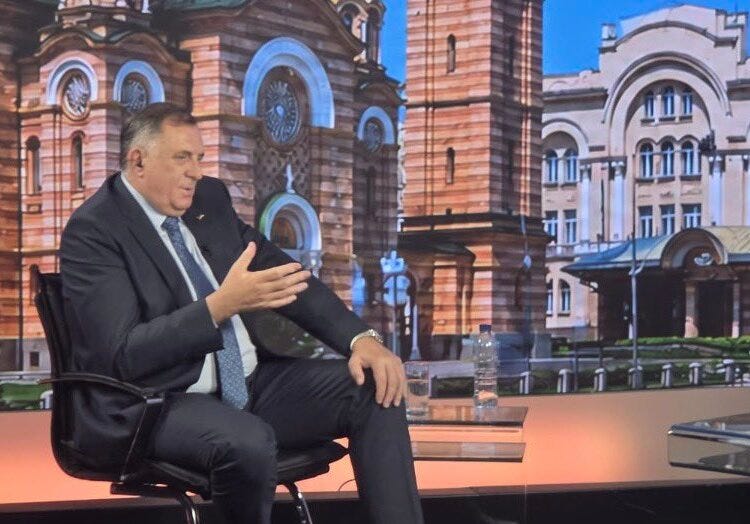
This image is used for illustrative purposes only.
Dodik’s long march toward Washington
Thirty years after the end of Bosnia and Herzegovina’s brutal civil war — an inter-ethnic conflict that killed more than 100,000 people between 1992 and 1995 — the painstakingly constructed balance of the Dayton framework is under pressure it has not faced in decades. That pressure is coming not from Sarajevo or Belgrade, but from Washington.
Milorad Dodik is not a new figure on the Balkan stage. This Bosnian Serb politician spent two decades systematically eroding the Dayton Agreement, the 1995 U.S.-brokered peace deal that ended Bosnia’s war and established a power-sharing framework among the country’s three main ethnic communities. He openly called for Republika Srpska — the Serb-majority autonomous entity that, alongside the Bosniak-Croat Federation, makes up the territory of Bosnia and Herzegovina — to secede. Convicted in a Sarajevo court for defying decisions issued by the international High Representative, and placed under U.S. sanctions since 2017 — including by Trump’s own first term in office, a fact Dodik was careful not to mention — he had appeared cornered, if not isolated.
That calculation collapsed on October 29, 2025. The U.S. Treasury Department’s Office of Foreign Assets Control (OFAC), the agency responsible for enforcing U.S. economic sanctions, removed Dodik, his family members, dozens of his allies, and companies linked to his inner circle from the sanctions list. OFAC offered no public explanation. Dodik, for his part, thanked Donald Trump on X for correcting what he called a “great injustice” inflicted by the Obama and Biden administrations.
The mechanics behind this decision are less romantic. They are called lobbying. Several U.S. firms with ties to the Republican Party — including Becker & Poliakoff, Tactic Global, and MO Strategies — had been retained by Republika Srpska‘s authorities following Trump’s reelection. Their stated goal, in filings made under the Foreign Agents Registration Act (FARA), which requires lobbyists for foreign principals to publicly disclose their activities, was to “promote dialogue between Banja Luka and the Trump administration.” Among those who lobbied for sanctions relief: Rod Blagojevich, the disgraced former governor of Illinois, convicted of federal corruption charges and sentenced to prison before Trump commuted his sentence in 2020.
A transactional pivot with devastating consequences
The sanctions removal did not occur in isolation. It came as part of a sequence that, in its coherence, resembles an informal arrangement between Banja Luka and Washington — though one that cannot be formally established from available sources.
On September 29, 2025, Dodik announced he was stepping down as president of the entity. The Republika Srpska National Assembly then, in mid-October, annulled several separatist laws at the core of its standoff with High Representative Christian Schmidt — appointing an interim president, Ana Trišić-Babić, in the same session. His ally Siniša Karan won a special presidential election on November 23, 2025, with 50.39% of the vote. The day after the sanctions were lifted, October 30, the U.N. Security Council voted unanimously to renew the mandate of EUFOR Althea, the EU’s peacekeeping force in Bosnia — with Russia, to Brussels’ considerable relief, abstaining from a veto.
The Trump administration framed this entire sequence as the result of its own discreet diplomatic work to “defuse the crisis” in Bosnia. That framing is difficult to verify independently. It also sidesteps the central question: were Dodik’s concessions durable, or were they a tactical maneuver designed to secure U.S. rehabilitation before reverting to the same playbook?
On April 7, 2026, Donald Trump Jr. arrived in Banja Luka as the personal guest of Igor Dodik. The visit — which included a 200-meter security perimeter and was not formally notified to Bosnia’s state institutions — was presented publicly as a Trump Organization business trip. Speaking at a panel of local officials and entrepreneurs, Trump Jr. described the European Union as “a little bit of a mess” and predicted “a major fracture” between the bloc’s eastern and western member states. That same day, U.S. Vice President JD Vance was in Budapest to back the reelection campaign of nationalist Prime Minister Viktor Orbán.
Schmidt leaves, Dayton shakes
It is against this backdrop that Christian Schmidt, Germany’s former agricultural minister and the international High Representative for Bosnia and Herzegovina since August 2021 — a post with sweeping executive powers to remove officials and impose legislation in order to uphold the Dayton peace settlement — announced his resignation on May 11, 2026. His office described it as a personal decision. Schmidt will remain in his post until a successor is appointed, and he appeared before the U.N. Security Council the following day to deliver his final semiannual report.
That report was bleak. Schmidt warned of a decisive crossroads between rule-of-law consolidation and progressive institutional fragmentation. He laid out four priorities for his successor: preserving the institutional order, restoring central state functions, resolving the contentious issue of state property allocation, and protecting electoral integrity ahead of the general elections scheduled for October 2026.
Several Balkan media outlets have attributed the resignation to U.S. pressure — a claim that, while plausible, has not been formally established. What is documented is that the Trump administration has clearly broken from its predecessors on Bosnia policy. And Dodik, barely an hour after the announcement, posted on X that Schmidt was leaving “the same way he arrived: with no legitimacy, no U.N. Security Council decision and no backing from international law.”
What Europe now faces
Republika Srpska bet on Trump and won.
It secured Dodik’s political rehabilitation, normalized its relationship with Washington, and now sees the departure of the international official who represented the legal constraint on its separatist ambitions. Against this, the European Union maintains EUFOR Althea — roughly 2,000 troops operating under a U.N. mandate — and continues to fund reform programs tied to Bosnia’s EU candidacy, a path in which a significant segment of Bosnian Serb leadership has little interest.
The concrete stakes for Bosnia’s citizens are immediate: without a credible High Representative equipped with the so-called Bonn Powers — which authorize the removal of elected officials and the imposition of legislation to protect the peace deal — the legal safeguards against separatist legislation weaken significantly. Russia has long called for the outright dissolution of the Office of the High Representative. Should Washington align with that position, the appointment of a successor becomes unlikely.
The bottom line
Is this the deliberate, incremental dismantling of the Dayton order? Or a transactional realignment — risky as it may be — that could nonetheless produce a new, if rougher, form of stability? The answer will depend largely on what Siniša Karan, Republika Srpska‘s president, does with the latitude Trump has just handed him — and on whether Europe is prepared to act when that answer turns out to be the wrong one.
Sources: Reuters · Associated Press · Defense News · Brussels Signal · Balkan Insight · House of Commons Library