
Belfast's old wounds
When anti-immigrant riots broke out in Belfast this week, they didn't emerge from nowhere. They erupted from the fault lines of a conflict the city never fully left behind.

At a Glance
In early June 2026, starting Tuesday, June 9, a knife attack for which a Sudanese national was charged triggered several nights of anti-immigrant riots across Belfast, Northern Ireland. Immigrant families were driven from their homes in targeted attacks across unionist neighborhoods.
The violence is rooted in the unhealed fractures of the Troubles — three decades of armed conflict that ended in 1998 — including persistent urban segregation, loyalist paramilitary influence, and deep economic marginalization in Belfast’s poorest Protestant communities.
A new rhetoric is surfacing — Catholics and Protestants united against immigration — but researchers say it remains marginal, driven by far-right actors, and contradicted by the basic facts on the ground: it was immigrant families, not unionist neighborhoods, who paid the price.
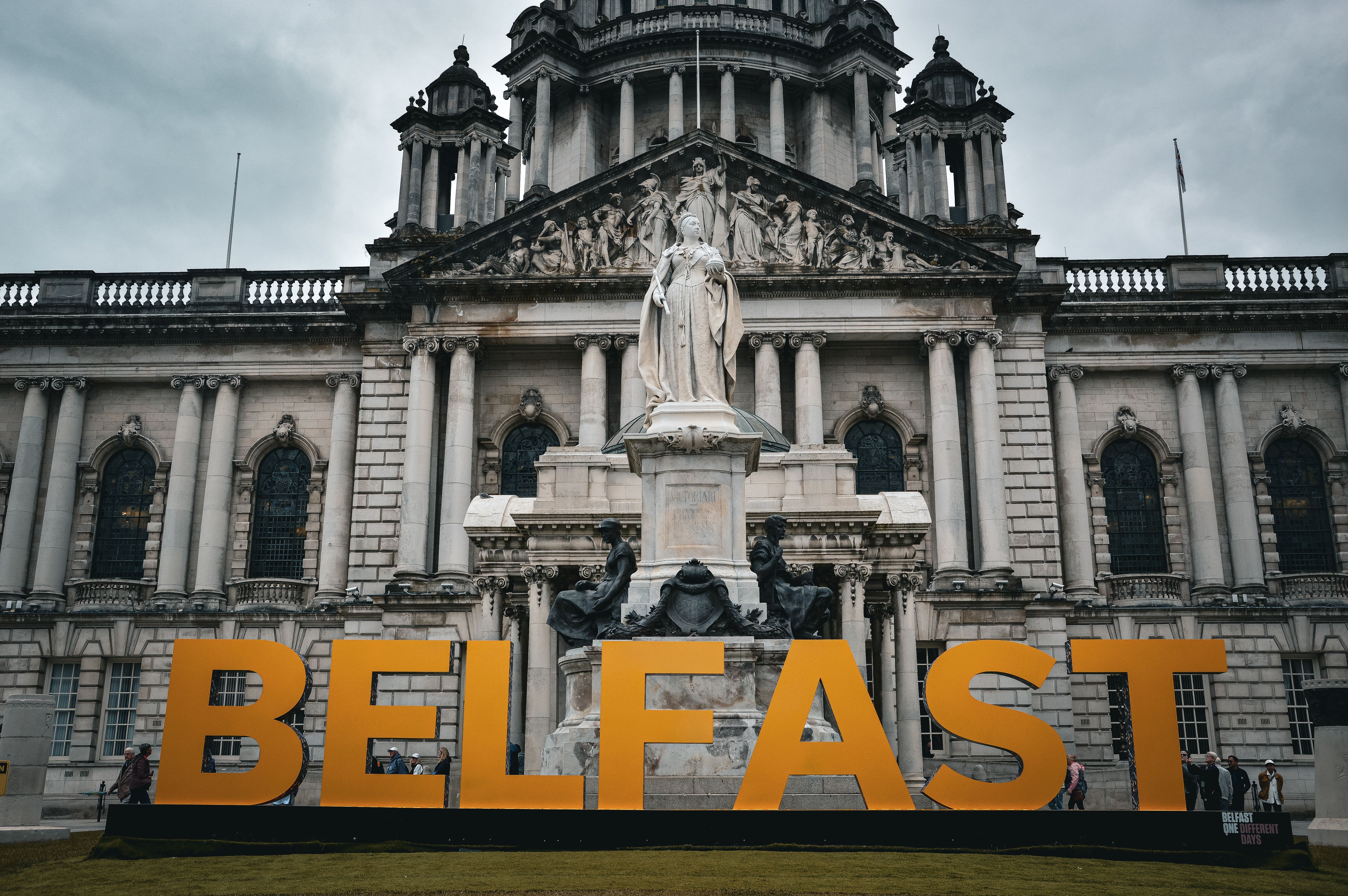
This image is used for illustrative purposes only.
The trigger
On Monday, June 8, a video spread across Northern Ireland: a violent knife attack on a man in Belfast. A Sudanese national was charged in connection with the assault. By Tuesday, June 9, rioters — often masked young men — were moving through unionist neighborhoods targeting one specific group: immigrant families. In Tiger’s Bay and other unionist strongholds, homes belonging to people from ethnic minorities were attacked, burned out, and their occupants forced to flee. The violence was not a clash between communities. It was one community turning on another that had no part in the grievance that supposedly triggered it.
Fractures that never healed
To understand Belfast in 2026, you first have to read Belfast in 1998. The Good Friday Agreement — the peace accord signed that year by the British and Irish governments along with Northern Ireland’s main political parties — ended three decades of armed conflict between republican Catholics, who sought unification with the Republic of Ireland, and unionist Protestants, who supported remaining within the United Kingdom. Peace was signed, but the city’s geography never followed. The “interface areas” — zones where walls and metal barriers still separate Protestant and Catholic neighborhoods — remain chronic flashpoints. It was in and around these spaces that rioters assembled before turning against immigrant residents living in their midst.
“There are still deep community divisions. There is still segregation, particularly in the most deprived areas,” said Joanne Hughes, a researcher at Queen’s University Belfast who studies the role of education in divided societies.
The role of loyalist paramilitaries
The first nights of rioting raised a question that residents and pro-Irish political leaders were quick to ask: who is mobilizing these masked young men? Loyalist paramilitary organizations — which retain a real hold over parts of the young male Protestant population in working-class neighborhoods — neither orchestrated nor encouraged the violence. But they made no effort to stop it either. The Belfast Telegraph reported, citing a loyalist source, that these groups were “neither orchestrating nor encouraging” the unrest, but were deliberately standing aside. Seán Óg Ó Murchú, a Belfast-based author and republican, described this dynamic plainly: “There is an influence of paramilitary organizations on the unionist side. These are, in some ways, the aftermath of the Troubles.”
Real marginalization, weaponized by the far right
Researchers point to a structural cause behind the riots: a deepening sense of dispossession within unionist communities. Belfast’s Catholic population has now surpassed its Protestant population since the end of the Troubles — a demographic shift that many unionists experience as a direct identity threat. Ó Murchú observed that unionists “see their identity and culture eroding.” At the same time, government data published last month showed that the share of 16-to-24-year-olds in Northern Ireland not in employment, education, or training had climbed to 11.6%, up from the previous quarter.
Joanne Hughes described most of those participating as people who “feel marginalized, who lack hope.” Dominic Bryan, a political anthropologist at Queen’s University, noted that the dominant perception in these communities is that migrants are taking housing that would otherwise be theirs. That perception drove rioters toward the homes of people who had nothing to do with the housing crisis — and everything to do with being visibly foreign.
It is in this environment that figures like Tommy Robinson — the anti-Islam activist whose legal name is Stephen Yaxley-Lennon — have gained traction. Ó Murchú captured the message: that these people’s culture is eroding because of “the brown-skinned man living next door.”
Dominic Bryan identified a concrete shift underway: in certain unionist and Protestant areas, “the other” is no longer the Catholic but the person of a different skin color.
Analysis: the signal hiding inside the noise
The riots were accompanied by a predictable online dimension: images showing the Irish tricolor and the British Union Jack intertwined circulated on social media — part of a broader wave of contested and manipulated content, including apparent AI-generated material, that spread rapidly during the unrest. Some individuals at the fringes of the demonstrations voiced a narrative of Catholic-Protestant unity against immigration. Researchers are clear that this framing remains marginal and largely a far-right construct. Dominic Bryan put it plainly: “I think, in the general population, this idea would be considered ridiculous.” Ó Murchú described it as “heartbreaking,” noting that not long ago, it was his own ancestors who were driven from their homes.
The Belfast riots are not an isolated Irish episode. They reflect a pattern playing out across multiple European democracies: when institutions can no longer offer economic prospects to working-class communities, the search for a substitute enemy begins. The immigrant replaces the neighbor across the wall — the Catholic yesterday, the Sudanese today. And crucially, the immigrant pays the price. The rioters did not attack the system that failed them. They attacked the families living two streets over.
This shift carries particular weight in Northern Ireland’s case. The Good Friday Agreement was built on the mutual recognition of two communal traditions. If a third identity — the “anti-immigrant” — were to supplant those older divisions, the institutions born from the 1998 accord could find themselves without a foundation. That hypothesis remains speculative at this stage, but it is worth naming.
Brexit adds another layer of fragility. Several researchers who specialize in Northern Ireland suggest that the Northern Ireland Protocol — the mechanism that keeps Northern Ireland aligned with the EU single market to avoid a hard border with the Republic of Ireland — was experienced by many unionists as a betrayal, proof that London was sacrificing them on the altar of geography. That political grievance feeds a sense of dispossession that helps explain, though does not excuse, what happened to those families in Tiger’s Bay.
The bottom line
Belfast may be Europe’s oldest laboratory for observing how a society emerges — or fails to — from communal conflict. What the riots of June 2026 raise is not simply a question of immigration or public order. It is a question about the durability of a peace built on silenced wounds rather than healed ones — and about who bears the cost when those wounds reopen. In Belfast this week, the answer was the same as it has always been: not those who light the fires, but those who lose everything in them.
Belfast’s walls are still standing, twenty-eight years after the peace agreement. Who will take them down — and when?
Sources: France 24 · AFP · RTBF