
Belarus's dangerous drift: what Tsihanouskaya's Kyiv visit revealed
Kyiv rubble, an Oreshnik strike, Tsihanouskaya's historic visit and Macron's call to Lukashenko — three signals pointing to Belarus's dangerous drift toward Moscow.

The night of May 23–24, 2026 will be recorded in the annals of this war. Russia fired 90 missiles and 600 drones at Kyiv and the surrounding region — among them an Oreshnik hypersonic ballistic missile, a weapon capable of carrying a nuclear warhead and virtually impossible to intercept with current air-defense systems. Four people were killed and more than 80 injured, according to a tally established May 25. Every district of the capital sustained damage. The National Chernobyl Museum — devoted to the 1986 nuclear disaster, the worst in history — was destroyed. By the number of sites hit, it was the most damaging single attack on Kyiv since Russia’s full-scale invasion began. The following morning, as residents cleared debris from the streets, Sviatlana Tsihanouskaya landed in the city — for the first time.
At a Glance
Russia launched one of the largest aerial assaults of the entire war on the night of May 23–24, 2026, deploying 90 missiles and 600 drones including an Oreshnik hypersonic missile, against Kyiv.
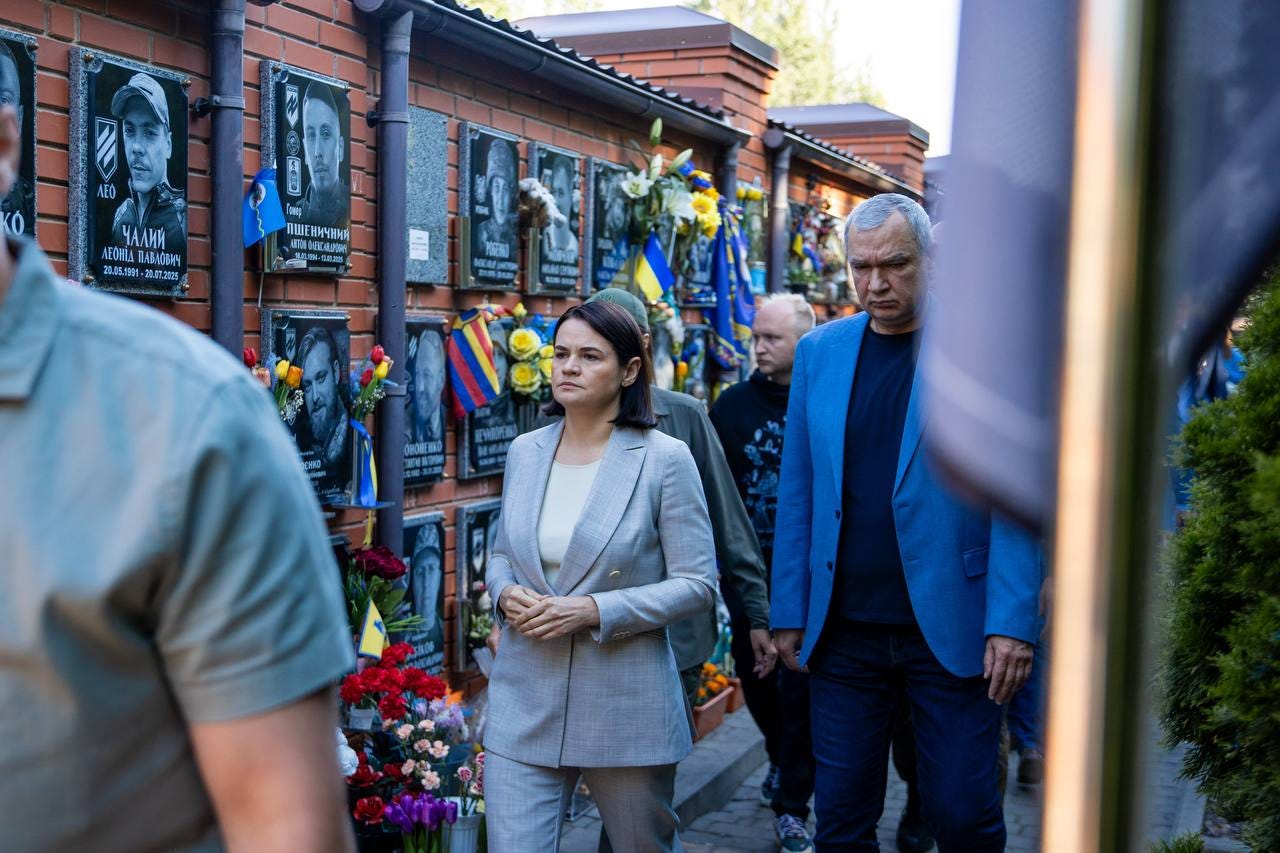
Sviatlana Tsihanouskaya, the internationally recognized leader of Belarus’s opposition in exile, made her first-ever visit to Kyiv on May 25 to pay tribute to a Belarusian fighter who died serving in Ukraine’s military.
French President Emmanuel Macron called Belarusian leader Alexander Lukashenko — their first contact since February 26, 2022 — to warn him of the risks of allowing Belarus to be drawn into the conflict.
This image is used for illustrative purposes only.
The capital under the rubble
The May 24 attack was not merely a record-breaking assault — it marked a qualitative shift. It was the third time Russia had deployed the Oreshnik, an intermediate-range ballistic missile that Vladimir Putin once described as traveling “like a meteorite,” capable of destroying underground bunkers and effectively outpacing Ukraine’s air defenses. The strike hit Bila Tserkva, a city roughly 50 miles south of Kyiv. Beyond the physical destruction, the use of this weapon sent a clear signal to Western partners about Russia’s escalating willingness to deploy its most advanced strike capabilities.
Moscow justified the offensive as retaliation for a Ukrainian strike on an educational facility in Starobilsk, a town in Russian-occupied eastern Ukraine. Russian authorities reported 21 people killed, including students. Ukraine disputed the account, saying only military targets had been struck. That disputed sequence — unresolved at the time of writing — forms the immediate backdrop to Tsihanouskaya’s visit.
Tsihanouskaya in Kyiv: a political act amid the ruins
Sviatlana Tsihanouskaya — the internationally recognized leader of Belarus’s democratic opposition, who ran against longtime authoritarian ruler Alexander Lukashenko in the disputed August 2020 presidential election and has since led the opposition from exile — did not come to Kyiv for a press conference. She came to honor Maria Zaitseva, a Belarusian dissident who had joined Ukraine’s armed forces and was killed in action.
“The freedom of Belarus and the freedom of Ukraine are inseparable,” Tsihanouskaya wrote on X. The statement is as political as it is personal: it articulates a central thesis of Belarus’s democratic movement — that Russia’s defeat in Ukraine is a necessary, if not sufficient, condition for the fall of the Lukashenko regime.
Macron calls Lukashenko: a diplomatic signal after four years of silence
Tsihanouskaya’s visit came the day after a less visible but potentially weightier development: the first phone call between French President Emmanuel Macron and Alexander Lukashenko since February 26, 2022. The call was placed at Paris’s initiative, according to Lukashenko’s press office, and covered Belarus-France relations and Belarus-EU ties. According to a source close to the Élysée Palace, as reported by Agence France-Presse, Macron underscored the risks Belarus would face if it allowed itself to be drawn into a war between Russia and Ukraine, and called on Minsk to take concrete steps toward improving relations with Europe.
What this sequence may suggest — though it cannot be formally established — is a growing Western anxiety about a more direct Belarusian slide into the conflict. In the days preceding the call, Russia had delivered tactical nuclear warheads to Belarus, and the two countries had launched joint military exercises involving nuclear weapons. This constellation — weapons deliveries, nuclear drills, an Oreshnik strike, and an emergency call from Paris — points to a convergent reading among Western capitals:
Belarus is becoming a secondary but increasingly active component of Russia’s military architecture.
Analysis: three years of “active neutrality” and its limits
Belarus has until now maintained an ambiguous posture. Lukashenko — who has ruled the country with an iron grip for more than three decades, repeatedly manipulating elections to stay in power — allowed Russian troops to use Belarusian territory to launch the February 2022 invasion of Ukraine, without committing Belarusian forces directly. This posture — what might be called passive co-belligerence — has allowed him to extract concessions from Moscow (subsidized energy, loans, political cover) while preserving enough flexibility to conduct quiet outreach toward the West. Since Donald Trump returned to the White House, Lukashenko released hundreds of political prisoners as part of agreements that led to the partial lifting of U.S. sanctions.
But the recent joint nuclear exercises, the weapons deliveries, and intensifying pressure along the Minsk-Moscow axis could indicate that this margin is shrinking. Macron’s call — the first in four years — may represent a last attempt to keep a diplomatic line open to Minsk before that window closes entirely.
For a reader unfamiliar with the region’s geography, a rough analogy helps: imagine Mexico allowing a hostile foreign power to use its territory to attack the United States, while formally maintaining neutrality. That is roughly the position Belarus has occupied since 2022 — and the question now is how much longer that fiction holds.
The bottom line
The image of Tsihanouskaya standing in a Kyiv still smoldering from the most destructive attack of the war raises a question that diplomats have been reluctant to ask directly: how far can Belarus go in supporting Moscow before triggering a collective Western response? And if that response is slow in coming, is there still time to keep Minsk off the battlefield — or are we watching a gradual military integration that makes the question moot?
Sources: Euronews · AP News · AFP