
Belarus goes nuclear: Minsk joins the drill
Belarus and Russia have launched joint nuclear weapons exercises — the first since Moscow deployed its Orechnik hypersonic missile on Belarusian soil.

Kyiv calls it an unprecedented act of coercion and is demanding a firm Western response.
At a Glance
Russia and Belarus launched joint nuclear drills on May 18, 2026, focused on the procedures for preparing and delivering nuclear munitions
The exercises follow Russia’s deployment of the Orechnik — its latest nuclear-capable hypersonic missile — to Belarus, and come after the New START treaty expired in February without a successor agreement
Ukrainian President Volodymyr Zelensky has ordered a troop buildup along Ukraine’s northern border, warning that Moscow is preparing a new offensive through Belarusian territory — an accusation the Kremlin has dismissed
A planned exercise, a deliberate signal
On May 18, 2026, Belarus’s Defense Ministry announced the launch of joint nuclear drills with Russia. The stated objective: training both countries’ forces in the preparation and delivery of nuclear munitions, with an emphasis on operational secrecy, long-distance troop movements, and engagement calculations. Missile and aviation units are involved.
Minsk describes the event as a “planned exercise” that is “not directed against third countries.” That standard disclaimer does little to ease concern in Western capitals. For a North American reader, the closest analogy would be Canada and Mexico jointly announcing nuclear drills along the U.S. border — in the middle of an active military standoff.
The context that makes this gesture count
This exercise does not emerge from a vacuum. The previous year, Moscow deployed the Orechnik — its newest nuclear-capable ballistic hypersonic missile — onto Belarusian soil, positioning a nuclear strike capability within reach of several NATO member capitals. In February 2026, the New START treaty — the last binding instrument limiting U.S. and Russian strategic nuclear arsenals, in force since 2011 — expired without a replacement. In the week of May 12, Moscow also test-fired its Sarmat intercontinental ballistic missile, capable of carrying a nuclear warhead.
This sequence — Orechnik deployment, New START collapse, Sarmat test, Belarusian drills — could signal a deliberate strategy by Moscow to normalize nuclear rhetoric as a tool of pressure on Western allies, though the precise intentions behind it remain formally unestablished.
Kyiv sounds the alarm on the northern front
Last week, President Zelensky ordered a reinforcement of Ukrainian troops along the northern border with Belarus. He said Moscow is preparing a new offensive in the Chernihiv-Kyiv direction (the axis of advance running from northern Belarus toward the Ukrainian capital) — partially replicating the operational pattern of the first weeks of the February 2022 invasion, when Russian columns advanced through Belarusian territory. He also raised the possibility of an operation against a NATO member state, without naming one.
The Kremlin rejected Zelensky’s statements on Monday, calling them “an attempt to incite violence” — a formulaic denial that offers no factual rebuttal of the troop movements he described.
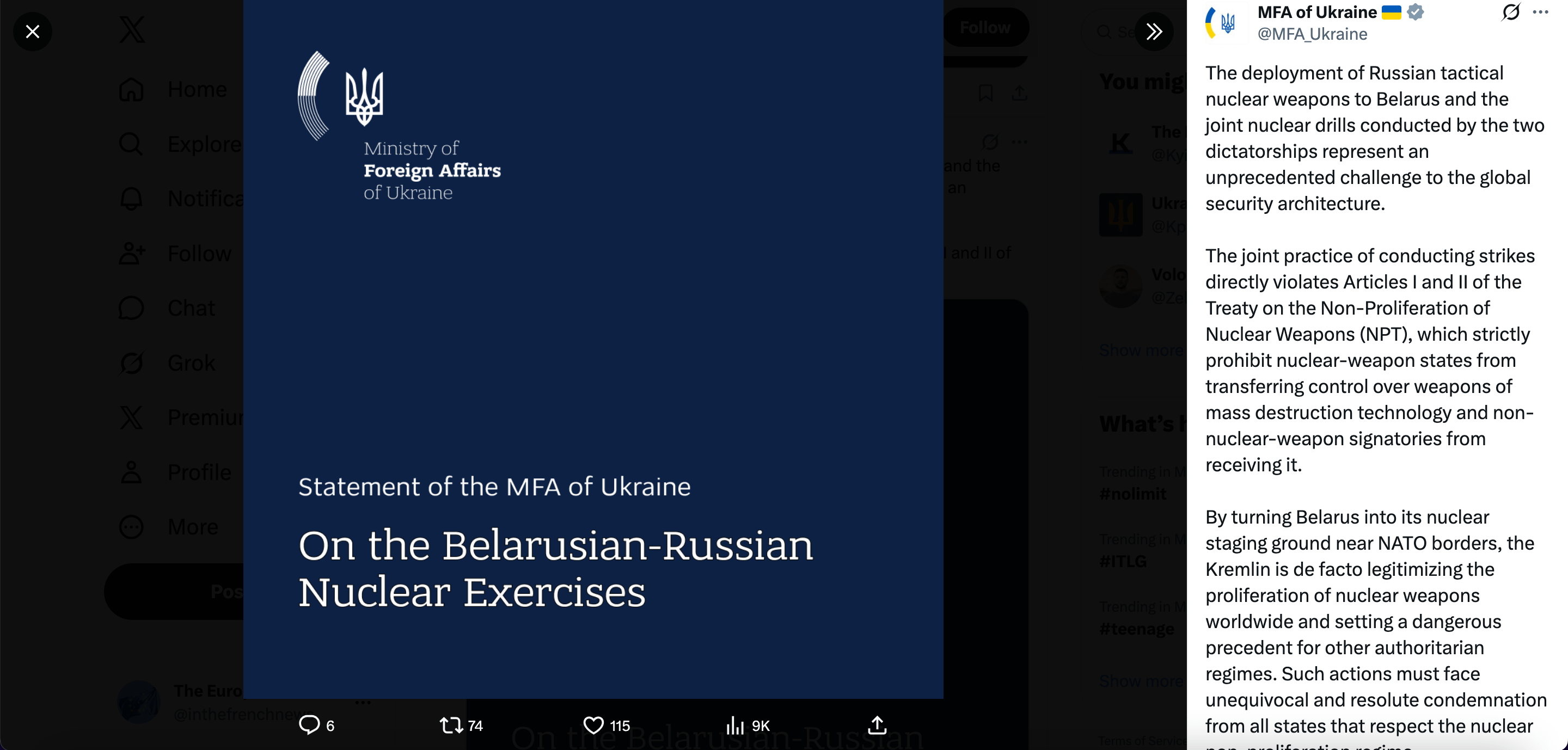
Ukraine’s Foreign Ministry issued a firm statement, describing the exercises as an “unprecedented challenge to the global security architecture” and calling on partners to respond in a coordinated manner: tighter sanctions on Moscow and Minsk, increased military support for Ukraine, and a stronger Allied presence on NATO’s eastern flank.
Analysis — What Belarus is in the process of becoming
① The end of Minsk’s strategic ambiguity. Since Belarus served as a launchpad in 2022, Alexander Lukashenko — who has ruled the country for more than 30 years and is closely aligned with Putin — has progressively converted his country into a Russian military forward base. The hosting of the Orechnik and now these joint nuclear drills mark a further step: Minsk is no longer merely a passive ally; it is actively participating in Moscow’s nuclear deterrence posture. This deepening military integration could make Belarus co-responsible for any future escalation — which is precisely what Ukrainian diplomacy is arguing when it speaks of “complicity in nuclear blackmail.”
② The collapse of arms control as a structural variable. The disappearance of New START creates a normative void unprecedented since the 1970s. No binding mechanism now limits the deployment of Russian and American strategic nuclear weapons, nor provides for cross-inspection. In this context, the Russo-Belarusian drills are not merely a tactical event: they illustrate what a world without an arms control architecture looks like — more opaque, less predictable. Think of it as the nuclear equivalent of removing all traffic signals from an intersection: not an act of war in itself, but a condition in which accidents become far more likely.
③ A northern flank NATO watches but may be underestimating. Since Finland and Sweden joined the Alliance, NATO’s eastern flank (the Alliance’s front-line member states bordering Russia and Belarus) is better covered in conventional terms. But the nuclear question there is distinct: the Orechnik stationed in Belarus brings several Allied capitals within range, and it is plausible that the Alliance has yet to formally articulate a regional nuclear response posture that matches this reality. These exercises may be testing precisely that gap in NATO’s resolve.
The Bottom Line
Russia and Belarus are drilling together on how to use nuclear weapons. The treaty that governed the two great powers’ arsenals no longer exists. And no one is negotiating its replacement.
The real question is not whether these exercises represented a “planned” threat or an opportunistic show of force — it is what democracies have prepared for the day the next exercise is not announced in advance.
Sources: Euronews · AFP · Ukraïnska Pravda · Belarus Defense Ministry · Ukraine Ministry of Foreign Affairs