
Belarus gets Russia's nukes: NATO's new pressure point
Russia has moved nuclear warheads onto Belarusian soil during massive military drills — as Baltic states reel from repeated drone incursions. The message to NATO is deliberate and unmistakable.

At a Glance:
Russia and Belarus jointly confirmed the delivery of nuclear munitions to forward field storage sites on Belarusian territory, releasing what they described as video evidence of the transfer.
The three-day drills involve 64,000 troops, more than 200 missile launchers, 140 drones, and 13 submarines — eight of them strategic, nuclear-capable vessels.
Ukraine’s Security Service (SBU) immediately tightened security across northern regions; President Volodymyr Zelensky warned of a possible Russian-Belarusian offensive push toward Kyiv and Chernihiv.
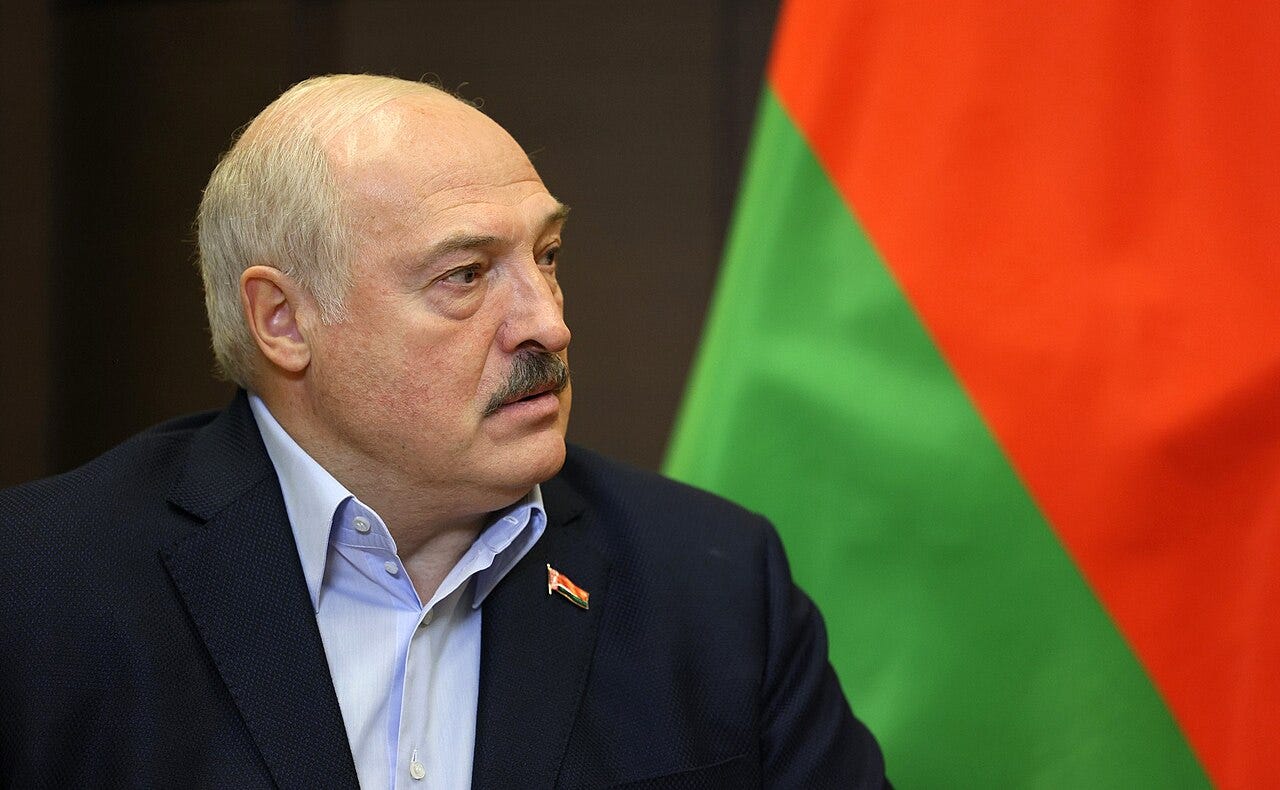
This image is used for illustrative purposes only.
What happened: a calculated show of force
On May 22, Russia’s and Belarus’s defense ministries made a joint announcement: nuclear munitions had been delivered to “forward field storage sites” [translated from Russian] within a Belarusian missile unit’s operational zone, as part of ongoing nuclear exercises. Both ministries released footage simultaneously — military vehicles disappearing into a wooded area at an undisclosed location, missiles being loaded onto mobile launchers.
The system on display is the Iskander-M — designated SS-26 Stone in NATO’s classification system, and Russia’s successor to the Soviet-era Scud ballistic missile. Its guided munitions reach up to 310 miles and can carry either conventional or nuclear warheads. A range of 310 miles that, depending on the trajectory, could put Warsaw, Vilnius, or Riga within reach — and Berlin within certain firing solutions, according to open-source defense estimates.
The exercise is not a routine drill. Russia’s Defense Ministry announced on May 19 that the three-day maneuvers — running through Thursday — involve 64,000 personnel, 7,800 pieces of equipment, more than 200 missile launchers, 140 drones, 73 surface vessels, and 13 submarines, eight of them strategic boats capable of carrying ballistic missiles.
The backdrop: a deliberate escalation sequence
These drills did not emerge from nowhere. Since early May, the Baltic states — Estonia, Latvia, and Lithuania, all NATO members bordering Russia and Belarus — have been hit by a series of unidentified drone incursions serious enough to temporarily shut down Vilnius airport and trigger the resignation of Latvia’s defense minister at the time. Ursula von der Leyen, president of the European Commission, the EU’s executive arm, pledged a coordinated European response, without specifying its nature or timeline.
The sequence — drone incursions, then nuclear drills with physical warhead transfers — could indicate a deliberate strategy of graduated pressure along NATO’s northeastern flank, though no source has formally established a causal link between the two sets of events.
Analysis: deterrence as diplomatic language
① The announcement is the operation. The joint Russian-Belarusian decision to release footage of the transfer — an unusual move — suggests the immediate objective is communicative, not purely military. Moscow is not hiding that it is showing. The performance is the point.
② Belarus as a nuclear forward base. Under what is widely referred to as the 2023 agreement on the forward deployment of Russian tactical nuclear weapons in Belarus — whose precise terms have never been made public — Minsk has locked itself into the role of asymmetric strategic partner: hosting capabilities it does not formally control, in exchange for an existential security guarantee against regime change. This transfer confirms the arrangement is operational, not merely rhetorical. For Western audiences, a rough analogy exists: it resembles the forward-basing of U.S. tactical nuclear weapons at allied NATO sites in Europe under the alliance’s nuclear-sharing arrangements — except here, the host nation has no joint role in authorization or deployment decisions.
③ Ukraine’s reaction reveals the real concern. The SBU’s immediate reinforcement of northern border security, and Zelensky’s direct references to a potential offensive toward Kyiv and Chernihiv, suggest Kyiv is not reading these drills as purely symbolic. Whether that reading reflects concrete intelligence — which cannot be established from open sources at this stage — the operational dimension of the exercises may carry more weight than Moscow publicly acknowledges.
④ NATO’s response dilemma. Each Russian nuclear demonstration that goes unanswered by a proportionate Western response implicitly recalibrates the threshold of tolerance. The alliance has consistently avoided any direct nuclear counter-signaling to gestures of this kind — a posture Moscow may interpret as license to continue the sequencing.
The bottom line
Russia has just turned Belarus into Europe’s nuclear front stage — with Minsk’s visible consent.
The question is no longer whether Moscow is prepared to use this geography as a pressure lever: that is now a documented, filmed, and broadcast reality. What remains open is how NATO responds. At what point do these demonstrations stop being signals and start becoming precedents?
Sources: Euronews · Russian Ministry of Defense · Belarusian Ministry of Defense