
Bardella's Berlin play: what the charm offensive reveals
RN's Bardella met Germany's ambassador and courted Berlin in a key interview. The real audience isn't German — it's French voters ahead of the 2027 presidential race.

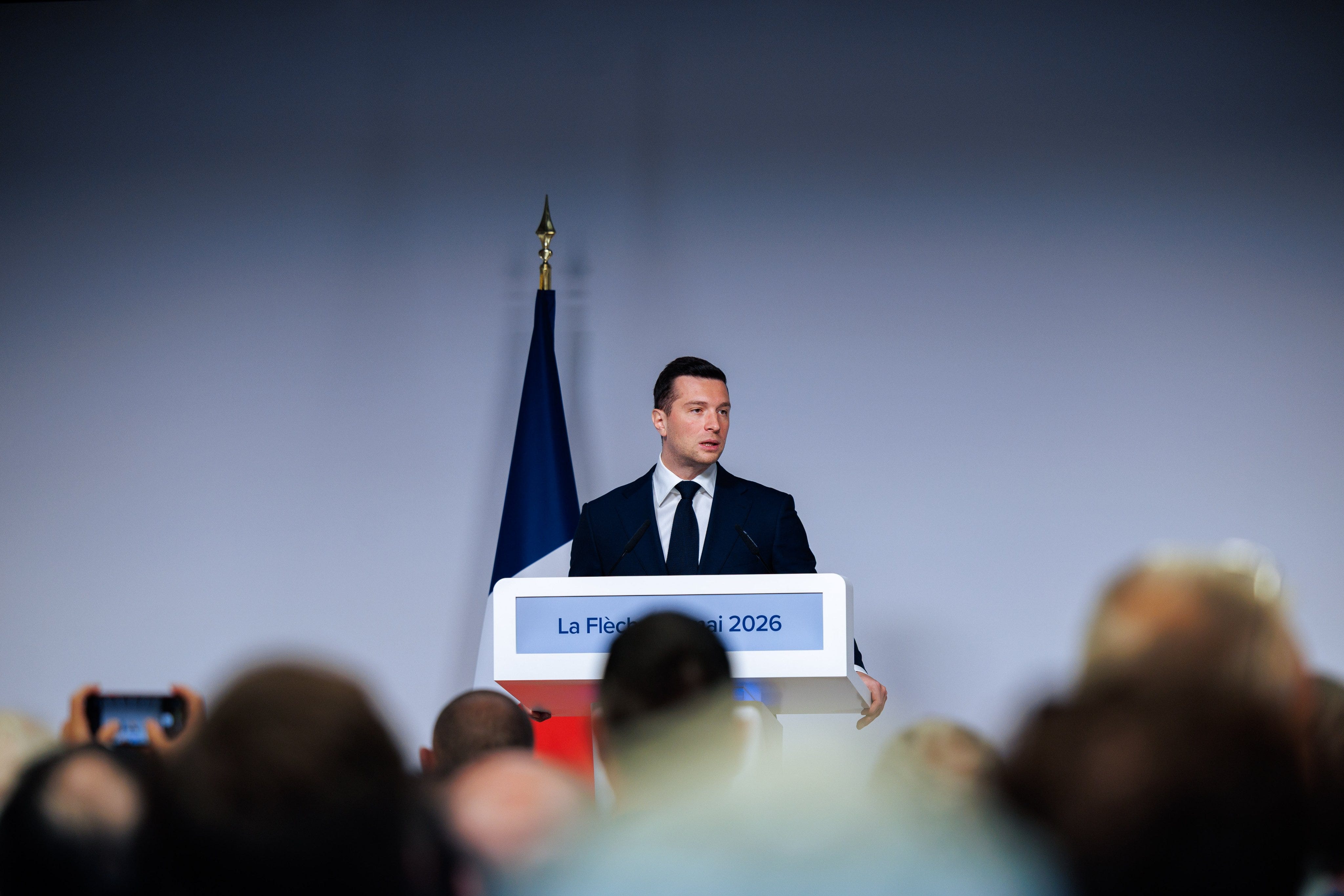
A discreet meeting with Germany’s ambassador in Paris. A lengthy interview with one of Germany’s most influential newspapers. A pointed rejection of the far-right Alternative für Deutschland. In the space of a few weeks, Jordan Bardella, president of France’s far-right Rassemblement National (RN) party, has sent a string of carefully calibrated signals toward Berlin. None of it is accidental — it is a constructed sequence, less than two years before France’s 2027 presidential election.
At a Glance:
Bardella met German Ambassador Stephan Steinlein in Paris in February 2026, in a meeting kept quiet until its confirmation in early May; the two sides discussed immigration and fiscal discipline, with reported areas of common ground
In an interview published in the Frankfurter Allgemeine Zeitung on May 12, 2026, Bardella called the AfD — Germany’s far-right party — an incompatible partner at the European level, while signaling convergence with Chancellor Friedrich Merz on deregulation, migration policy and economic competitiveness
The target audience isn’t Berlin. The maneuver is designed to persuade French business circles and wavering centrist voters that a Bardella presidency would not rupture France’s European commitments
Bardella and Germany: two gestures, one goal
The meeting with Ambassador Stephan Steinlein initially circulated quietly before being confirmed by the RN to AFP in early May. Bardella’s team was quick to downplay its diplomatic weight: as president of the RN and leader of the Patriots for Europe group in the European Parliament, he routinely meets ambassadors, they noted. They cited a December meeting with U.S. Ambassador Charles Kushner — attended by Marine Le Pen, the RN’s longtime figurehead and three-time presidential candidate — as evidence that such contacts are routine. The parallel was deliberate: an attempt to normalize what is, in fact, anything but.
Germany is not just any partner. France’s largest trading partner and the political spine of European integration since the 1963 Élysée Treaty — reaffirmed and expanded by the 2019 Aix-la-Chapelle Treaty — Berlin holds an informal veto over the credibility of French leaders on the continental stage. That Bardella felt compelled to reassure Germany’s ambassador speaks directly to his awareness of the obstacle his European image represents.
The FAZ interview drives the message home. The paper is the newspaper of record for Germany’s economic and conservative establishment — a readership that, for Bardella, carries more weight than the German public at large. In it, he disqualified the AfD on two grounds: its approach to historical memory — a direct reference to comments made in May 2024 by Maximilian Krah, then the AfD’s lead candidate for the European Parliament elections, who said he would never claim that every member of the Waffen-SS was automatically a criminal; and the party’s Eurosceptic wing, which advocates German withdrawal from the EU. That position, Bardella said, is incompatible with RN’s own line: to change Europe “without destroying anything.” In the same interview, he signaled common ground with Chancellor Merz on deregulation, migration and the need for a competitive Europe.
The limits of the distancing strategy
This is not a new playbook — but it is accelerating. Since 2024 and the formal break with the AfD in the European Parliament — the collapse of the Identity and Democracy group that both parties had shared — RN has systematically sought to distinguish itself from what mainstream German conservatives regard as an untouchable political force. The distinction serves a precise function in France: it neutralizes the argument that voting RN amounts to endorsing the kind of radicalism that German democracy has spent decades trying to contain.
AfD leader Alice Weidel responded coolly, telling the Junge Freiheit weekly that her party remained “closely in contact with Paris,” implying that Bardella’s public distancing was tactical positioning ahead of a foreign election rather than any substantive divergence. Other AfD figures called Bardella “poorly informed” about German internal politics.
These counterarguments belong in the picture. The February 2024 lunch between Marine Le Pen, Bardella and Weidel in Paris — reported at the time by France Inter, France’s public radio — is a piece of context that the May 2026 sequence does not erase. That meeting took place just weeks after Le Pen had publicly distanced herself from the AfD’s “remigration” strategy, illustrating the permanent tension between signals sent to different electorates.
The RN’s version of the 2024 split is also contested. According to Krah — now a member of the Bundestag — the break had less to do with his SS comments and more to do with RN’s unwillingness to abandon a French European budget policy that Berlin finds unfavorable. That account cannot be definitively resolved on the basis of available sources, but it deserves mention: a contested split narrative that both sides have reasons to frame differently.
Analysis: the Meloni method, RN edition
Bardella’s Berlin operation looks borrowed from the Giorgia Meloni handbook. Before taking power in Italy in October 2022, the leader of Fratelli d’Italia spent years reassuring European partners and financial markets, carefully separating her sovereignist line from structural Europhobia. The results in office have been mixed, according to most observers — but the credibility strategy worked electorally. Bardella appears to be following a version of the same sequence: hardening the identitarian message for the RN base at home, while projecting a posture of responsibility to foreign capitals.
The practical stakes extend beyond the diplomatic sphere. France exports roughly €100 billion in goods and services to Germany each year, and dozens of bilateral cooperation frameworks — on energy, infrastructure, defense and youth exchange — operate under Franco-German treaty obligations. A French government that disrupted these frameworks would face concrete economic costs. Whether a Bardella government would, in practice, maintain the cooperation it now champions in German newspapers is a question that neither ambassadorial meetings nor FAZ interviews can answer.
The German response is itself precisely calibrated. The German embassy confirmed it maintains contacts with “all political forces in the host country” — standard diplomatic language — without officially validating the meeting. Merz has so far maintained a public firewall against the AfD but has made no public comment on Bardella. Berlin keeps its channels open. That is not a natural partner dynamic: a hypothetical President Bardella would be an obligatory interlocutor, not a natural ally.
He can demonstrate moderation only through signals — an ambassador received, an interview granted, a foreign party repudiated.
What the sequence ultimately reveals is the nature of the constraint pressing on Bardella. Unlike a sitting head of government, he can demonstrate moderation only through signals — an ambassador received, an interview granted, a foreign party repudiated. The equation would be fundamentally different if he were in power and had to translate those signals into concrete policy on immigration, the rule of law, or France’s posture within the European Union. That gap — between the posture and the actual governing choices a RN administration would face — is precisely what his opponents will spend the next two years trying to widen.
The bottom line
An outstretched hand to Berlin can reassure French business elites and improve a candidate’s international standing. But it leaves the real question unanswered: would a government led by Jordan Bardella actually sustain, in practice, the Franco-German cooperation it celebrates in the FAZ’s pages — particularly on the European dossiers where French and German interests diverge most sharply, from agricultural policy to budget rules? It is on that distance between rhetoric and governance that Bardella’s presidential credibility will, in part, be decided.
Sources: AFP · France Inter · Frankfurter Allgemeine Zeitung · NZZ · Weltwoche · Junge Freiheit · Apollo News