
Attal vs. Philippe: France's center enters the race
Two former prime ministers, one political lane — and a pact that may not survive the campaign.

Gabriel Attal made it official on May 22, 2026. Standing in Mur-de-Barrez, a village of 700 in the rural Aveyron region of southern France, the former prime minister announced he would seek the French presidency in 2027. The setting was deliberate: a politician best known as a product of the Parisian political machine, choosing to launch his campaign as far from Paris as possible. Facing him across the center of the French political spectrum: Édouard Philippe, also a former prime minister under President Emmanuel Macron, already in the race. Two candidates, one lane — and a collision course that could define the next French election.
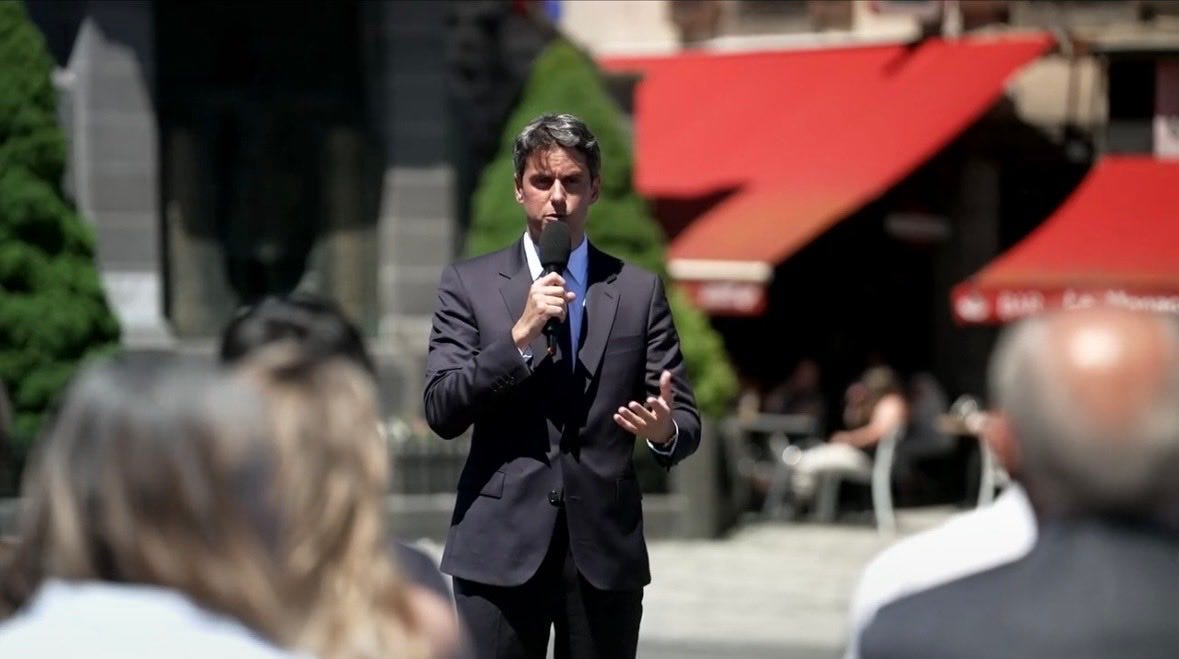
This image is used for illustrative purposes only.
At a Glance
Gabriel Attal, France’s former prime minister under Emmanuel Macron, formally declared his presidential candidacy on May 22, 2026, in Mur-de-Barrez, Aveyron.
The two centrist candidates reportedly struck a back-room deal in February 2026: whichever polls lower would drop out in favor of the other by early 2027.
Despite the agreement, both camps are already trading barbs — raising serious questions about whether the alliance can hold.
Two candidates, one lane
Attal and Philippe — both centrists, both shaped by the Macron years — are competing for the same voters, the same donors, and the same media oxygen. In French politics, the center is not a comfort zone: it demands a candidate who is distinct enough from both left and right to be credible, yet broad enough to survive a two-round election. For American readers, the closest analogy would be two moderate candidates fighting over the same primary electorate with no formal arbitration mechanism — except that in France, the general election itself is the primary, and vote-splitting can be fatal.
Attal’s rural launch was a carefully engineered signal. He has spent his career in the corridors of power in Paris; the Aveyron backdrop was designed to suggest something different. Philippe, meanwhile, fired back in the pages of Le Parisien, France’s leading daily newspaper, calling himself serious and dismissing any taste for showmanship — “I’m not going to climb on the table.” [translated from French] The subtext was clear — without ever naming his rival.
The February pact: rational design or ticking clock?
Behind the scenes, the two men reportedly sealed an agreement in February 2026, on the sidelines of a Paris campaign event for France’s upcoming municipal elections: the one trailing in the polls would withdraw in favor of the other by early 2027. On paper, the logic is sound. A split centrist vote is a gift to the Rassemblement National (RN), France’s far-right party, or to the hard left — the two forces both Attal and Philippe have built their careers opposing. A managed handoff preserves the lane; a collision squanders it.
But a pact of this kind rests on two fragile conditions: that polls produce a clear and stable gap, and that the losing camp accepts the verdict without defection. Neither is guaranteed. The precedents suggest that alliances of reason at the center rarely survive personal ambition intact.
The facade is already cracking
The back-channel messaging has already started, and it cuts deep. From Attal’s camp came the sharpest jab: that Philippe only polls well because he stays quiet — and stumbles every time he speaks. Philippe’s camp returns fire with a structural attack, not a stylistic one: “a third vote for Macron.” That line is more damaging than any quip about personality. It doesn’t target how Attal campaigns — it targets the legitimacy of his candidacy itself, framing him as an extension of an unpopular presidency rather than a genuine break from it.
Analysis
① The center lane in French politics is a structural trap. Two candidates competing for the same centrist electorate without a formal primary mechanism is arithmetically dangerous. In a two-round French presidential system, the first round rewards differentiation; the second rewards consolidation. Running two centrists into round one risks eliminating both.
② The “Macron vote” charge is Attal’s most structural vulnerability. The Philippe camp’s core attack — that an Attal vote is effectively a third Macron term — is not merely a campaign line. It is a perception risk grounded in biography. Attal was Macron’s prime minister. His rapid ascent through the Macron apparatus is a matter of public record. A single rural campaign launch is not enough to rewrite that narrative. He will need substantive policy differentiation — which, as of this writing, he has not yet produced.
③ Philippe plays for time; Attal plays for momentum — both are gambles. Philippe’s bet is that silence protects poll numbers and that visibility without substance is self-defeating. The risk is invisibility in a campaign where presence matters. Attal’s bet is that energy and events generate electoral gravity. The risk is that each event is also an opportunity to stumble. Mur-de-Barrez was well-executed; the next eighteen months will require the same discipline at scale.
④ The real arbiter will be public opinion in early 2027. The withdrawal pact, if honored, will make one of these men a kingmaker. The question is not only “who is ahead?” but “who can deliver their voters to the other without fracturing their coalition?” And on that front, France’s centrist history offers little comfort — at least not without a clear and undeniable polling gap that makes the choice impossible to contest.
The Bottom Line
Two candidates, one ticket available for the second round.
France’s center has rarely entered a presidential cycle with more assets — or more structural reasons to self-destruct. The withdrawal pact is necessary but not sufficient: someone will have to accept defeat before the polls make it undeniable, and accept it publicly enough that their supporters follow. The real question is not which of the two is the better candidate. It’s which one, when the moment comes, will be willing to stop being one.
Sources: Franceinfo