
Armenia's Republic Day parade: France's Caesar rolls into history
On May 28, Armenia puts French-made weapons on public display for the first time — ten days before pivotal elections, and as Moscow fumes.

Today, on Republic Square in Yerevan, Armenia is staging its most significant military showcase in years. The event — officially framed by Prime Minister Nikol Pashinyan not as a traditional mass parade but as a public display of recently acquired equipment, a “progress report to the citizens of Armenia” — features Bastion infantry fighting vehicles, Mistral surface-to-air missiles, and, for the first time, the Caesar self-propelled howitzer: the French-made 155mm artillery system that has become the symbol of the Franco-Armenian defense partnership and the same weapon proving its worth on the front lines of Ukraine. The occasion: Republic Day, marking the founding of the First Armenian Republic on May 28, 1918. The timing: ten days before parliamentary elections scheduled for June 7, in a country still processing the trauma of losing Nagorno-Karabakh in 2023. Whatever its format, this event is a political statement.
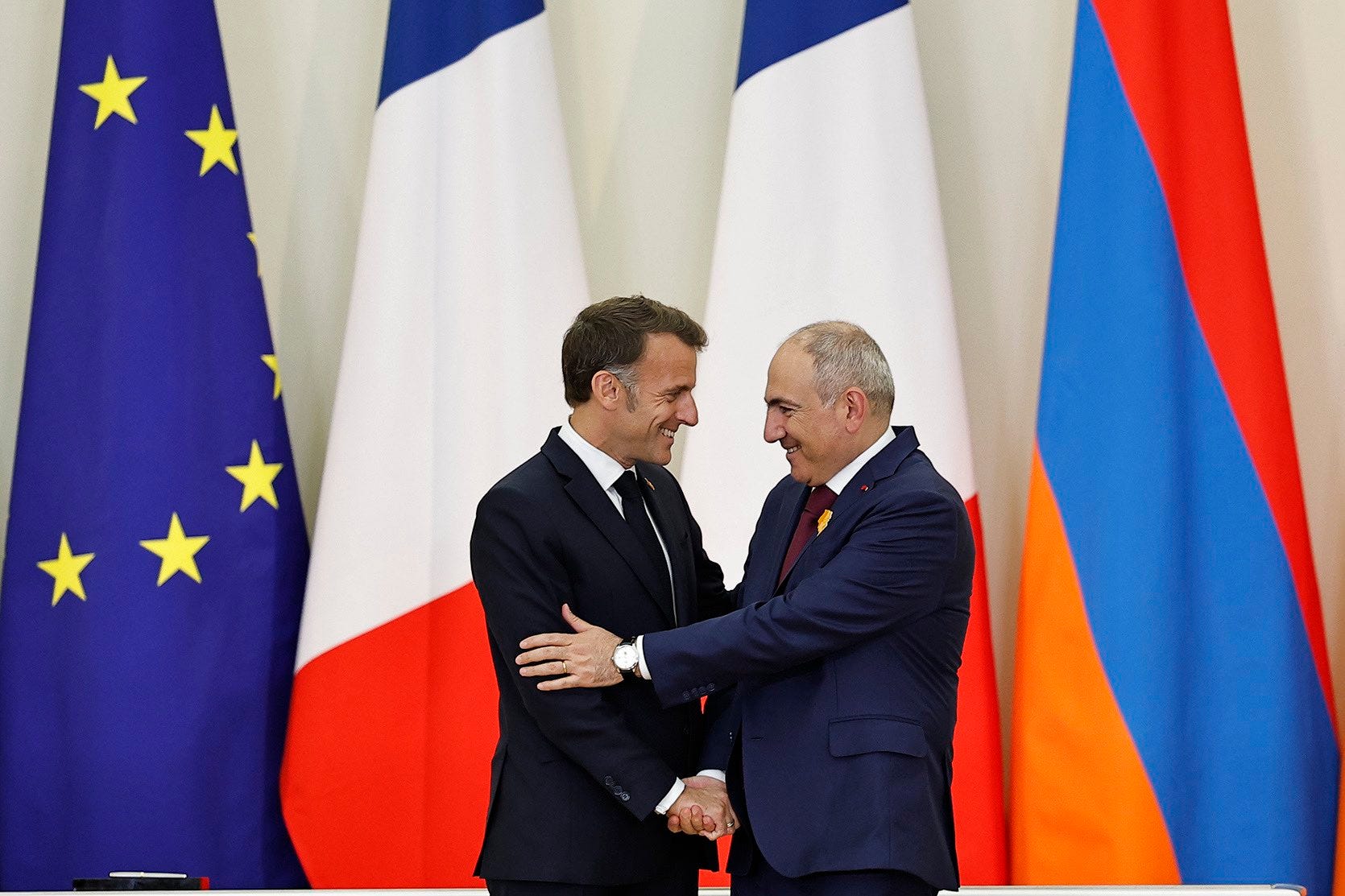
This image is used for illustrative purposes only.
At a Glance
For Republic Day on May 28, Yerevan is publicly displaying its first French Caesar howitzers and other Western-supplied equipment acquired since 2023, marking a radical break from decades of near-total dependence on Russian military hardware.
The event follows a dense diplomatic sequence: Macron’s state visit in early May, the first-ever EU-Armenia summit, and Zelensky’s appearance in Yerevan — which prompted Moscow to summon Armenia’s ambassador in protest.
Ten days before the June 7 parliamentary elections, Prime Minister Nikol Pashinyan is turning the display into an electoral argument: recovered sovereignty, visible and rolling.
A May 28th loaded with history
The date is not accidental. On May 28, 1918, an exhausted Armenian army won the Battle of Sardarabad against Ottoman forces — making possible the proclamation of the First Republic of Armenia. That improbable victory against overwhelming odds is the founding myth of modern Armenia.
Eight years after the humiliating military defeat of 2020, and three years after the fall of Nagorno-Karabakh that forced more than 100,000 ethnic Armenians into exile in September 2023, Pashinyan is deliberately invoking that memory. The May 28 event is framed as national reconstruction: an army that once sourced roughly 94% of its equipment from Russia now displays Caesar howitzers — with the first deliveries confirmed, the full volume of the order not officially disclosed — alongside Thales-manufactured GM200 air-defense radar systems and Mistral missiles, all of French origin.
The sequence that set the stage
To grasp the event’s full significance, it helps to rewind three weeks.
On May 4, Yerevan hosted the eighth summit of the European Political Community — an informal grouping of more than 40 European leaders, launched by Macron in 2022 to build a pan-continental dialogue beyond formal EU membership. Ukrainian President Volodymyr Zelensky was among those present. The following day, Russia summoned Armenia’s ambassador in protest. Foreign Ministry spokeswoman Maria Zakharova called it “categorically unacceptable” for Armenia to have provided a platform to what she described as a “terrorist.” Pashinyan’s response was blunt: Armenia is “not an ally of Russia” in the war against Ukraine.
On May 5, Macron and Pashinyan signed a bilateral strategic partnership that, according to the Élysée, would deliver “unprecedented defense efforts.” The first formal EU-Armenia summit followed. In the days after, President Vladimir Putin declared that Yerevan would have to choose between remaining in the Russia-led Eurasian Economic Union and pursuing its European aspirations — effectively issuing an ultimatum.
It was against this backdrop that Defense Minister Suren Papikyan released a video in mid-May showing Caesar systems being prepared for the display. The signal was immediately noted by regional capitals.
Pashinyan, the display and the ballot box
Pashinyan’s framing of the event was itself a political calculation. By presenting it as an open public showcase rather than a traditional military parade — “a progress report to the citizens of Armenia”, in his words — he sought to preempt the charge that Armenia was departing from its stated commitment to a peace agenda following the 2025 accord with Azerbaijan.
Because the criticism exists. Part of the opposition, backed by segments of the diaspora, accuses Pashinyan of having accepted the loss of Nagorno-Karabakh without adequate resistance. Others argue he is gambling with the country’s security by distancing Armenia from Moscow without equivalent Western guarantees in return. Neither the bilateral strategic partnership with France nor Armenia’s broader EU relationship carries a mutual-defense clause: there is no commitment comparable to NATO’s Article 5, which obliges all alliance members to treat an attack on one as an attack on all. That gap remains the central vulnerability in Yerevan’s security architecture.
But the display also gives Pashinyan a visual answer to his closest skeptics — those who doubted his government’s ability to rebuild a credible army after the 2020 rout. The Caesar systems, the Mistral batteries, the Bastion armored vehicles — all acquired since 2023 — are there, in motion, in front of cameras and citizens.
The army as argument
What is unfolding on Republic Square today goes beyond national celebration. Three dynamics are layered on top of each other.
The first is domestic. In a society scarred by two successive military defeats — 2020 and 2023 — displaying credible Western equipment responds to a deep demand for reassurance. The question is not whether these weapons are sufficient to match Azerbaijani military power — Baku’s defense budget is reportedly more than twice Yerevan’s, according to available open-source estimates, though precise figures vary — but whether the trajectory has been reversed.
The second is regional. The Caesar rolling through Yerevan is the same system firing on Russian positions in Ukraine since 2022. Moscow cannot ignore that equation, nor can Baku. The display sends a deterrence signal, even if that deterrence remains incomplete.
The third is European. For Paris, for Brussels, for the capitals tracking the South Caucasus, the Armenian showcase is a public, filmed validation of the Franco-Armenian bet. The image of a Caesar on Republic Square is worth dozens of diplomatic communiqués. It says: this partnership is real, it is operational, it is visible.
The bottom line
The real test will not come on Republic Square today, or at the ballot box on June 7.
It will come the day pressure on Armenia rises again — as it did in 2020 and 2023. On that day, the question will not be whether the Armenian army has Caesar systems. It will be whether Armenia’s Western partners are prepared to do more than deliver hardware.
Sources: France 24 · Euronews · Armenpress · Élysée · European Parliament