
Armenia's Prime Minister Defies Moscow Ahead of June 7 Vote
Nikol Pashinyan rejected Putin's demand for a referendum on Armenia's EU future, six days before elections that could seal Yerevan's break from Moscow's orbit.

At a Glance
Vladimir Putin called on Armenia to hold a referendum “as soon as possible” to choose between the EU and the Eurasian Economic Union (EAEU), the Moscow-led trade bloc of five former Soviet republics. Armenia’s Prime Minister Nikol Pashinyan rejected the demand on June 1, calling the choice “theoretical” at this stage.
Russia is escalating economic pressure: import bans on Armenian fish, produce, wine, and mineral water; threats to end discounted gas supplies; and the recall of Moscow’s ambassador for “consultations.”
A poll by the Breavis institute gives Pashinyan’s Civil Contract party roughly 65% support among decided voters ahead of the June 7 elections, far ahead of a fragmented, partly Kremlin-backed opposition.
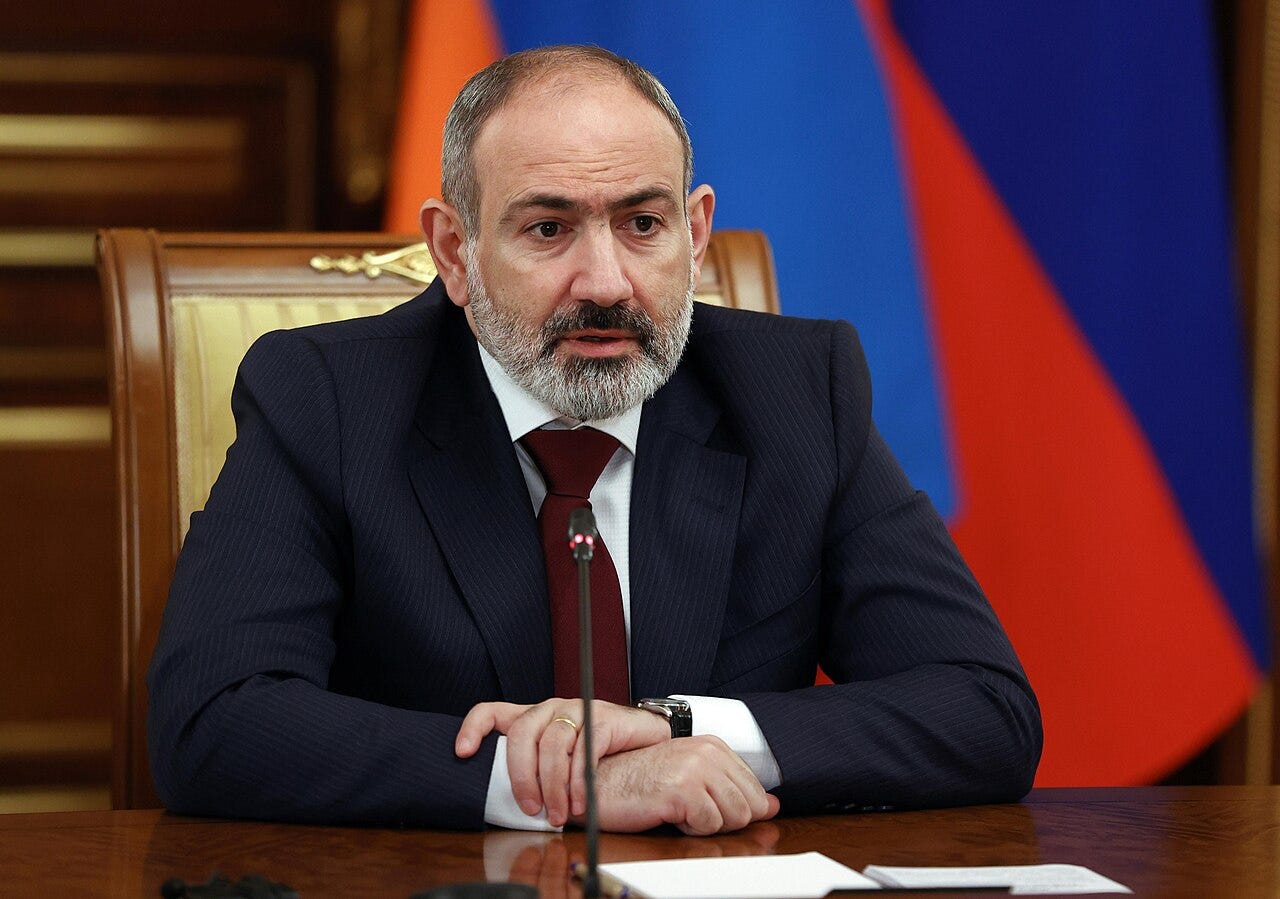
This image is used for illustrative purposes only.
On June 1 — his fiftieth birthday — Nikol Pashinyan, Armenia’s Prime Minister since 2018, drew a clear line. Delivering a video address on Facebook, he said it would be “illogical” to hold a referendum on Armenia’s geopolitical alignment as long as the country had not formally applied for EU membership or obtained candidate status.
“Today, this choice is theoretical — and putting a theoretical choice to a referendum is neither sensible nor justified.”
The statement came in direct response to Russian President Vladimir Putin, who had called at a May 29 summit in Astana, Kazakhstan, for Yerevan to decide “as soon as possible” between remaining in the EAEU and pursuing EU membership, arguing the two paths were irreconcilable.
The Kremlin’s ultimatum and its familiar playbook
At that summit, the leaders of Russia, Belarus, Kazakhstan, and Kyrgyzstan — the EAEU’s member states — issued a joint declaration warning that Armenia’s EU ambitions posed “substantial risks to the economic security” of the bloc’s members. Putin also drew a parallel between Armenia and Ukraine, suggesting that the conflict in Ukraine had its origins in Kyiv’s earlier attempts to seek closer ties with the European Union.
Alexander Lukashenko, the authoritarian president of Belarus and a close Kremlin ally, went further, urging Armenians to be “very careful not to repeat what happened in Ukraine.” The warning was pointed: Armenia had just emerged from its own devastating war, losing control of the Nagorno-Karabakh region to Azerbaijan in 2023.
This sequence — a political demand, mounting trade restrictions, threats to energy supplies, and the specter of Ukraine — follows a pattern that analysts have previously observed in Russia’s dealings with Georgia and other former Soviet states seeking closer ties with the West. Whether it amounts to a coordinated coercion strategy or a series of parallel pressures is, at this stage, difficult to establish definitively.
Armenia’s pivot: slow, deliberate, and now under fire
Pashinyan’s refusal to call a referendum is consistent with a broader, methodical reorientation underway since at least 2022. Armenia suspended its participation in the Collective Security Treaty Organization (CSTO), the Russia-led military alliance of former Soviet states, in 2024, after Moscow failed to come to its defense during the Azerbaijani offensive. In March 2025, the Armenian parliament voted by a wide majority to formally open an EU accession process. In May 2026, Yerevan hosted an EU summit for the first time — with Brussels hailing a “major leap forward” in relations.
At the same time, Pashinyan has been careful not to trigger a clean break. Armenia still belongs to the EAEU and imports more than 80% of its natural gas from Russia — a dependency that gives Moscow significant leverage. His position is that dual engagement remains possible, at least until formal EU candidacy materializes.
A landmark peace agreement with Azerbaijan, signed at the White House in August 2025 with U.S. President Donald Trump as mediator, added another pillar to this westward shift. Trump expressed his “total and absolute support” for Pashinyan in the days before the election, describing the Armenian leader as “a great friend and a great leader.”
Russia tightens the economic screws
Moscow has not limited itself to warnings. Russia’s food safety regulator announced a ban on Armenian fish imports — roughly 30% of Armenia’s aquaculture output is exported to Russia. Earlier bans had targeted Armenian produce, flowers, wines, brandy, and mineral water, with Russian Deputy Prime Minister Alexei Overchuk warning that EU membership could strip Yerevan of its favorable customs terms and drive up energy prices. Moscow also recalled its ambassador to Armenia on May 30 for “consultations” over Yerevan’s accelerating EU integration — a pointed diplomatic signal less than two weeks before the vote.
The election as referendum by other means
Armenia, a country of roughly 3 million people, holds parliamentary elections on June 7. The vote carries far greater significance than a standard legislative cycle. A poll conducted by the Breavis institute between May 5 and 11, drawing on 1,551 respondents, projects Civil Contract at close to 65% of decided voters — well ahead of a fractured opposition, no single part of which exceeds 12%.
Should those projections hold, Pashinyan would win not just a majority but potentially a two-thirds supermajority in parliament — enough to amend the constitution and formally enshrine Armenia’s EU path. Without such a margin, analysts suggest, even a victory could leave him unable to convert foreign policy intent into constitutional reality.
Reuters, citing unnamed Western intelligence officials, reported that Moscow was planning to bus tens of thousands of ethnic Armenians from Russia to vote in the election in an effort to tilt the outcome. The claim has not been independently verified.
Why this matters beyond the Caucasus
For Washington and Brussels, Armenia has become something of a test case: can a country exit Russia’s sphere of influence through institutional gradualism — without triggering the kind of open confrontation that preceded the war in Ukraine? The unusual convergence of U.S. and EU support for Pashinyan suggests both sides see real stakes in the outcome.
For the Kremlin, allowing a former Soviet republic to successfully complete a slow-motion pivot to the West — while remaining, for now, within the EAEU — would set a precedent it is clearly determined to prevent.
The Bottom Line
Armenia is running an experiment that no post-Soviet country has tried quite this way before: leaving Russia’s orbit not with a dramatic rupture, but with a quiet, years-long institutional drift. If Pashinyan wins a strong majority on June 7, this patient approach may be validated. If economic pressure and electoral interference prove effective enough to blunt his mandate, Moscow will have demonstrated that coercion can reverse a geopolitical trajectory without a single shot being fired. The world will be watching Yerevan on Sunday.
Sources: TV5 Monde · AFP · Euronews