
Armenia's Pashinyan wins — but not the keys to peace
Armenia's pro-European prime minister secures reelection but falls short of the two-thirds parliamentary majority needed to call the referendum Azerbaijan demands as a precondition for a peace deal.

At a Glance
Nikol Pashinyan’s Civil Contract party won Armenia’s June 7 legislative elections with 49.81% of the provisional official vote, confirming the country’s pro-Western orientation despite sustained Russian pressure.
The three main pro-Russian opposition groups combined for 37% of the vote and are on track to enter parliament — a significant counterweight that will constrain Pashinyan’s room to maneuver.
Pashinyan secures a working parliamentary majority through Armenia’s seat-bonus electoral system, but falls short of the two-thirds supermajority needed to call the constitutional referendum Azerbaijan demands — the central unresolved challenge of his new mandate.
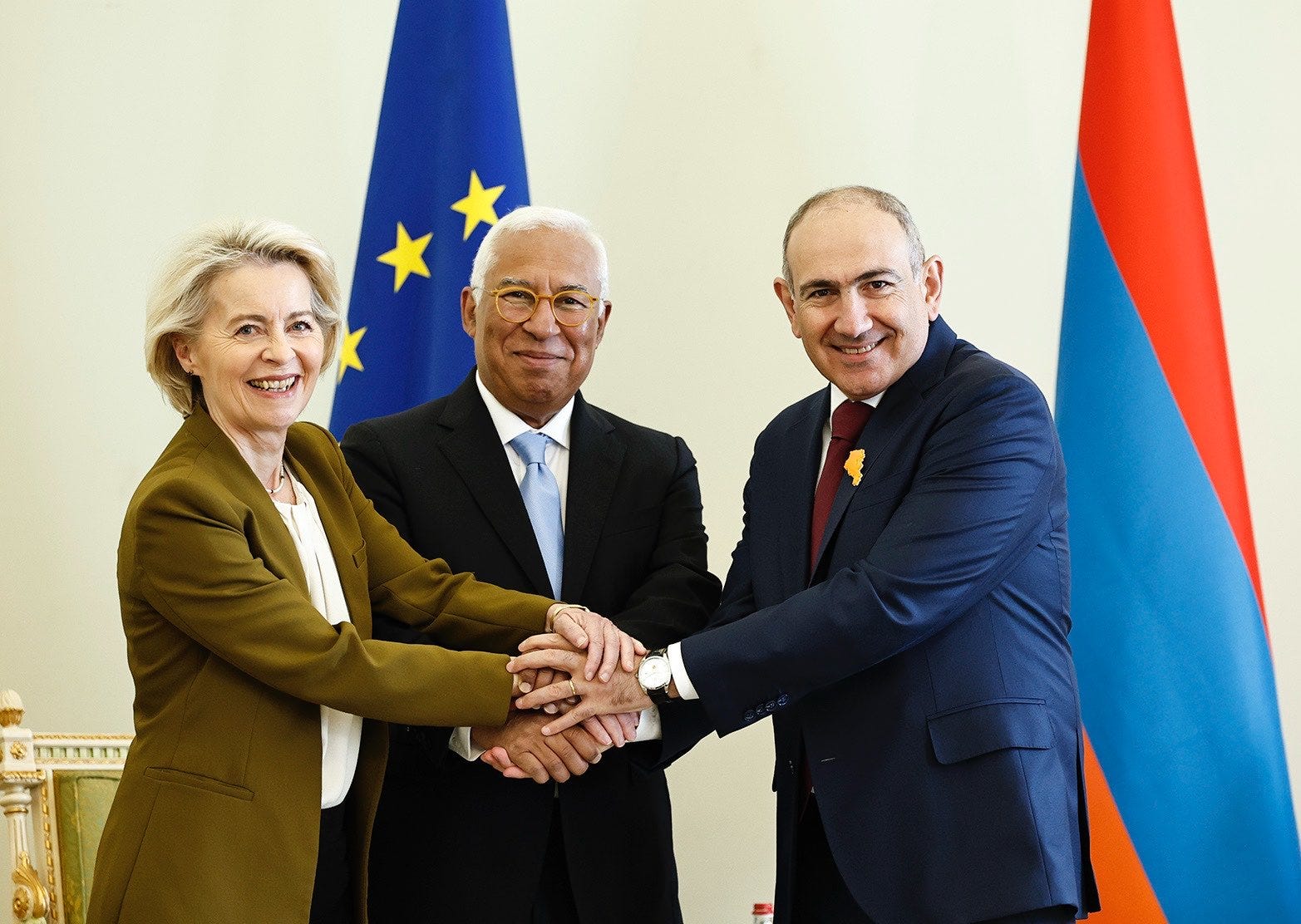
This image is used for illustrative purposes only.
Nikol Pashinyan won. But what he failed to secure may matter as much as the victory itself. On June 7, 2026, Armenians returned their pro-European prime minister with just under half the vote — a solid result in an election with major geopolitical stakes. What they did not deliver was a two-thirds parliamentary supermajority, the threshold that would allow Pashinyan to unilaterally call a referendum to amend the Armenian constitution’s preamble — specifically, its territorial references that Azerbaijan has long cited as incompatible with a lasting peace agreement.
Between the electoral win and a durable peace, the gap remains.
An official result still provisional
Provisional official results show Civil Contract at 49.81% — with final certified figures still expected in the coming days. Turnout reached 58.97%, roughly consistent with recent Armenian electoral cycles. The Strong Armenia alliance — led by Samvel Karapetyan, a Russian-Armenian billionaire who has been under house arrest for the past year on coup-plotting charges he rejects as politically motivated — finished second with 23.29%. The three main pro-Russian opposition groups combined for 37% and appear headed for parliamentary representation alongside Civil Contract.
Karapetyan called the vote rigged, declaring that “the elections are not over yet” and that the authorities “will not get the victory they want.” The Armenian Alliance separately described Pashinyan’s overnight statements as premature and amounting to “an usurpation of power.” Both statements were reported by Russia’s Interfax news agency.
The referendum lock: what victory does not unlock
This is the detail most early commentators glossed over in the election night euphoria. Armenia’s electoral system awards seat bonuses to the leading party, giving Civil Contract a working parliamentary majority sufficient for day-to-day governance. But calling the constitutional referendum Baku demands requires a two-thirds supermajority — a threshold Pashinyan did not reach.
The referendum at stake is specific: it would amend the preamble of Armenia’s constitution, which contains territorial references to Nagorno-Karabakh and the 1990 Declaration of Independence that Azerbaijan considers obstacles to a formal peace treaty. Without that amendment, Baku has signaled it will not sign. With pro-Russian parties holding more than a third of parliamentary seats, securing the necessary votes for such a referendum — likely not before 2027 at the earliest — will require cross-party negotiations that carry no guarantee of success.
The regional context: what this election signals
These were the first elections in Armenia since Azerbaijan’s lightning military campaign in 2023, when Baku retook full control of Nagorno-Karabakh — a mountainous, landlocked enclave roughly the size of Rhode Island that had been governed by ethnic Armenians since the early 1990s following a war between the two countries. Russia, officially Armenia’s security guarantor under a mutual defense treaty, stood aside during the offensive. That inaction triggered a deep crisis of trust between Yerevan and Moscow — and, paradoxically, strengthened Pashinyan’s political position: the case for Western alignment had become more credible than the Russian security umbrella.
Pashinyan’s victory validates his core strategy: negotiating a peace deal with Azerbaijan, normalizing relations with Turkey — a close ally of Baku — and aligning Armenia more closely with European norms and institutions. But Moscow has not released its grip without resistance. Analysts documented disinformation campaigns, cyberattacks, and Kremlin-friendly narratives framing Western alignment as dangerous in the weeks before the vote. Russia also banned imports of several Armenian products ahead of election day, a move widely interpreted as economic coercion.
Three tensions this result does not resolve
The peace deal with Baku remains conditional
Pashinyan has pledged to “institutionalize peace between Armenia and Azerbaijan.” No formal agreement has been signed. The constitutional referendum Baku demands — amending the preamble’s territorial language, a process that cannot begin before building cross-party consensus, and realistically not before 2027 — is now the real test of his mandate. Without it, the electoral win remains suspended above its most concrete objective.
A stronger-than-expected pro-Russian opposition
At 37% combined, pro-Russian parties outperformed pre-election expectations. They will be in parliament. That means Armenia’s Western pivot will proceed under the constant scrutiny of a potential blocking minority — and that Moscow retains institutional leverage in Yerevan even after losing the popular vote.
The oligarch problem persists
The Karapetyan model — a Russian-Armenian billionaire under house arrest on serious criminal charges, bankrolling an opposition party from a position of legal jeopardy — illustrates a structural reality: the economic interests linked to Russia remain deeply embedded in Armenian political life. The “oligarchic system” Pashinyan pledged to dismantle when he came to power in 2018 has not disappeared. It has simply changed its wardrobe.
The Bottom Line
Pashinyan won the vote. He has not yet won the peace. Armenia has chosen a direction — European, negotiated, pragmatic — but geography does not yield to a single election. The constitutional referendum, normalization with Baku, effective dismantling of oligarchic networks, and resilience against Russian pressure: these are the four tests that will determine, over the coming months, whether this mandate was a turning point or merely a reprieve.
Sources: Euronews · AFP · Reuters